সব বই

পেশাদার

1 Markets I: The Ecosystem and Exchange-Traded Marketsবাজার অনলাইন 2 Markets II: Rates, FX and Creditবাজার অনলাইন 3 Markets III: Commodities, Energy and Cryptoবাজার অনলাইন 4 Quantitative Methodsপদ্ধতি অনলাইন 5 Derivatives and Volatilityডেরিভেটিভস অনলাইন 6 Rates, Credit, XVA and Riskসুদহার, ঋণ ও ঝুঁকি অনলাইন 7 Research Craft: Predictors, Backtests, Measurement, Portfoliosগবেষণা অনলাইন 8 Strategies I: Equities and Futuresকৌশল অনলাইন 9 Strategies II: Volatility, Relative Value, Macro and the Bank Desksকৌশল অনলাইন 10 Microstructure and Executionএক্সিকিউশন অনলাইন 11 Market Making and High-Frequency Tradingমার্কেট মেকিং অনলাইন 12 Machine Learning for Marketsমেশিন লার্নিং অনলাইন 13 Low-Latency Softwareপ্রযুক্তি অনলাইন 14 Networks, Hardware and Trading Infrastructureপ্রযুক্তি অনলাইন 15 Research, Data and Risk Platformsপ্রযুক্তি অনলাইন 16 The Desk and the Firmপ্রতিষ্ঠান অনলাইন 17 The Industry: Firms, Roles and Careersক্যারিয়ার অনলাইন 18 Interviews I: Maths, Probability and Speedক্যারিয়ার অনলাইন 19 Interviews II: Markets, Trading Games and the Final Roundক্যারিয়ার অনলাইন 20 Interviews III: Codeক্যারিয়ার অনলাইন
অ্যাপ পরিচিতি Coach সাইন ইন পড়া শুরু করো

বইগুলো এখনো বাংলা ভাষায় পাওয়া যায় না — ইংরেজি সংস্করণ দেখানো হচ্ছে।

Biology · পরিভাষা

The testis and spermatogenesis কী?

Definition 8.1 University Biology — Year 2 · অধ্যায় 8 — Sexual Reproduction of Mammals

The testis is a mass of seminiferous tubules, several hundred metres in all, whose walls make sperm; between the tubules lie Leydig cells, which make testosterone. In the tubule wall, spermatogonia at the outer edge divide by mitosis, keeping a stem population and sending cells inward; these grow into primary spermatocytes, which undergo meiosis I (to two secondary spermatocytes) and meiosis II (to four haploid spermatids); the spermatids shed most of their cytoplasm, condense their nucleus, grow a flagellum and cap the nucleus with the acrosome, a vesicle of enzymes, to become spermatozoa that are released into the lumen. Large Sertoli cells span the wall, nursing the germ cells and forming, by tight junctions between them, a blood–testis barrier that keeps the immune system away from cells that first appear at puberty. The whole sequence takes about 6464 days in a man and yields some 10810^{8} sperm a day from puberty to old age. Sperm leave the testis immotile and mature in the epididymis for two weeks.
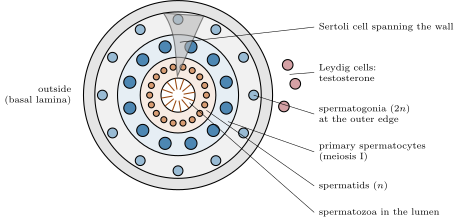
A seminiferous tubule in cross-section. Germ cells mature from the outer wall (spermatogonia) inward (spermatocytes, spermatids, spermatozoa in the lumen), supported by Sertoli cells; Leydig cells between the tubules make testosterone.
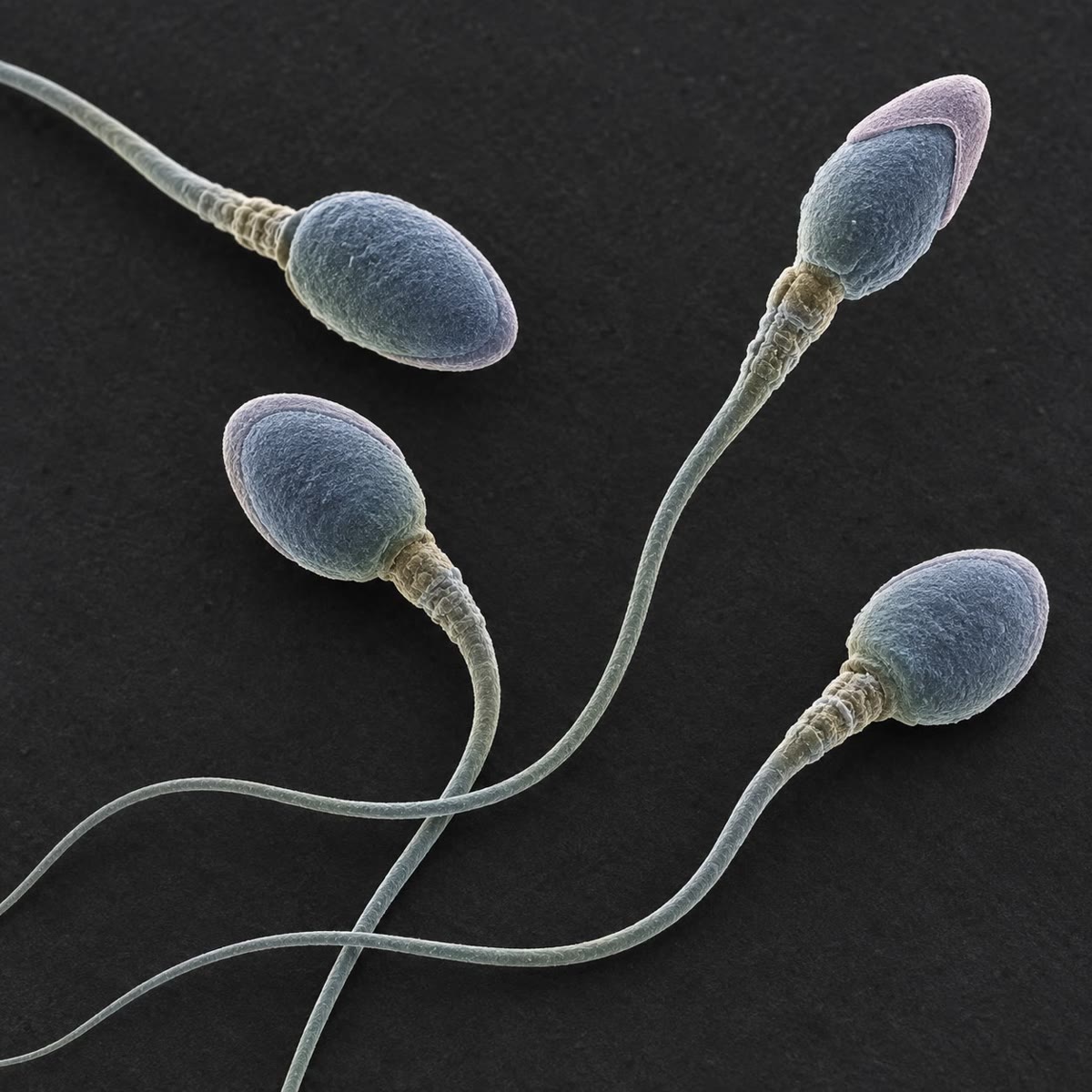
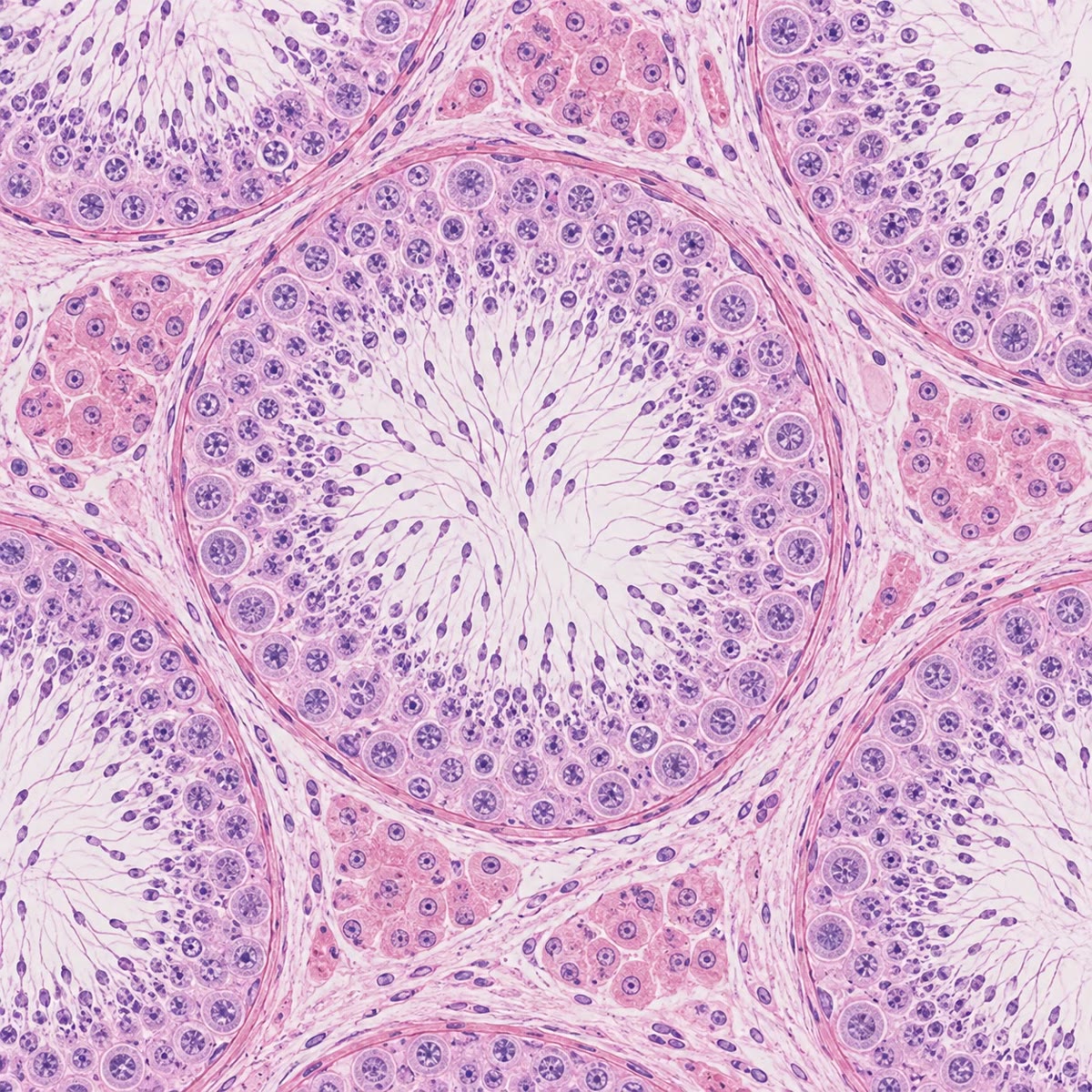
Left: seminiferous tubules in section, the germ cells layered from the wall to the lumen. Right: spermatozoa under the scanning electron microscope, the acrosomal cap visible on the heads. Left: seminiferous tubules in section, the germ cells layered from the wall to the lumen. Right: spermatozoa under the scanning electron microscope, the acrosomal cap visible on the heads.
Left: seminiferous tubules in section, the germ cells layered from the wall to the lumen. Right: spermatozoa under the scanning electron microscope, the acrosomal cap visible on the heads.
প্রসঙ্গসহ পড়ো →