All books

Professional

Apps About Coach Log in Start reading

Chemistry · Glossary

What is Adiabatic flame temperature?

Definition 1.22 University Chemistry — Year 2 · Chapter 1 — Enthalpies of Reaction

The adiabatic flame temperature of a fuel is the temperature reached by the products of its complete combustion when the reaction takes place at constant pressure, without any exchange of heat, from reactants at 298 K298\,\mathrm{K}.

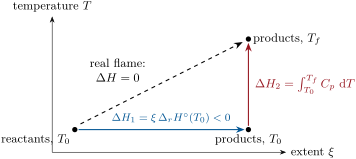
The adiabatic flame (dashed) and an equivalent path through two steps: reaction at constant temperature, then heating of the products. Since H is a state function, the two enthalpy changes of the steps add up to zero.
The adiabatic flame (dashed) and an equivalent path through two steps: reaction at constant temperature, then heating of the products. Since HH is a state function, the two enthalpy changes of the steps add up to zero.
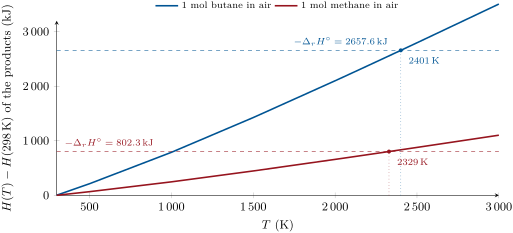
Enthalpy needed to heat the combustion products of one mole of fuel (carbon dioxide, steam, and the nitrogen and argon of the air) from 298\, K, from the tabulated enthalpies. Each curve meets the heat released by its combustion at the adiabatic flame temperature: about 2400\, K for butane, 2330\, K for methane.
Enthalpy needed to heat the combustion products of one mole of fuel (carbon dioxide, steam, and the nitrogen and argon of the air) from 298 K298\,\mathrm{K}, from the tabulated enthalpies. Each curve meets the heat released by its combustion at the adiabatic flame temperature: about 2400 K2400\,\mathrm{K} for butane, 2330 K2330\,\mathrm{K} for methane.
Read in context →