University Chemistry — Year 2 · Bachelor Year 2
1Enthalpies of Reaction
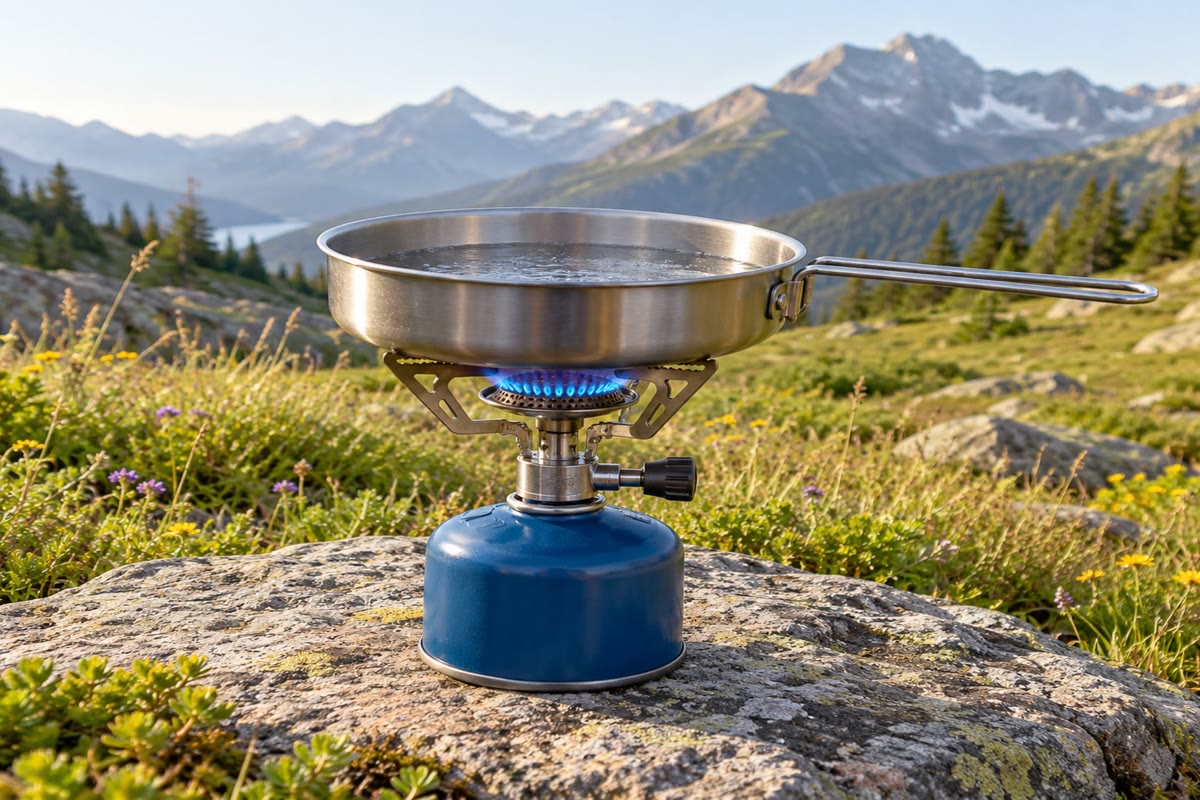
A camping-gas cartridge screwed under a small burner: a few grams of butane bring a litre of water to the boil in minutes, and the blue flame under the pan is far hotter than the boiling water. How much heat does a reaction release, how much of it reaches the pan, and how hot can the flame get? None of these questions needs a burner to be answered: tables of a few numbers per substance, measured once and for all, give the heat of every reaction that can be written with those substances, at any temperature. This chapter builds that bookkeeping. It applies the first law of thermodynamics, known from physics, to a system whose composition changes, defines the enthalpy of a reaction as a partial derivative, and shows how to compute it from formation enthalpies, from bond enthalpies and along cycles, how it changes with temperature, and what it says about flames and calorimeters.
You already know
From physics: the first law ; the enthalpy , a state function; at constant external pressure, between two states at that pressure, the heat received is ; the heat capacity at constant pressure ; the enthalpy of a perfect gas depends on alone. The Year 1 volume described a reacting system by its extent and the stoichiometric numbers of , and fixed the standard state of each species at . The school volume (grade 11) called a reaction exothermic when it releases heat and estimated combustion energies from bond energies.
1.1 Reaction quantities
A closed system in which the single reaction takes place is described by its temperature, its pressure and its extent: the amounts are . Every extensive state function of the system, its enthalpy for instance, is then a function , and its exact differential is
Definition 1.1 (Reaction quantity, reaction enthalpy)
For an extensive state function of a closed system in which the reaction takes place, the reaction quantity is the partial derivative
the change of per unit extent at fixed temperature and pressure, in units of per mole. For it is the reaction enthalpy , in .
Remark 1.2 (A derivative, not a difference)
The symbol is an operator: it applies to the state of the system, which it leaves unchanged. Writing the reaction differently (doubling its coefficients) doubles , so a reaction quantity is meaningless without its equation. When the partial molar enthalpies of the species are used (Chapter 3), , by the chain rule applied to .
Proposition 1.3 (Heat received at constant temperature and pressure)
When the reaction advances from to in a system kept at constant and , the system receives the heat
when does not depend on .
Proof. At constant (and, here, constant external pressure), the heat received is the change of enthalpy, (physics). At fixed and the differential of reduces to ; integrating from to gives the result. ∎
Definition 1.4 (Exothermic, endothermic, athermic)
A reaction is exothermic in a given state if : run forward at constant and , it gives heat to the surroundings. It is endothermic if , and athermic if .
The heat of a reaction does not, in general, depend on the composition: for perfect gases and for pure solids and liquids, the enthalpy of each species does not depend on what surrounds it, and is fixed once is.
Proposition 1.5 (Ideal systems)
In a mixture of perfect gases with pure condensed phases, depends on the temperature alone, and equals the standard reaction enthalpy defined below. For solutes in dilute solution the equality holds to a good approximation.
Proof. In a perfect-gas mixture each gas behaves as if alone, with an enthalpy that does not depend on (physics: the enthalpy of a perfect gas depends on only). A pure solid or liquid has , and is a few for a condensed phase, negligible against reaction enthalpies of tens of . So , whose derivative with respect to is : it depends on alone, and its value is the one computed with every species in its standard state. ∎
1.2 Standard reaction enthalpies and Hess’s law
Definition 1.6 (Standard reaction quantity)
The standard reaction quantity is the reaction quantity computed with every species in its standard state at temperature , the being the standard molar values. For it is the standard reaction enthalpy ; it depends on only.
Only differences of enthalpy are measurable, so a reference is chosen once and for all, as the hydrogen electrode was chosen for potentials.
Definition 1.7 (Standard reference state, standard enthalpy of formation)
The standard reference state of an element at temperature is its most stable form at under : , , and as perfect gases, carbon as graphite, sodium as the metal, bromine as the liquid (at ). The standard enthalpy of formation of a compound is the standard reaction enthalpy of its formation reaction, the one that makes one mole of the compound from its elements in their reference states. By construction, for an element in its reference state.
Example 1.8 (Formation reactions)
The formation reaction of water is , with at ; that of methane is , ; that of nitrogen monoxide, , : an endothermic compound, which the hot gases of an engine nevertheless make. The half coefficients are not a problem: the formation reaction is a bookkeeping device, not a mechanism.
Theorem 1.9 (Hess’s law)
If a reaction is the sum, with coefficients , of reactions , its standard reaction enthalpy is the same combination of theirs: (Hess’s law). In particular, a standard reaction enthalpy can be computed along any path of reactions that leads from the reactants to the products.
Proof. Each is linear in the stoichiometric numbers. If the reaction is times the reactions , its stoichiometric numbers are , and . Behind the algebra is the first law: is a state function, so its change between the same initial and final states does not depend on the path. ∎
Proposition 1.10 (Reaction enthalpy from formation enthalpies)
.
Proof. Take the path that decomposes the reactants into their elements in their reference states (the reverse of their formation reactions, with the coefficients ), then forms the products from the same elements (coefficients ). The elements cancel because the equation is balanced, and Hess’s law adds the enthalpies. ∎
Example 1.11 (Combustion of methane)
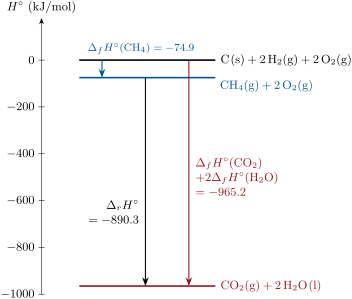
For , at . The value measured in a calorimeter is : the table and the flame agree within the uncertainty of the data. If the water leaves as vapour (), : the difference, , is the enthalpy of vaporisation of two moles of water, which a gas boiler recovers by condensing its fumes.
Method 1.12 (A Hess cycle)
To find the enthalpy of a reaction that cannot be measured directly:
- write the target reaction with its states;
- find reactions of known enthalpy (combustions, formations) whose combination, with coefficients , gives the target;
- check that every species not in the target cancels;
- add the enthalpies with the same coefficients.
Example 1.13 (Carbon to carbon monoxide)
Burning carbon always makes some carbon dioxide, so the enthalpy of is not measured directly. The two combustions () and (, measured) are; the target is the first minus the second: , the formation enthalpy of carbon monoxide.
History — Germain Henri Hess
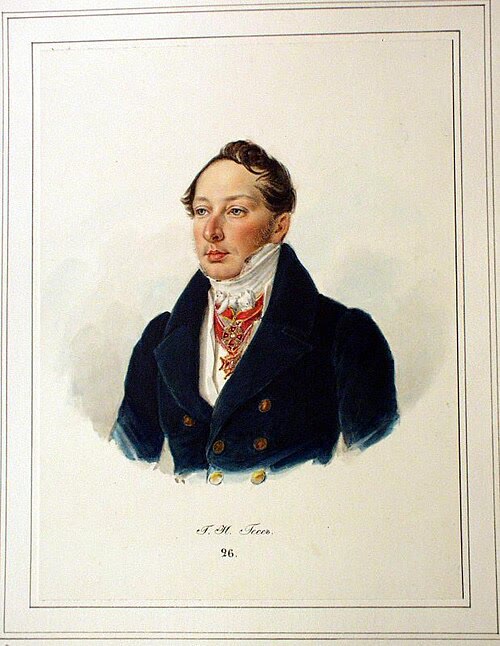
Germain Henri Hess (1802–1850), professor of chemistry in Saint Petersburg, measured the heats released when sulfuric acid is diluted or neutralised in several steps, and found in 1840 that the total did not depend on the steps taken: the “law of constant heat summation”, stated before the first law of thermodynamics itself, which explains it. (Portrait by I. I. Reimers, 1837–1838; CC BY-SA 4.0, Wikimedia Commons.)
1.3 Computing reaction enthalpies
From bond enthalpies
When the formation enthalpy of a compound is missing, the energy of its bonds gives an estimate, in the gas phase.
Definition 1.14 (Bond dissociation enthalpy, mean bond enthalpy)
The bond dissociation enthalpy of a bond A–B in a gaseous molecule is the standard reaction enthalpy of the breaking of that bond into two gaseous fragments, for a diatomic molecule. When a molecule has equal bonds, its mean bond enthalpy is the standard enthalpy of its complete atomisation into gaseous atoms divided by .
The atomisation enthalpies are themselves formation enthalpies: those of the gaseous atoms, minus that of the molecule. The table below is computed in this way.
| bond | enthalpy () | obtained from |
|---|---|---|
| H–H | 436 | , dissociation |
| O=O | 498 | , dissociation |
| NN | 945 | , dissociation |
| Cl–Cl | 243 | , dissociation |
| H–Cl | 432 | , dissociation |
| C–H | 416 | , mean of four |
| N–H | 391 | , mean of three |
| O–H | 464 | , mean of two |
| C=O | 804 | , mean of two |
| C–C | 330 | , with C–H taken from methane |
| C=C | 589 | , with C–H taken from methane |
Proposition 1.15 (Estimate from bond enthalpies)
For a reaction between gases,
Proof. Follow the path that atomises every reactant (enthalpy: the bonds broken) and then builds the products from the atoms (minus the bonds formed). Hess’s law makes the sum exact when each bond enthalpy is that of the bond in its own molecule; replacing it by a mean value from another molecule is the approximation. ∎
Example 1.16 (Hydrogenation of ethene)
In , one C=C and one H–H are broken and replaced by one C–C and two C–H. With the table: ; from formation enthalpies the value is . The agreement is good here because the table’s C–C and C=C were obtained from these very molecules; for a molecule unlike those of the table, an error of 10 to is common.
Lattice enthalpies: the Born–Haber cycle
Definition 1.17 (Lattice enthalpy)
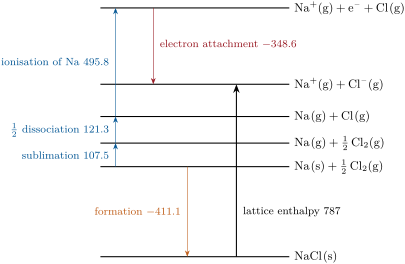
The lattice enthalpy of an ionic crystal is the standard reaction enthalpy of its dissociation into gaseous ions: for sodium chloride, . It is positive, and measures the cohesion of the crystal.
It cannot be measured directly, but a cycle through the elements gives it from measurable quantities: the formation enthalpy of the crystal, the atomisation of the elements, the ionisation energy of the metal and the electron affinity of the non-metal (both defined in the Year 1 volume).
Method 1.18 (The Born–Haber cycle)
- From the elements in their reference states, draw two paths: one to the crystal (formation), one to the gaseous ions (sublimation of the metal, atomisation of the non-metal, ionisation, electron attachment).
- Close the cycle with the lattice enthalpy, from the crystal up to the gaseous ions.
- Write that the sum of the enthalpies round the cycle is zero, and solve for the unknown. Ionisation energies and electron affinities are tabulated in eV per atom: multiply by .
Example 1.19 (Sodium chloride)
. The ionisation energy and the electron affinity are energies at ; their corrections to ( for each) cancel between the two steps. A crystal model with point charges gives a similar value, which is why sodium chloride is called ionic.
1.4 Reaction enthalpies and temperature
Tables give at . A reactor runs at , a flame at : how does change with the temperature?
Theorem 1.20 (Kirchhoff’s law)
so that (Kirchhoff’s law), in the absence of a change of state between and .
Proof. With every species in its standard state, is a function of two variables whose second partial derivatives are continuous; by Schwarz’s theorem they commute:
Integrating between and gives the second form. A change of state of a species inside the interval adds its enthalpy of transition, with the stoichiometric number. ∎
Example 1.21 (Ammonia synthesis when hot)
For , and, with the heat capacities at , . Taken as constant, it gives . The tables, which follow the heat capacities as they grow with temperature, give : the constant- estimate is off by 4 %, a fair price for a one-line computation. Over , the reaction enthalpy changes by about a seventh.
1.5 Adiabatic reactions and calorimetry
Flame temperature
In a flame the reaction is fast and the heat has no time to leave: the gases heat themselves.
Definition 1.22 (Adiabatic flame temperature)
The adiabatic flame temperature of a fuel is the temperature reached by the products of its complete combustion when the reaction takes place at constant pressure, without any exchange of heat, from reactants at .
Proposition 1.23 (Computing a flame temperature)
If the reaction advances by from reactants at and the final system has heat capacity , the final temperature satisfies
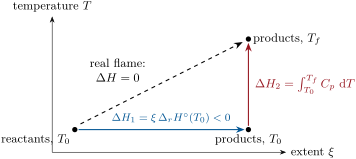
Proof. Adiabatic and at constant pressure, the transformation has . As is a state function, any path between the same initial and final states gives the same . Take the path of the figure below: first the reaction at , with (Proposition 1.3, with ideal behaviour); then the heating of the final system from to , . Their sum is zero. ∎
Method 1.24 (Flame temperature)
- Write the complete combustion of one mole of fuel; in air, add the nitrogen and argon that come with the oxygen (they are heated too); take the water as vapour.
- Compute per mole of fuel.
- Either take a constant heat capacity of the products: ; or find such that the sum of the tabulated increments equals , by interpolation.
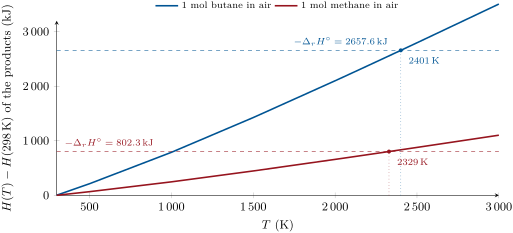
The computed temperatures are upper bounds. Above about , carbon dioxide and water begin to dissociate into carbon monoxide, hydrogen, oxygen and radicals; these endothermic reactions take back part of the heat, and a real butane flame in air is noticeably cooler than computed. In pure oxygen there is no nitrogen to heat and the flame is much hotter, which is why welders burn ethyne with oxygen rather than with air.
Calorimetry
Proposition 1.25 (Constant volume and constant pressure)
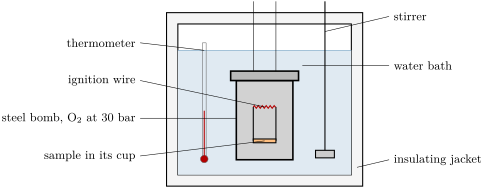
In a closed steel vessel (a bomb calorimeter) the heat measured is , and for perfect gases and condensed phases
where is the sum of the stoichiometric numbers of the gaseous species.
Proof. , and at fixed . The of the condensed phases is negligible, and for the gases with , whose derivative with respect to is . ∎
Method 1.26 (Calorimetry)
- Calibrate: burn a mass of a standard of known energy of combustion (or pass a known electrical energy), read the temperature rise , and deduce the heat capacity of the whole calorimeter (water and vessel, its “water equivalent”).
- Burn the sample, read : the heat released is , so at constant volume.
- Correct to with ; in an open (constant-pressure) calorimeter, directly.
Example 1.27 (A bomb measurement)
For the combustion of butane with liquid water, , so : the correction is a few parts per thousand, larger than the uncertainty of a good bomb measurement, so it is never omitted.
History — Calorimetric bombs, 1881
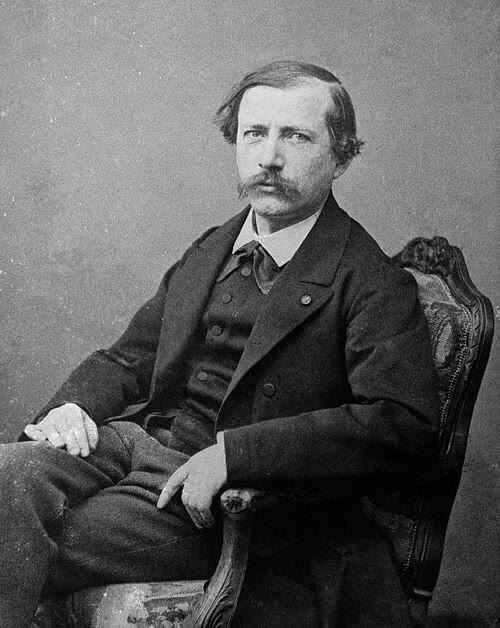
Marcellin Berthelot (1827–1907) burned organic compounds in compressed oxygen inside a closed steel vessel lined with platinum, so that the combustion was complete and nothing escaped: the calorimetric bomb, still the instrument of record for heats of combustion. He also coined the words exothermic and endothermic. (Photograph: public domain, Wikimedia Commons.)
1.6 Exercises
Exercise 1.1 ★
Using the standard enthalpies of formation of the chapter, compute at of the combustion of propane, , given . Is the reaction exothermic?
Solution
Solution of Exercise 1.1.
, negative: exothermic. (The measured combustion enthalpy is the same, .)
Exercise 1.2 ★
Compute the heat released by burning of methane (water formed liquid) and of dihydrogen, . Which fuel gives more heat per kilogram?
Solution
Solution of Exercise 1.2.
Methane: , so per kilogram. Dihydrogen: , : about 2.6 times more per kilogram (but far less per litre, the gas being light).
Exercise 1.3 ★
A bomb calorimeter gives for liquid benzene burning as at . Compute .
Solution
Solution of Exercise 1.3.
, so , in agreement with the value computed from formation enthalpies, .
Exercise 1.4 ★
Given for and for , compute the enthalpy of , the reaction that takes place in the hot coke of a blast furnace.
Solution
Solution of Exercise 1.4.
The target is the first reaction minus twice the second: . It is endothermic: the hot coke cools as it turns carbon dioxide into carbon monoxide.
Exercise 1.5 ★★
Estimate with the bond enthalpies of the chapter the enthalpy of , taking for C–Cl. Then compute the same quantity from the formation enthalpies, given , and comment on the difference.
Solution
Solution of Exercise 1.5.
Bonds broken: C–H and Cl–Cl, ; bonds formed: C–Cl and H–Cl, : estimate . From formation enthalpies: . The gap comes from the mean C–Cl value, an average over several molecules, and from the C–H bond broken in methane, stronger than the mean of the four.
Exercise 1.6 ★★
The standard enthalpy of vaporisation of water at is . Compute it. With for the liquid and for the vapour, both taken as constant, estimate it at (superheated water under pressure), and compare with the tables, which give for the liquid and for the vapour at .
Solution
Solution of Exercise 1.6.
At : . Kirchhoff with : at . The tables give : the constant heat capacities are excellent over this interval.
Exercise 1.7 ★★
Use a Born–Haber cycle to compute the lattice enthalpy of potassium chloride from: , sublimation of potassium , ionisation energy of potassium , , electron affinity of chlorine . Why is it smaller than that of sodium chloride?
Solution
Solution of Exercise 1.7.
Ionisation: ; attachment: . Lattice enthalpy , less than the of sodium chloride: is larger than , the ions are farther apart and attract each other less.
Exercise 1.8 ★★
A coffee-cup calorimeter is calibrated by passing of electrical energy, which raises its temperature by . Then of hydrochloric acid at is mixed in it with of sodium hydroxide solution at , both at the same initial temperature: the temperature rises by . Compute the enthalpy of .
Solution
Solution of Exercise 1.8.
Heat capacity of the calorimeter: . Heat released: , for (the acid is limiting, the base in slight excess): .
Exercise 1.9 ★★
Octane, a model of petrol, has . Compute the enthalpy of its combustion (water liquid), the heat released per kilogram, and the mass of carbon dioxide emitted per megajoule. Compare with methane.
Solution
Solution of Exercise 1.9.
: ; with , . Carbon dioxide: for , that is , against for methane: methane has more hydrogen per carbon, and burning hydrogen releases heat without carbon dioxide.
Exercise 1.10 ★★★
Compute the adiabatic flame temperature of methane burning in the stoichiometric amount of pure oxygen, with constant heat capacities (those of the chapter at : 37.13, ). Compare with the result in air, in the same approximation. Why is the true flame in oxygen much colder than this computation says?
Solution
Solution of Exercise 1.10.
Products of : ; ; , almost three times the value in air, because no nitrogen takes its share of the heat. The real oxygen flame is far colder: long before , carbon dioxide and water dissociate into carbon monoxide, hydrogen, oxygen and atoms, endothermic reactions that absorb most of the heat; and the heat capacities grow with .
Exercise 1.11 ★★★
The heat capacity of a gas is often written . For the synthesis of ammonia, take and (fitted to the tables between and ). Integrate Kirchhoff’s law from to and compare with the value in the tables, , and with the constant- estimate.
Solution
Solution of Exercise 1.11.
, within of the tables (), where the constant- estimate was off by .
Exercise 1.12 ★★★
Nitrogen monoxide forms in engines by . Compute its standard reaction enthalpy at . Show that, if is small, the reaction absorbs about the same heat at ; using the heat capacities of the tables at ( , 29.12, ), estimate the change between and . Explain why an endothermic reaction can be a problem precisely in the hottest flames.
Solution
Solution of Exercise 1.12.
(endothermic). , so between and the reaction enthalpy changes by about , one per cent. An endothermic reaction is favoured by high temperature (Chapter 4): cold air makes almost no nitrogen monoxide, the hottest flames make the most, which is why combustion temperature is a lever against this pollutant.
1.7 Problem: The Camping-Gas Cartridge
Problem 1.1
Weekend problem — the energy of butane, a measurement in a bomb calorimeter, the water heated in a pan, and the temperature of the flame
A camping stove burns butane from a cartridge holding . Data at ( in ): , , , . Molar masses: , . Heat capacity of liquid water . Dry air: , , by volume. .
Part I — The fuel.
- Write the complete combustion of butane, water formed liquid, for one mole of butane.
- Compute its standard reaction enthalpy at .
- Compute it again with the water formed as vapour, and explain the difference.
- Compute the heat released per gram of butane in each case.
- Which of the two values describes a camping stove, whose water leaves the flame as vapour?
- What heat can the whole cartridge release on the stove?
Part II — A measurement. A sample of of butane is burnt in a bomb calorimeter whose heat capacity is ; the water formed condenses.
- What quantity does a bomb calorimeter measure, and why?
- Compute of the reaction of question 1.
- Compute the expected .
- Compute the expected temperature rise of the calorimeter.
- The rise read is . Deduce the measured and , and the relative difference with the tables.
Part III — The pan.
- Compute the heat needed to bring of water () from to .
- The stove does it with of butane. Compute its efficiency (heat received by the water over heat released).
- Where does the rest of the heat go?
- How many litres of water can the whole cartridge bring to the boil at this efficiency?
Part IV — The flame.
- Butane burns in the stoichiometric amount of air. Compute the amounts of dinitrogen and argon that come with the dioxygen needed by one mole of butane.
- List the amounts of the products, nitrogen and argon included.
- Explain, with a two-step path, why the heat released at by the reaction (water as vapour) is entirely used to heat these gases.
- Using the heat capacities at , 37.13, 33.59, 29.12, , compute the heat capacity of the products.
- Deduce the flame temperature with constant heat capacities.
- The enthalpy increments of the tables give, for the products of one mole of butane, between and , and between and . Find the flame temperature by linear interpolation.
- Why is the first estimate too high?
- Why is the measured temperature of a butane flame lower still?
- State the adiabatic flame temperature of butane in air.
Solution
Solution of Problem 1.1.
1. . 2. . 3. With water vapour, ; the difference, , is the enthalpy of vaporisation of five moles of water ( each). 4. and . 5. The second: the water leaves as vapour and its heat of condensation is lost. 6. , about . 7. At constant volume the heat received is (no pressure work): the bomb measures . 8. (the water is liquid). 9. . 10. ; heat ; . 11. Heat : and , below the tables in absolute value: heat lost by the calorimeter or a slightly incomplete combustion. 12. ; . 13. Heat released ; efficiency . 14. Into the hot combustion gases that escape round the pan, the air heated by the flame and the pan’s walls, and radiation. 15. . 16. of come with of and of . 17. , , , . 18. The flame is adiabatic and isobaric, so . Along a path made of the reaction at () followed by the heating of these products, : all the heat goes into the gases. 19. . 20. . 21. . 22. The heat capacities of the gases grow with temperature (by about a quarter between and ): the room-temperature values heat the gases too cheaply. 23. Above carbon dioxide and water partly dissociate (endothermic), the flame radiates, and mixing with air is never perfect. 24. The adiabatic flame temperature of butane in air is .