
সব বই

পেশাদার

1 Markets I: The Ecosystem and Exchange-Traded Marketsবাজার অনলাইন 2 Markets II: Rates, FX and Creditবাজার অনলাইন 3 Markets III: Commodities, Energy and Cryptoবাজার অনলাইন 4 Quantitative Methodsপদ্ধতি অনলাইন 5 Derivatives and Volatilityডেরিভেটিভস অনলাইন 6 Rates, Credit, XVA and Riskসুদহার, ঋণ ও ঝুঁকি অনলাইন 7 Research Craft: Predictors, Backtests, Measurement, Portfoliosগবেষণা অনলাইন 8 Strategies I: Equities and Futuresকৌশল অনলাইন 9 Strategies II: Volatility, Relative Value, Macro and the Bank Desksকৌশল অনলাইন 10 Microstructure and Executionএক্সিকিউশন অনলাইন 11 Market Making and High-Frequency Tradingমার্কেট মেকিং অনলাইন 12 Machine Learning for Marketsমেশিন লার্নিং অনলাইন 13 Low-Latency Softwareপ্রযুক্তি অনলাইন 14 Networks, Hardware and Trading Infrastructureপ্রযুক্তি অনলাইন 15 Research, Data and Risk Platformsপ্রযুক্তি অনলাইন 16 The Desk and the Firmপ্রতিষ্ঠান অনলাইন 17 The Industry: Firms, Roles and Careersক্যারিয়ার অনলাইন 18 Interviews I: Maths, Probability and Speedক্যারিয়ার অনলাইন 19 Interviews II: Markets, Trading Games and the Final Roundক্যারিয়ার অনলাইন 20 Interviews III: Codeক্যারিয়ার অনলাইন
অ্যাপ পরিচিতি Coach সাইন ইন পড়া শুরু করো

বইগুলো এখনো বাংলা ভাষায় পাওয়া যায় না — ইংরেজি সংস্করণ দেখানো হচ্ছে।

Chemistry · পরিভাষা

Catalyst, catalysis কী?

অন্য নাম: catalyst · catalysis

Definition 42.1 School Chemistry — Grades 1 to 12 · অধ্যায় 42 — Catalysis

A catalyst is a species that makes a reaction faster without being used up: it takes part in the mechanism but is given back, unchanged, at the end, and it does not appear in the overall equation. The speeding up of a reaction by a catalyst is catalysis.
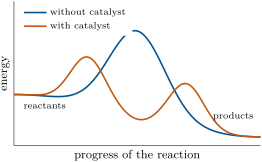
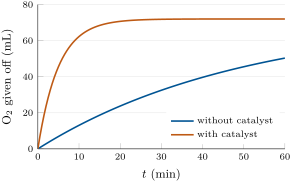
Left: energy along the reaction; the catalysed path goes through an intermediate and two lower barriers. Right: oxygen given off by a hydrogen peroxide solution; the catalyst speeds the reaction up, but the final volume is the same. (Model curves.)

উদাহরণ

Example 42.4 (Iodide ions and hydrogen peroxide)

Hydrogen peroxide decomposes very slowly on its own: 2 HX2OX2→2 HX2O+OX2\ce{2H2O2 -> 2H2O + O2}. With a little potassium iodide dissolved in it, it froths at once. The iodide ion opens a path in two steps:

HX2OX2+IX−→HX2O+IOX−,HX2OX2+IOX−→HX2O+OX2+IX−.\ce{H2O2 + I- -> H2O + IO-}, \qquad \ce{H2O2 + IO- -> H2O + O2 + I-} .

Added, the two steps give back 2 HX2OX2→2 HX2O+OX2\ce{2H2O2 -> 2H2O + O2}: the iodide ion, used in the first step and returned in the second, is the catalyst; the ion IOX−\ce{IO-} is an intermediate.

Example 42.5 (Iron(III) ions)

Iron(III) ions also catalyse the decomposition, through the couple FeX3+\ce{Fe^{3+}}/FeX2+\ce{Fe^{2+}} (Chapter 35): they first oxidise hydrogen peroxide, 2 FeX3++HX2OX2→2 FeX2++OX2+2 HX+\ce{2Fe^{3+} + H2O2 -> 2Fe^{2+} + O2 + 2H+}, then the iron(II) ions formed are oxidised back by more hydrogen peroxide, 2 FeX2++HX2OX2+2 HX+→2 FeX3++2 HX2O\ce{2Fe^{2+} + H2O2 + 2H+ -> 2Fe^{3+} + 2H2O}. The pale orange colour of the solution turns greenish while the gas is given off, then comes back when the hydrogen peroxide is used up: a sign that the catalyst takes part and is regenerated.

Example 42.6 (The catalytic converter)

The exhaust of a petrol engine contains carbon monoxide and nitrogen monoxide, both toxic, and unburnt fuel. In the catalytic converter, a ceramic honeycomb coated with platinum and rhodium, they react on the metal surface:

2 CO+2 NO→2 COX2+NX2,\ce{2CO + 2NO -> 2CO2 + N2} ,

and the hydrocarbons burn to carbon dioxide and water. The gases cross the converter in a fraction of a second, too fast for any reaction without a catalyst.

প্রসঙ্গসহ পড়ো →