
All books

Professional

Apps About Coach Log in Start reading

Chemistry · Glossary

What is Conductimetric titration?

Definition 46.8 School Chemistry — Grades 1 to 12 · Chapter 46 — Titrations by pH and Conductivity

In a conductimetric titration the conductivity is measured after each addition of titrant. The titrated solution is diluted in a large volume of water, so that the volume added hardly changes it: the points then lie on straight lines, which change slope at equivalence.
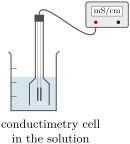
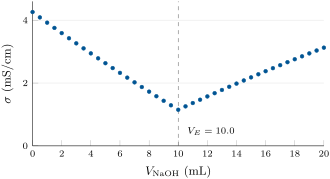
Left: a conductimetry cell. Right: 100\, mL of hydrochloric acid at 0.0100\, mol/ L titrated by sodium hydroxide at 0.100\, mol/ L (computed with Kohlrausch’s law). The conductivity falls, then rises: two straight lines meeting at equivalence.
Left: a conductimetry cell. Right: 100 mL100\,\mathrm{mL} of hydrochloric acid at 0.0100 mol/L0.0100\,\mathrm{mol}/\mathrm{L} titrated by sodium hydroxide at 0.100 mol/L0.100\,\mathrm{mol}/\mathrm{L} (computed with Kohlrausch’s law). The conductivity falls, then rises: two straight lines meeting at equivalence.

Examples

Example 46.9 (Reading the two lines)

Before equivalence each OHX−\ce{OH-} added removes an HX3OX+\ce{H3O+} (λ=349.8\lambda = 349.8) and brings in a NaX+\ce{Na+} (λ=50.3\lambda = 50.3): the conductivity falls steeply. After equivalence, NaX+\ce{Na+} and OHX−\ce{OH-} (λ=198.3\lambda = 198.3) simply accumulate: it rises. The two lines meet at VE=10.0 mLV_E = 10.0\,\mathrm{mL}, so the acid was 0.100×10.0/100=0.0100 mol/L0.100 \times 10.0 / 100 = 0.0100\,\mathrm{mol}/\mathrm{L}.

Read in context →