School Chemistry — Grades 1 to 12 · Grades 1–12
46Titrations by pH and Conductivity
A bottle of wine vinegar is labelled “6 % acidity”: six grams of ethanoic acid in every hundred grams of vinegar. Neither ethanoic acid nor its conjugate base is coloured, and no permanganate will help here. But a pH meter dipped into the vinegar, or a cell measuring how well it conducts, follows the reaction with a base drop by drop, and the shape of the curve shows exactly where equivalence lies. Ten minutes at the bench, and the label is checked.
You already know
A titration, its equivalence and equivalent volume (Chapter 36); acidity constants (Chapter 44); Henderson’s relation and indicators (Chapter 45); solutions of ions conduct electricity (Chapter 17).
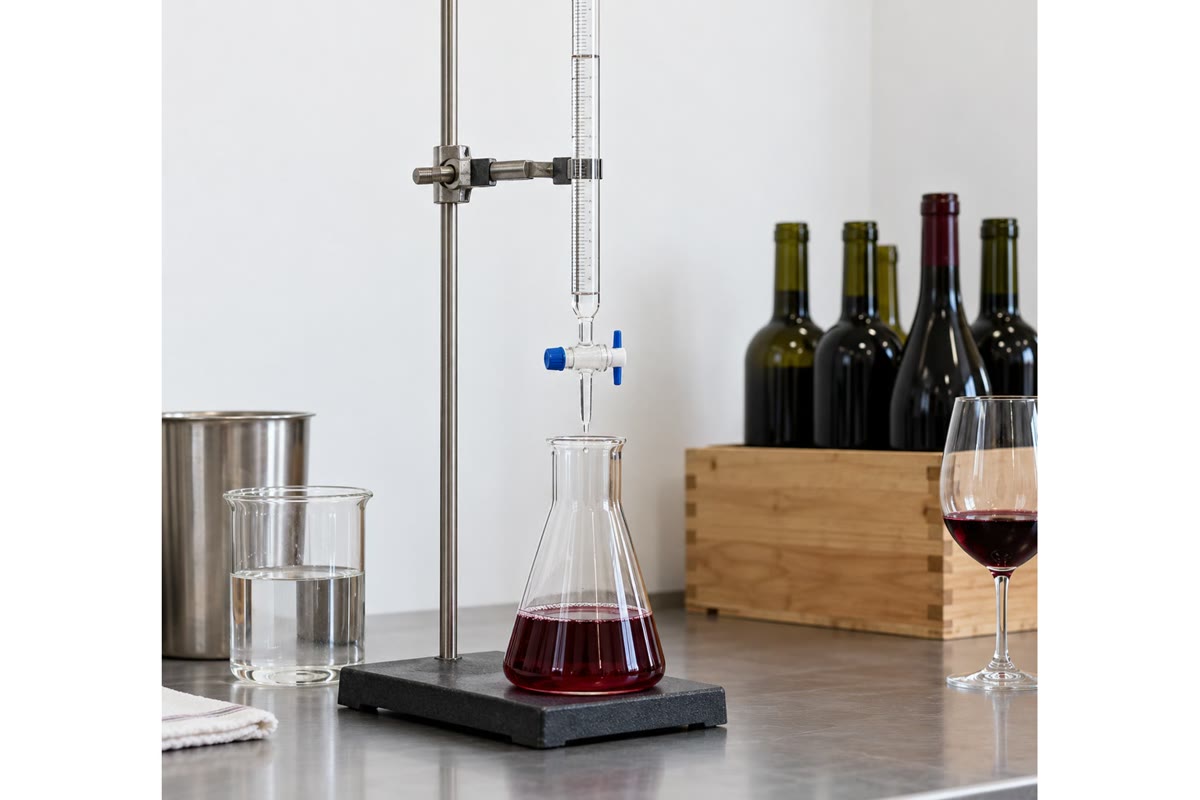
46.1 The pH-metric titration
Definition 46.1 (pH-metric titration, half-equivalence)
In a pH-metric titration the pH of the titrated solution is measured after each addition of titrant, and the curve pH against the volume added is drawn. Half-equivalence is the point where half the equivalent volume has been added.
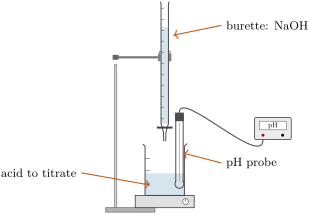
In the lab — Calibrating a pH meter
Before use, the probe is rinsed with distilled water and dipped in two buffer solutions of known pH, usually 7.0 and 4.0 (or 10.0): the meter is set to read their values. Between solutions the probe is rinsed and gently dabbed dry, never wiped; it is stored with its tip wet.
Method 46.2 (The derivative method)
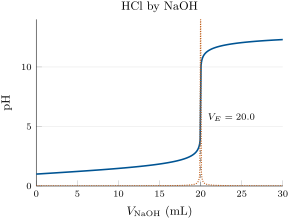
Compute, between successive measurements, the slope , and plot it against (a spreadsheet or a calculator does it). The equivalent volume is where this slope is largest: the peak of the derivative curve.
Method 46.3 (The tangent method)
- Draw two parallel tangents to the curve, one before and one after the jump, on either side of it.
- Draw the parallel line halfway between them.
- Where it cuts the curve is the equivalence point: read (and the pH at equivalence).
Proposition 46.4 (At half-equivalence, )
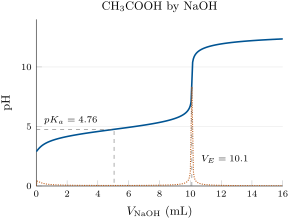
In the titration of a weak acid by a strong base, at half-equivalence .
Proof. The reaction is total. At half-equivalence half of the acid has been turned into : , and Henderson’s relation gives . ∎
Remark 46.5 (Choosing an indicator from the curve)
The indicator must change colour inside the jump. For hydrochloric acid the jump spans about pH 4 to 10 and many indicators fit, bromothymol blue best; for ethanoic acid the jump is shorter and basic, around 7 to 11: phenolphthalein (8.0–10.0) fits, bromothymol blue would change too early.
46.2 Conductivity and conductimetric titrations
Definition 46.6 (Conductivity, molar ionic conductivity)
The conductivity of a solution measures how well it conducts electricity; it is read on a conductimeter in (or ). Each ion contributes to it in proportion to its concentration, with a coefficient , its molar ionic conductivity.
Proposition 46.7 (Kohlrausch’s law)
For a dilute solution, . At , in : 349.8, 198.3, 76.2, 50.3. The oxonium and hydroxide ions conduct far better than all other ions.
Proof. Admitted (Year 1 volume). The values of and come from the measured conductivities of hydrochloric acid and sodium chloride solutions, from which that of is subtracted. ∎
Definition 46.8 (Conductimetric titration)
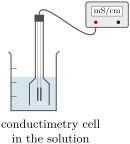
In a conductimetric titration the conductivity is measured after each addition of titrant. The titrated solution is diluted in a large volume of water, so that the volume added hardly changes it: the points then lie on straight lines, which change slope at equivalence.
Example 46.9 (Reading the two lines)
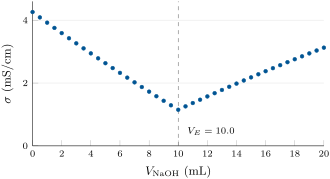
Before equivalence each added removes an () and brings in a (): the conductivity falls steeply. After equivalence, and () simply accumulate: it rises. The two lines meet at , so the acid was .
Method 46.10 (Equivalence from a conductimetric titration)
Draw the best straight line through the points before equivalence and the best line through the points after it; read at their intersection. Points near equivalence, where the lines bend, are left out.
Remark 46.11 (Which method when)
A coloured indicator is fastest when a suitable one exists. A pH-metric titration also gives the of a weak acid, and works with coloured or cloudy solutions. A conductimetric titration needs no jump in pH at all: it works for very weak or very dilute acids, and for precipitation reactions, as long as the ions change.
Safety


Sodium hydroxide solutions burn the skin and the eyes, even dilute ones in the eyes: goggles throughout, and any splash rinsed at once with a lot of water.
46.3 Exercises
Exercise 46.1 ★
Read the equivalent volume on the curve of hydrochloric acid titrated by sodium hydroxide at , and deduce the concentration of the of acid.
Solution
Solution of Exercise 46.1.
; .
Exercise 46.2 ★
A weak acid is titrated by sodium hydroxide; . At the pH is 3.75. Give the of the acid. Which acid of the scale could it be?
Exercise 46.3 ★
Which indicator would you choose for the titration of ethanoic acid by sodium hydroxide? Why not methyl red?
Solution
Solution of Exercise 46.3.
Phenolphthalein: its range 8.0–10.0 lies in the jump, which is basic. Methyl red (4.2–6.3) would change near half-equivalence, far too early.
Exercise 46.4 ★
Why must a pH meter be calibrated before use? With what?
Solution
Solution of Exercise 46.4.
The probe’s response drifts with time and temperature: it is set to read correctly in two buffer solutions of known pH.
Exercise 46.5 ★
Using the molar ionic conductivities, rank the ions , , , from the best conductor to the worst.
Solution
Solution of Exercise 46.5.
(349.8) > (198.3) > (76.2) > (50.3).
Exercise 46.6 ★★
of an ethanoic acid solution need of sodium hydroxide at . Compute its concentration.
Solution
Solution of Exercise 46.6.
.
Exercise 46.7 ★★
Near equivalence, the readings are: , pH 5.7; , 6.1; , 7.0; , 10.5; , 11.0. Compute between successive points and locate .
Solution
Solution of Exercise 46.7.
Slopes: 2.0, 4.5, 17.5 and . The largest lies between 10.0 and : .
Exercise 46.8 ★★
In the conductimetric titration of hydrochloric acid, explain the sign of the slope before equivalence and after it, using the ions present.
Solution
Solution of Exercise 46.8.
Before equivalence each added removes an (very conducting) and brings a (much less conducting): the conductivity falls. After it, and accumulate without reacting: it rises.
Exercise 46.9 ★★
Sketch the conductimetric curve of ethanoic acid titrated by sodium hydroxide. Why does the conductivity rise even before equivalence?
Solution
Solution of Exercise 46.9.
At the start, few ions (the weak acid hardly reacts with water): low conductivity. Before equivalence, ethanoate and sodium ions are formed in place of uncharged molecules: it rises, slowly. After equivalence, and accumulate: it rises faster. Two rising lines, the second steeper.
Exercise 46.10 ★★
On the computed curve of the diluted vinegar, read the pH at the start, at half-equivalence and at equivalence. Why is the starting pH much higher than that of hydrochloric acid at the same concentration?
Solution
Solution of Exercise 46.10.
About 2.9, 4.76 and 8.7. Ethanoic acid is weak: only a few percent of it gives oxonium ions, so the pH starts higher than the 1.0 of hydrochloric acid at a similar concentration.
Exercise 46.11 ★★
Why is the titrated solution diluted in a large volume of water before a conductimetric titration?
Solution
Solution of Exercise 46.11.
So that the volume of titrant added hardly changes the total volume: the concentrations, and so the conductivity, then vary along straight lines.
Exercise 46.12 ★★★
A solution contains both hydrochloric acid and ethanoic acid. It is titrated by sodium hydroxide while the pH is measured. Explain why the curve shows two jumps, and what each equivalent volume measures.
Solution
Solution of Exercise 46.12.
The hydroxide ions react first with the strong acid (), then with the weak one. The first jump marks the end of the hydrochloric acid (its equivalent volume measures it), the second the end of the ethanoic acid (the volume between the two jumps measures it).
Exercise 46.13 ★★★
Compute the conductivity at the start of the conductimetric titration of the chapter ( hydrochloric acid) and at equivalence ( of sodium chloride solution). Compare with the figure.
Exercise 46.14 ★★★
A pH meter badly calibrated reads every pH 0.2 too high. What error does it cause on the equivalent volume of a pH-metric titration? On the read at half-equivalence?
Solution
Solution of Exercise 46.14.
None on : the jump is at the same volume, whatever the offset of the readings. The read at half-equivalence is 0.2 too high.
Exercise 46.15 ★★★
Why can a conductimetric titration follow the reaction of silver ions with chloride ions, , while a pH-metric titration cannot? Describe the expected curve when silver nitrate is added to sodium chloride (take of close to that of ).
Solution
Solution of Exercise 46.15.
The pH does not change during this precipitation, but the ions do: before equivalence each added removes a and brings a of similar conductivity, so the conductivity stays nearly constant (the sodium ions were there from the start); after equivalence and accumulate and it rises. A flat line, then a rising one.
46.4 Problem: Is the Vinegar 6 %?
Problem 46.1
Weekend problem — does a vinegar labelled “6 % acidity” really hold six grams of ethanoic acid per hundred grams?
A vinegar labelled “6 % acidity” is checked. of it are weighed: . The vinegar is diluted ten times, then of the diluted solution are titrated by sodium hydroxide at , with a pH meter; the computed curve of the chapter (right) matches the measurements.
Part I — Preparing the sample.
- What does “6 % acidity” mean?
- If the label is right, what mass of ethanoic acid do of vinegar contain? What molar concentration is that?
- Why is the vinegar diluted before titration?
- Which glassware is used to dilute it ten times?
Part II — The pH-metric titration.
- Write the equation of the titration reaction.
- Read the equivalent volume on the curve.
- Compute the concentration of the diluted vinegar.
- Deduce that of the vinegar.
- Read the pH at half-equivalence. What does it give?
- Why is the pH at equivalence above 7?
- Which indicator would have given the same result?
Part III — A conductimetric check.
- The titration is repeated with a conductimetry cell, the sample diluted in of water. Which ions appear in the solution before equivalence?
- Why does the conductivity rise only slowly before equivalence?
- Why does it rise faster after?
- Why is the conductivity very low at the start?
- Where should the two lines meet?
Part IV — The verdict.
- Compute the mass concentration of ethanoic acid in the vinegar.
- Compute the mass of ethanoic acid in of vinegar.
- Deduce the mass of ethanoic acid per of vinegar.
- State the final answer: what is the acidity of the vinegar?
Solution
Solution of Problem 46.1.
1. of ethanoic acid per of vinegar.
2. of vinegar hold ; : in , that is .
3. Undiluted, would need about of sodium hydroxide at : more than a burette holds.
4. A volumetric pipette and a volumetric flask.
5. .
6. .
7. .
8. .
9. pH 4.76 at : the of ethanoic acid.
10. At equivalence the solution holds sodium ethanoate, and ethanoate is a weak base.
11. Phenolphthalein, whose range 8.0–10.0 contains the pH at equivalence (about 8.7).
12. Sodium ions and ethanoate ions.
13. Each added turns a nearly un-ionised molecule into , with a : ions of modest conductivity are added slowly.
14. Beyond equivalence the hydroxide ions, very conducting, accumulate with the sodium ions.
15. The weak acid gives very few ions to water.
16. At , as in the pH-metric titration.
17. .
18. in .
19. per .
20. The vinegar has an acidity of : the label is right.