All books

Professional

Apps About Coach Log in Start reading

Chemistry · Glossary

What is Diazonium chemistry?

Also known as: diazonium ion · diazotisation · Sandmeyer reaction · azo coupling

Definition 23.9 University Chemistry — Year 2 · Chapter 23 — Amines and Nitrogen Compounds

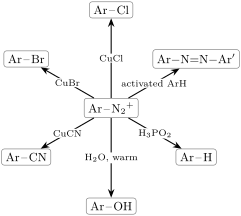
A diazonium ion is a cation R−NX+ ≡N\ce{R-N+ #N}. Diazotisation converts a primary aromatic amine into an aryl diazonium salt with sodium nitrite and a strong acid at 0–5∘C5{}^{\circ}\mathrm{C}. In a Sandmeyer reaction, a copper(I) salt (CuCl\ce{CuCl}, CuBr\ce{CuBr}, CuCN\ce{CuCN}) replaces the diazonium group by Cl, Br or CN with loss of dinitrogen. In an azo coupling, the diazonium ion, a weak electrophile, attacks an activated aromatic ring to give an azo compound Ar−N=N−Ar′\mathrm{Ar{-}N{=}N{-}Ar'}.

Reactions of an aryl diazonium salt. The N2+ group is replaced by halogen or cyanide (Sandmeyer, copper(I) salts), by OH (warm water) or by H (hypophosphorous acid), or kept in an azo coupling.
Reactions of an aryl diazonium salt. The NX2X+\ce{N2+} group is replaced by halogen or cyanide (Sandmeyer, copper(I) salts), by OH\ce{OH} (warm water) or by H (hypophosphorous acid), or kept in an azo coupling.
Read in context →