All books

Professional

Apps About Coach Log in Start reading

Chemistry · Glossary

What is Diels–Alder reaction?

Also known as: Diels--Alder reaction · diene · dienophile

Definition 17.10 University Chemistry — Year 2 · Chapter 17 — Frontier Orbitals and Reactivity

The Diels–Alder reaction is the concerted addition of a conjugated diene, in its s-cis conformation, to an alkene or alkyne, the dienophile, forming a six-membered ring with two new σ\sigma bonds and one new π\pi bond.

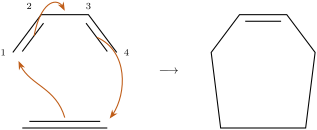
The Diels–Alder reaction of butadiene and ethene, written with curly arrows: three pairs of electrons move at once, in a cyclic, concerted step; two  bonds form at the ends of the diene, and the π bond moves to its centre.
The Diels–Alder reaction of butadiene and ethene, written with curly arrows: three pairs of electrons move at once, in a cyclic, concerted step; two σ\sigma bonds form at the ends of the diene, and the π\pi bond moves to its centre.
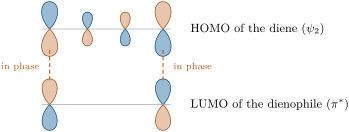
Frontier orbitals of butadiene and ethene, lobes in proportion to their Hückel coefficients. Facing each other, the end lobes of the diene’s HOMO and the lobes of the dienophile’s LUMO have the same signs at both ends: the two  bonds can form together, on the same face of each partner.
Frontier orbitals of butadiene and ethene, lobes in proportion to their Hückel coefficients. Facing each other, the end lobes of the diene’s HOMO and the lobes of the dienophile’s LUMO have the same signs at both ends: the two σ\sigma bonds can form together, on the same face of each partner.
Read in context →