University Chemistry — Year 2 · Bachelor Year 2
17Frontier Orbitals and Reactivity
A bottle of cyclopentadiene left on the shelf slowly turns into its dimer: two molecules of the same diene join into a bridged bicyclic compound, and only one of the possible stereoisomers forms. Nothing in the curly arrows of the Year 1 volume predicts which. Two orbitals do: the highest occupied orbital of one molecule and the lowest empty orbital of the other. This chapter turns the two-level interaction of Chapter 14 into a tool for reactivity — which atom a nucleophile attacks, from which side, and why a diene and an alkene combine into a ring in a single step.
You already know
Chapter 14: two interacting orbitals, four-electron repulsion. Chapter 16: Hückel levels and coefficients of conjugated systems. The Year 1 volume: nucleophiles and electrophiles, curly arrows, kinetic control, stereospecific, stereoselective and regioselective reactions, electrophilic additions to alkenes, nucleophilic substitution.
17.1 Two orbitals, revisited
When two molecules approach, their orbitals overlap and interact. Most of the interaction is weak, the orbitals being far apart in energy; a perturbative form of the two-level result then suffices.
Theorem 17.1 (Weak interaction of two levels)
Two orbitals of energies , coupled by a resonance integral with (overlap neglected), are shifted to
to first order in : the lower level falls and the upper rises by the same amount, the smaller as the gap is larger.
Proof. By Theorem 14.14 the exact levels are . With , , and . ∎
Proposition 17.2 (Two electrons attract, four repel)
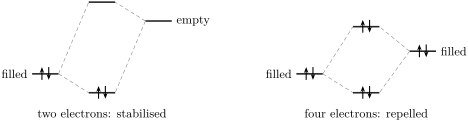
If the two interacting orbitals hold two electrons in all, the system is stabilised by about . If they hold four, the system is destabilised.
Proof. Two electrons go into the lowered level: gain . With four, the upper level is filled too; to the order of Theorem 17.1 the two shifts cancel, and with the overlap kept the upper level rises more than the lower falls (Proposition 14.5): a net repulsion. ∎
17.2 Frontier orbitals
Definition 17.3 (Frontier orbitals)
The HOMO (highest occupied molecular orbital) and the LUMO (lowest unoccupied molecular orbital) of a molecule are its frontier orbitals.
Proposition 17.4 (The dominant interaction)
Between two closed-shell molecules, the stabilising interactions that matter most are between the HOMO of one and the LUMO of the other; of the two such pairs, the one with the smaller gap dominates. A nucleophile reacts through its HOMO, an electrophile through its LUMO.
Argument. Filled–filled pairs repel (Proposition 17.2) and empty–empty pairs hold no electrons: only filled–empty pairs stabilise, each by . The HOMO is the highest filled level and the LUMO the lowest empty one, so a HOMO–LUMO pair has the smallest gap among them; by the theorem, the smallest gap gives the largest term. ∎
Definition 17.5 (Charge control and orbital control)
A reaction is under charge control when the attraction between the charges of the two partners decides where they react, and under orbital control when the overlap of the frontier orbitals decides it, the attack taking place where their coefficients are largest.
Definition 17.6 (Hard and soft species)
A hard nucleophile or hard electrophile is small, carries a concentrated charge and has a HOMO (respectively a LUMO) far from that of its partners: it reacts under charge control. A soft nucleophile or soft electrophile is large and polarisable, with a high HOMO (respectively a low LUMO): it reacts under orbital control. Hard reacts preferably with hard, soft with soft.
The hydroxide ion and the fluoride ion are hard nucleophiles, iodide and thiolates soft; a proton and a carbocation are hard electrophiles, the carbon of a halogenoalkane soft.
Definition 17.7 (Ambident nucleophile)
An ambident nucleophile has two nucleophilic atoms connected by conjugation, which can each attack an electrophile.
The cyanide ion is attacked at nitrogen, where the negative charge is larger, by hard electrophiles, and at carbon, where its HOMO has its larger coefficient, by soft ones: a halogenoalkane gives a nitrile . Enolate ions, met in Chapter 25, react at carbon or at oxygen in the same way.
Method 17.8 (A frontier-orbital analysis)
- Identify the nucleophile (high HOMO) and the electrophile (low LUMO).
- Draw the two frontier orbitals with their coefficients and signs.
- The reaction occurs where the overlap is largest: atoms with the largest coefficients, lobes of the same sign facing each other.
- The direction of approach follows the shape of the LUMO (perpendicular to a plane, at the back of a bond).
- A smaller HOMO–LUMO gap means a faster reaction (other things being equal).
The direction of attack follows from the LUMO. The LUMO of a carbonyl group is its orbital, larger on carbon and perpendicular to the plane: nucleophiles approach the carbon from above or below the plane, not along the axis. The LUMO of a halogenoalkane is the orbital of the bond, whose large lobe on carbon points away from X: the nucleophile attacks from the back, and the carbon is inverted — the stereochemistry of the bimolecular substitution of the Year 1 volume.
17.3 The Diels–Alder reaction
Definition 17.9 (Concerted reaction)
A concerted reaction makes and breaks all its bonds in a single step, through one transition state, without an intermediate.
Definition 17.10 (Diels–Alder reaction)
The Diels–Alder reaction is the concerted addition of a conjugated diene, in its s-cis conformation, to an alkene or alkyne, the dienophile, forming a six-membered ring with two new bonds and one new bond.
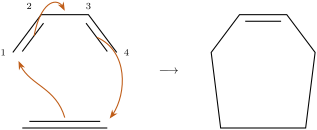
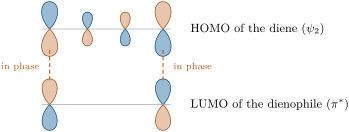
The dominant interaction is between the HOMO of the diene, , and the LUMO of the dienophile, . Their lobes at the ends of the diene and on the two carbons of the dienophile have matching signs when the dienophile approaches the face of the diene: both new bonds can form at once, on the same face of each partner.
Proposition 17.11 (Stereospecificity)
The Diels–Alder reaction is stereospecific: substituents cis on the dienophile are cis in the product, trans substituents remain trans.
Proof. The reaction is concerted and both new bonds form on the same face of the dienophile: its two carbons never rotate with respect to each other, and the relative positions of their substituents are carried into the ring. ∎
Proposition 17.12 (Regioselectivity)
With unsymmetrical partners, the major product joins the atom of the diene with the largest coefficient in its HOMO to the atom of the dienophile with the largest coefficient in its LUMO.
Argument. In the transition state the two new bonds are not yet equally formed; the stabilisation is larger when the larger coefficients overlap ( grows with the product of the coefficients of the overlapping atoms), so that orientation is reached at lower energy. ∎
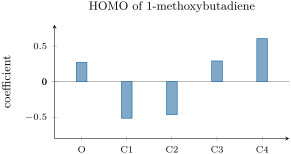
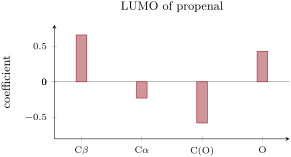
The donor group raises the diene’s HOMO ( instead of 0.62) and the acceptor lowers the dienophile’s LUMO ( instead of ): the gap narrows, and such pairs react much faster than butadiene with ethene. A diene rich in electrons and a dienophile poor in electrons is the typical combination.
Definition 17.13 (Endo and exo adducts)
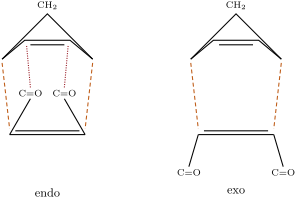
When a cyclic diene adds to a dienophile carrying an unsaturated substituent, the endo adduct has that substituent pointing towards the newly formed double bond (under the diene in the transition state), the exo adduct away from it. The endo rule states that the endo adduct is formed faster.
Proposition 17.14 (The endo rule)
Under kinetic control, the endo adduct is the major product, although the exo adduct is often the more stable.
Proof. Admitted at this level. ∎
The usual explanation is a secondary overlap, in the endo approach, between the lobes of the substituent’s system and those of the central atoms of the diene’s HOMO; it lowers the endo transition state without forming a bond. The rule is empirical and has exceptions; the Year 3 volume treats these reactions with the symmetry of their orbitals.
Method 17.15 (Drawing a Diels–Alder product)
- Put the diene in its s-cis conformation, the dienophile facing its ends.
- Draw the two new bonds from the diene’s ends to the dienophile’s carbons, and the new bond between C2 and C3 of the diene.
- Keep the dienophile’s substituents on the same side (cis stays cis).
- For unsymmetrical partners, join the largest coefficients (“ortho” or “para” products for 1- or 2-substituted dienes).
- With a cyclic diene, put the unsaturated substituent endo.
In the lab — Cracking dicyclopentadiene
Cyclopentadiene is sold as its dimer and regenerated just before use: the dimer is heated to its boiling point (about ) in a flask fitted with a fractionating column, where it splits back into the monomer (a retro-Diels–Alder reaction), which distils at and is collected in a receiver cooled in ice. The monomer dimerises again within hours at room temperature and is used at once. Both compounds are flammable and harmful; the work is done in a fume hood.
Safety


Cyclopentadiene and its dimer are highly flammable and toxic by inhalation; maleic anhydride is corrosive and a respiratory sensitiser. They are handled in a fume hood, with gloves and eye protection, away from flames.
17.4 Exercises
Exercise 17.1 ★
Give the HOMO and the LUMO (energies in Hückel units) of ethene, of the allyl anion and of butadiene.
Exercise 17.2 ★
Classify as hard or soft: , , , a thiolate , the carbon of iodomethane, .
Solution
Solution of Exercise 17.2.
Hard: , , . Soft: , , the carbon of iodomethane.
Exercise 17.3 ★
Which of these dienes can take part in a Diels–Alder reaction: buta-1,3-diene, cyclopentadiene, penta-1,4-diene, (2Z,4Z)-hexa-2,4-diene in its s-cis form?
Solution
Solution of Exercise 17.3.
Butadiene (s-cis conformer accessible) and cyclopentadiene (locked s-cis) react; penta-1,4-diene is not conjugated and does not. The (2Z,4Z) diene can reach the s-cis form only by pushing its two inner methyl groups into each other: it reacts very poorly.
Exercise 17.4 ★
Draw the product of butadiene with propenenitrile .
Solution
Solution of Exercise 17.4.
Cyclohex-3-ene-1-carbonitrile: a six-membered ring, double bond between the former C2 and C3 of the diene, the group on one of the two ring carbons formed from the dienophile.
Exercise 17.5 ★★
Two orbitals at and interact with (exercise data). Compute the perturbative stabilisation of two electrons, then the exact one.
Solution
Solution of Exercise 17.5.
: perturbative . Exact: lower level , gain .
Exercise 17.6 ★★
The cyanide ion reacts with iodomethane to give ethanenitrile , but with a carbocation in a strongly ionising solvent it gives some isonitrile . Explain.
Solution
Solution of Exercise 17.6.
Iodomethane is a soft electrophile: orbital control, attack by the atom with the larger HOMO coefficient, carbon. A free carbocation is a hard electrophile: charge control, attack in part by nitrogen, which carries more negative charge.
Exercise 17.7 ★★
Using the coefficients of the chapter, predict the major product of 1-methoxybutadiene with propenal.
Exercise 17.8 ★★
Draw the endo adduct of cyclopentadiene with methyl propenoate.
Solution
Solution of Exercise 17.8.
A bicyclo[2.2.1]heptene (norbornene) skeleton with the ester group on a carbon of the former dienophile, pointing towards the new bond, under the six-membered ring (endo), on the side opposite the bridge.
Exercise 17.9 ★★
Why does maleic anhydride react with cyclopentadiene at room temperature, while ethene needs heating under pressure?
Solution
Solution of Exercise 17.9.
The two carbonyl groups lower the LUMO of the dienophile: its gap with the HOMO of cyclopentadiene is much smaller than that of ethene, the stabilisation of the transition state is larger, and the barrier lower.
Exercise 17.10 ★★★
Cyclopentadiene reacts with dimethyl maleate (cis diester) and with dimethyl fumarate (trans diester). Draw both products and say how many stereoisomers each gives.
Solution
Solution of Exercise 17.10.
The reaction is stereospecific: the maleate gives the adduct with both ester groups cis (endo,endo as the major product; it is achiral, a meso compound); the fumarate gives the trans adduct, one ester endo and one exo, formed as a pair of enantiomers (racemic).
Exercise 17.11 ★★★
The Diels–Alder reaction has and . Explain the signs and why the reverse reaction becomes favourable at high temperature.
Solution
Solution of Exercise 17.11.
Two bonds become two stronger bonds: . Two molecules become one: . grows with and becomes positive above : at high temperature the adduct splits back (retro-Diels–Alder).
Exercise 17.12 ★★★
In hydrazine , each nitrogen carries a lone pair. Using the four-electron interaction, explain why the molecule avoids the conformation in which the two lone pairs are parallel.
Solution
Solution of Exercise 17.12.
Two filled lone-pair orbitals side by side form a four-electron interaction, which repels. The molecule turns about the bond until the lone pairs are roughly perpendicular (a gauche conformation), where their overlap, and the repulsion, is small.
17.5 Problem: Cracking Cyclopentadiene
Problem 17.1
Weekend problem — the dimerisation of cyclopentadiene as a Diels–Alder reaction, the thermodynamics of cracking, the frontier orbitals of cyclopentadiene and maleic anhydride, and the stereochemistry of their adduct
Data: boiling points, cyclopentadiene , dicyclopentadiene about . Hückel model energies (a model): cyclopentadiene, treated as a butadiene unit, HOMO and LUMO ; maleic anhydride, LUMO about .
Part I — The dimer.
- Draw cyclopentadiene and show that its diene unit is held s-cis.
- In the dimerisation, one molecule is the diene. What is the other?
- Draw the dimer and number the new bonds.
- Which adduct, endo or exo, forms at room temperature, and why?
- Is the dimerisation stereospecific? Explain with the mechanism.
- Why does the dimerisation not need a catalyst?
Part II — Thermodynamics of cracking.
- Give the sign of of the dimerisation, from the bonds formed and broken.
- Give the sign of .
- Write and show that it changes sign at a temperature .
- Why is the dimer stable at room temperature, and the monomer favoured when hot?
- In the cracking set-up, why does distilling the monomer as it forms drive the reaction?
- Why must the monomer be kept cold and used quickly?
Part III — Frontier orbitals.
- For cyclopentadiene reacting with itself, compute the HOMO–LUMO gap in units of .
- For cyclopentadiene with maleic anhydride, compute the gap between the diene’s HOMO and the anhydride’s LUMO.
- Which pair reacts faster? Explain.
- Why do the two carbonyl groups of maleic anhydride lower its LUMO?
- Which orbital of maleic anhydride gives the secondary overlap of the endo approach?
Part IV — The adduct with maleic anhydride.
- Draw the endo adduct.
- Mark its stereocentres.
- Is the adduct chiral? (Look for a mirror plane.)
- Why do the two hydrogens of the former dienophile end up on the same side of the ring?
- What would the exo adduct look like?
- Can the endo and exo adducts interconvert at room temperature? Why?
- How would the anhydride react with water, and what product would form?
- State the number of stereocentres of the endo adduct of cyclopentadiene and maleic anhydride.
Solution
Solution of Problem 17.1.
1. A five-membered ring with two conjugated double bonds and a : the ring holds the diene unit in the s-cis conformation. 2. The dienophile, through one of its double bonds. 3. A norbornene skeleton fused to a cyclopentene ring; the two new bonds join the ends of the diene to the two carbons of the dienophile’s double bond. 4. The endo adduct (endo rule): the remaining ring of the dienophile lies under the diene in the transition state. 5. Yes: it is concerted, both bonds form on the same face of each partner, and the geometry of the dienophile is kept. 6. Cyclopentadiene is both a good diene (locked s-cis) and a dienophile, and the reaction is concerted, with no charged intermediate to stabilise. 7. Negative: two bonds are replaced by two bonds. 8. Negative: two molecules give one. 9. with both terms negative: negative at low , zero at , positive above. 10. At room temperature : dimerisation is favoured, though slow. Near the boiling point of the dimer the equilibrium favours the monomer, and it is reached quickly. 11. The monomer leaves the hot mixture as vapour: removing a product keeps the equilibrium shifting towards the monomer (Le Chatelier). 12. At room temperature it dimerises again; cold slows that reaction. 13. . 14. . 15. Cyclopentadiene with maleic anhydride: the smaller gap gives a larger stabilisation of the transition state, a faster reaction. 16. They are conjugated with the bond and electron-withdrawing: as in propenal, they draw the level down. 17. Its LUMO, which has lobes on the carbonyl carbons facing the central carbons of the diene’s HOMO. 18. Norbornene skeleton; the anhydride ring under the new double bond, opposite the bridge. 19. The two bridgehead carbons and the two carbons carrying the anhydride: four stereocentres. 20. No: a mirror plane passes through the bridge and between the two halves of the molecule; it is a meso compound. 21. They were cis on the dienophile, and the concerted addition keeps them cis. 22. The same skeleton with the anhydride ring on the side of the bridge. 23. No: changing endo to exo would mean breaking and remaking bonds, through the retro-reaction, which needs heating. 24. Water opens the anhydride: the cis dicarboxylic acid, both groups endo. 25. The endo adduct has stereocentres.