All books

Professional

Apps About Coach Log in Start reading

Chemistry · Glossary

What is Equilibrium state, quantitative reaction?

Also known as: equilibrium state · quantitative reaction

Definition 7.21 University Chemistry — Year 1 · Chapter 7 — Describing a Chemical System: Extent, Activities, Q and K

The final state is an equilibrium state when all the species of the reaction are present and Q=K∘Q = K^\circ. The reaction is quantitative (or total) when at the final state the limiting reactant has practically disappeared, ξf≈ξmax⁡\xi_f \approx \xi_{\max}; this happens when K∘K^\circ is very large.

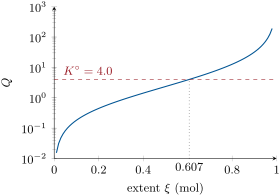
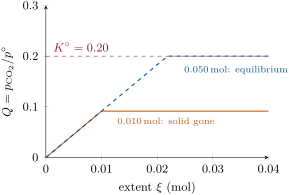
Left: the quotient of CO + H2O <=> CO2 + H2 rises with the extent and meets K once (weekend problem). Right: for CaCO3(s) <=> CaO(s) + CO2(g) in a closed 10\, L vessel, Q = p_ CO2/p grows with ; with 0.050\, mol of carbonate it reaches K = 0.20 (equilibrium), with 0.010\, mol the carbonate is exhausted first and the final state is not an equilibrium. Left: the quotient of CO + H2O <=> CO2 + H2 rises with the extent and meets K once (weekend problem). Right: for CaCO3(s) <=> CaO(s) + CO2(g) in a closed 10\, L vessel, Q = p_ CO2/p grows with ; with 0.050\, mol of carbonate it reaches K = 0.20 (equilibrium), with 0.010\, mol the carbonate is exhausted first and the final state is not an equilibrium.
Left: the quotient of CO+HX2O⇌COX2+HX2\ce{CO + H2O <=> CO2 + H2} rises with the extent and meets K∘K^\circ once (weekend problem). Right: for CaCOX3(s)⇌CaO(s)+COX2(g)\ce{CaCO3(s) <=> CaO(s) + CO2(g)} in a closed 10 L10\,\mathrm{L} vessel, Q=pCOX2/p∘Q = p_{\ce{CO2}}/p^\circ grows with ξ\xi; with 0.050 mol0.050\,\mathrm{mol} of carbonate it reaches K∘=0.20K^\circ = 0.20 (equilibrium), with 0.010 mol0.010\,\mathrm{mol} the carbonate is exhausted first and the final state is not an equilibrium.

Examples

Example 7.24 (A quantitative reaction)

For A+B⇌C+D\mathrm{A + B \rightleftharpoons C + D} in solution with [A]0=[B]0=0.10 mol/L[\ce{A}]_0 = [\ce{B}]_0 = 0.10\,\mathrm{mol}/\mathrm{L} and K∘=106K^\circ = 10^6: assuming total reaction, [C]=[D]=0.10[\ce{C}] = [\ce{D}] = 0.10; then 0.102/ε2=1060.10^2/\varepsilon^2 = 10^6 gives ε=1.0×10⁻⁴ mol/L\varepsilon = 1.0 \times 10^{-4}\,\mathrm{mol}/\mathrm{L}, 0.1 % of the initial amount: the hypothesis is justified.

Read in context →