University Chemistry — Year 1 · Bachelor Year 1
7Describing a Chemical System: Extent, Activities, Q and K
A hydrogen plant feeds natural gas and steam into tubes heated red-hot; what comes out is never pure hydrogen but a mixture of hydrogen, carbon monoxide, carbon dioxide, unreacted methane and steam, whose proportions the engineers must know before they design the next unit. Predicting the composition that leaves a reactor — the final state of a chemical system — is the subject of this chapter. It needs a precise description of the system (its variables and its composition), a single number that measures how far a reaction has gone (the extent), and the law that tells where the reaction stops (the equilibrium constant). These tools are used in every later chapter on solutions.
You already know
Book 1 (grade 10) followed a reaction with a progress table and found the limiting reactant; Book 1 (grade 12) introduced the reaction quotient and the equilibrium constant of a non-total reaction. From physics we use the perfect-gas law , with .
7.1 Describing a system
Definition 7.1 (System, phase)
A physico-chemical system is the matter contained in a chosen region of space, the rest being its surroundings. It is a closed system if it exchanges no matter with the surroundings (it may exchange energy). A phase is a part of the system in which the intensive variables vary continuously: a gas mixture is one phase, two immiscible liquids are two phases, each solid is a phase of its own.
Definition 7.2 (Intensive and extensive variables)
A variable of state is extensive if it is proportional to the size of the system (mass, volume, amount of substance) and intensive if it is not (temperature, pressure, concentration, density, mole fraction). The ratio of two extensive variables is intensive.
Definition 7.3 (Composition variables)
For a constituent of a phase containing the amounts of all its constituents:
- its mole fraction is , and its mass fraction ; both lie between 0 and 1 and sum to 1;
- in a solution of volume , its molar concentration is , in ;
- in a gas mixture at total pressure , its partial pressure is .
Proposition 7.4 (Partial pressures of perfect gases)
In a mixture of perfect gases of volume at temperature , the partial pressure of a constituent is the pressure it would exert alone in the whole volume, , and the partial pressures add up to the total pressure: .
Proof. For the mixture , so , and gives . ∎
Example 7.5 (Air)
Dry air contains, by volume (that is, by amount, for perfect gases), 78.08 % dinitrogen, 20.95 % dioxygen and 0.93 % argon. Under the partial pressure of dioxygen is ; on a mountain where the pressure is , it falls to , though the composition is the same.
7.2 Extent of reaction
Definition 7.6 (Stoichiometric numbers, extent)
A reaction is written , where the stoichiometric number of species is negative for a reactant and positive for a product: in , , , . In a closed system where this reaction alone takes place, the amounts change as
which defines the extent of reaction (in moles), zero at the start and the same for every species.
Definition 7.7 (Maximum extent, limiting reactant)
The maximum extent is the largest value of for which no amount is negative: . The reactant that reaches zero at is the limiting reactant. When the extent can also be negative (the reverse reaction), .
Method 7.8 (The progress table)
To follow a reaction in a closed system:
- write the balanced equation, and below it one column per species;
- first row: the initial amounts ;
- second row: the amounts at extent , ;
- for gases add a column with the total amount ;
- compute (and ) and identify the limiting reactant;
- last row: the final amounts, at the final extent (found from the equilibrium condition, or equal to if the reaction is total).
Example 7.9 (Synthesis of ammonia)
From of and of :
| total | ||||
|---|---|---|---|---|
| initial | 2.0 | 3.0 | 0 | 5.0 |
| extent |
: dihydrogen is limiting. If the reaction were total, the final state would hold and .
Definition 7.10 (Final fractional extent, yield)
The final fractional extent of a reaction is , between 0 and 1. In a synthesis, the yield of a product is the ratio of the amount obtained to the amount that the limiting reactant would give if the reaction were total; when the product is not lost during isolation, it equals .
7.3 Activities
Definition 7.11 (Standard state, activity)
The activity of a species is a dimensionless number that measures, in the expression of equilibrium laws, how much of it is available; it is defined relative to a standard state, a reference state at the temperature considered and under the standard pressure . In the ideal approximations used in this book:
- for a gas, (the standard state is the pure perfect gas at );
- for a solute in a dilute solution, with ;
- for the solvent of a dilute solution, and for a pure solid or a pure liquid alone in its phase, .
Remark 7.12 (Ideal and real)
These expressions hold for perfect gases and for dilute solutions. In concentrated solutions ions attract and repel one another and the activity departs from ; the corrections, written with activity coefficients, are studied in the Year 2 volume with the chemical potential. For the concentrations used in this book (below about ) the ideal expressions are accurate to a few per cent.
7.4 The reaction quotient and the equilibrium constant
Definition 7.13 (Reaction quotient)
The reaction quotient of a reaction in a given state of the system is
the product of the activities of the products divided by that of the reactants, each raised to the power of its stoichiometric coefficient.
Example 7.14 (Three quotients)
For : . For : , the solvent having activity 1. For : , the solids having activity 1.
Definition 7.15 (Standard equilibrium constant)
The standard equilibrium constant of a reaction is the value taken by its reaction quotient when the system is at equilibrium. It is dimensionless and depends only on the reaction and the temperature.
Theorem 7.16 (Law of mass action)
At a given temperature, a system in which a reaction can take place in both directions evolves until ; at equilibrium, whatever the initial composition,
Proof. Admitted at this level. ∎
Proposition 7.17 (Direction of evolution)
A system in which evolves in the forward direction ( increases); if , it evolves in the reverse direction; if , it is at equilibrium.
Proof. Admitted at this level. ∎
Remark 7.18 (Where these laws come from)
Both statements follow from the second law of thermodynamics, through the free energy of reaction and the chemical potentials of the species: they are derived in the Year 2 volume, which also gives from tables of thermodynamic data and explains how it changes with temperature. Here they are used as laws.

Proposition 7.19 (Combining constants)
If and are the constants of reactions (1) and (2): the reverse of (1) has the constant ; the reaction has ; the sum has .
Proof. The quotient of the reverse reaction is ; that of is ; that of the sum is . Writing these identities at equilibrium, where each quotient equals its constant, gives the result. ∎
Proposition 7.20 (One equilibrium state)
For a single reaction in a closed system at fixed temperature (and, for gases, fixed volume or pressure), the quotient is a strictly increasing function of on , going from 0 to when no species of constant activity is involved. The equation then has exactly one solution in this interval.
Proof. Take a solution reaction, . Its logarithmic derivative is
each term being positive where all amounts are. As a reactant amount tends to 0 in a denominator and ; as a product amount tends to 0 and . A continuous increasing function from 0 to takes the value once. (For gases at constant pressure, the total amount also varies; the result still holds, as can be checked in each case.) ∎
7.5 Final states
Definition 7.21 (Equilibrium state, quantitative reaction)
The final state is an equilibrium state when all the species of the reaction are present and . The reaction is quantitative (or total) when at the final state the limiting reactant has practically disappeared, ; this happens when is very large.
Method 7.22 (Finding the final state)
To find the final state of a single reaction:
- draw the progress table and compute (and );
- compute at the start and compare it with to find the direction;
- express with the activities and solve for in ;
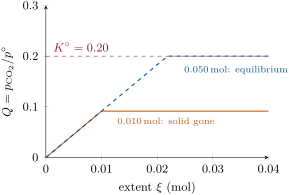
- if a species of activity 1 (a solid) is involved, check that it is still present at that extent: if it would have to become negative, it disappears first and the final state is not an equilibrium (, ).
Method 7.23 (The quantitative-reaction hypothesis)
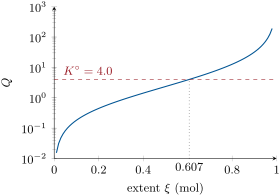
When is large (typically above ), assume the reaction total: set , compute the final amounts, then find the small amount of the limiting reactant left by writing with the other amounts unchanged. The hypothesis is accepted if is small compared with the other amounts (below about 1 %).
Example 7.24 (A quantitative reaction)
For in solution with and : assuming total reaction, ; then gives , 0.1 % of the initial amount: the hypothesis is justified.
Method 7.25 (Two simultaneous reactions)
When two reactions take place in the same system, give each its own extent, and ; every amount is , and the final state satisfies both and (a system of two equations). If one constant is much larger than the other, treat the corresponding reaction first as quantitative, then the second on the result.
History — The law of mass action, 1864
In 1864 the Norwegian chemist Cato Guldberg and his brother-in-law, the pharmacist Peter Waage, published in Norwegian their law of “active masses”: a reaction proceeds until the forces of the forward and reverse reactions balance, each proportional to the concentrations of its reactants. Their work went unnoticed abroad until they republished it in two more widely read languages, in 1867 and 1879; Jacobus van ’t Hoff, who had rediscovered the law, acknowledged their priority.
7.6 Exercises
Exercise 7.1 ★
Classify as intensive or extensive: temperature, volume, amount of substance, molar concentration, density, pressure, mass, mole fraction.
Solution
Solution of Exercise 7.1.
Intensive: temperature, molar concentration, density, pressure, mole fraction. Extensive: volume, amount of substance, mass.
Exercise 7.2 ★
Using the composition of dry air given in the chapter, compute the partial pressures of , and under a total pressure of .
Solution
Solution of Exercise 7.2.
, , .
Exercise 7.3 ★
Draw the progress table of from of and of . Find , the limiting reactant and the final state if the reaction is total.
Solution
Solution of Exercise 7.3.
, , . : dihydrogen is limiting. Final state: 0, , .
Exercise 7.4 ★
Write the reaction quotient of: (a) ; (b) ; (c) ; (d) .
Exercise 7.5 ★★
Reactions (1) and (2) have the constants and . Give the constants of , and .
Solution
Solution of Exercise 7.5.
is the sum: . : . : .
Exercise 7.6 ★★
A reaction has . In which direction does the system evolve if, initially, ? If ? If only reactants are present?
Solution
Solution of Exercise 7.6.
: forward. : reverse. Only reactants: , forward.
Exercise 7.7 ★★
The gas dissociates, , with at the temperature of the experiment. Starting from of under a total pressure kept at , write the progress table with the total amount, express and find the equilibrium extent.
Solution
Solution of Exercise 7.7.
, , total . With , . gives , .
Exercise 7.8 ★★
In solution, with and initial concentrations . Find the equilibrium concentrations and the final fractional extent.
Solution
Solution of Exercise 7.8.
With : , so and (the other root exceeds 0.10). , , .
Exercise 7.9 ★★
For from equal amounts of and , show that the final fractional extent is . What value of gives ?
Solution
Solution of Exercise 7.9.
From of each: , so and . requires , : about , the usual threshold for a quantitative reaction.
Exercise 7.10 ★★★
Calcium carbonate is heated at in a closed vessel of , initially empty of gas, for which for . Find the final state for and for of carbonate.
Solution
Solution of Exercise 7.10.
At equilibrium , that is . With of carbonate this cannot be reached: all of it decomposes, , , and the final state ( , , no ) is not an equilibrium. With : equilibrium, and , left.
Exercise 7.11 ★★★
A substance isomerises in solution in two ways, () and (). Starting from of alone, find the final amounts of the three isomers.
Solution
Solution of Exercise 7.11.
At equilibrium and (the volume cancels). Then : , , .
Exercise 7.12 ★★★
An acid and an alcohol give an ester and water, , all in one liquid phase, with (take the activities as the mole fractions; the total amount does not change). Compute the maximum yield of ester from of each reactant, then from of acid and of alcohol.
7.7 Problem: The Outlet of a Hydrogen Plant
Problem 7.1
Weekend problem — composition variables of a feed, steam reforming treated as total, the water–gas shift at equilibrium, and the hydrogen content of the gas leaving the plant
A hydrogen plant is fed with of methane and of steam (per unit of time) under . In the reformer, is assumed total. In the shift reactor, reaches equilibrium; take at its temperature. Molar masses: , .
Part I — The feed.
- Compute the mole fractions of methane and steam in the feed.
- Compute their partial pressures.
- Compute their mass fractions.
- Which of the quantities used so far are intensive?
- Give the activities of methane and steam in the feed.
Part II — Reforming.
- Draw the progress table of the reforming reaction.
- Compute and name the limiting reactant.
- Give the amounts leaving the reformer.
- Compute the total amount of gas, and compare it with the feed.
- Compute the mole fractions leaving the reformer.
- Why is steam fed in excess?
Part III — The shift reactor.
- Draw the progress table of the shift reaction, starting from the gas leaving the reformer.
- Show that , and that it does not depend on the pressure.
- Compute at the inlet and predict the direction of evolution.
- Write the equation for the equilibrium extent and solve it, keeping the root that makes sense.
- Give the amounts leaving the shift reactor.
- Compute the final fractional extent of the shift reaction.
- With twice as much steam in the feed (), the gas enters the shift reactor with of steam: compute the new equilibrium extent.
Part IV — What leaves the plant.
- What value of would be needed to convert 99 % of the carbon monoxide in the first case?
- Explain why a shift reactor converts more when it runs at a temperature where its constant is larger, and why plants use two shift reactors in series.
- The steam is condensed out of the gas leaving the shift reactor. Compute the mole fraction of hydrogen in the dry gas.
- List the impurities that remain and their amounts.
- Compute the mole fraction of hydrogen in the gas leaving the shift reactor, steam included.
Solution
Solution of Problem 7.1.
1. ; . 2. and . 3. Masses 16.04 and : , . 4. Mole fractions, mass fractions, partial pressures (and the total pressure); the amounts are extensive. 5. : 7.5 for methane, 22.5 for steam. 6. , , , , total . 7. ; methane is limiting. 8. 0, , , . 9. , against in the feed: the reaction makes four molecules from two. 10. 0.333, 0.167, 0.500. 11. To make sure all the methane reacts and to leave steam for the shift reaction, whose quotient it lowers. 12. , , , , total 6.00 at every extent. 13. with : the factors cancel between numerator and denominator (two gas molecules on each side), leaving the expression given. 14. : , forward. 15. , that is : ; the other root, 4.39, exceeds . 16. , , , . 17. . 18. , , : more steam, more conversion. 19. . 20. is increasing, so a larger is met at a larger extent. The constant of this reaction is larger at lower temperature, where the reaction is slow: a first reactor works hot and fast, a second cooler one finishes the conversion (the temperature dependence of is treated in the Year 2 volume). 21. . 22. of and of . 23. : six molecules in ten leaving the shift reactor are hydrogen.