
All books

Professional

Apps About Coach Log in Start reading

Chemistry · Glossary

What is Felkin–Anh model and chelation control?

Also known as: Felkin--Anh model · chelation control

Definition 28.9 University Chemistry — Year 3 · Chapter 28 — Asymmetric Synthesis

The Felkin–Anh model predicts the major diastereomer of a nucleophilic addition to a carbonyl group next to a stereocentre: the largest group on that centre lies perpendicular to the carbonyl plane, and the nucleophile approaches anti to it, past the smallest group, along the Bürgi–Dunitz trajectory. Under chelation control, a metal ion bound to both the carbonyl oxygen and a donor group on the stereocentre locks the conformation, and the nucleophile adds to the less hindered face of the chelate ring.
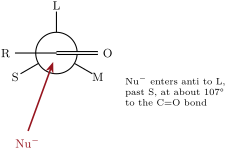
Felkin–Anh model, seen along the bond from the carbonyl carbon (front, bonds to O and R) to the stereocentre (back circle, groups L, M and S). The large group is perpendicular to the carbonyl plane; the nucleophile comes from the opposite side, close to the small group and away from the oxygen.
Read in context →