University Chemistry — Year 3 · Bachelor Year 3
28Asymmetric Synthesis
L-DOPA, the drug that eases the symptoms of Parkinson’s disease, was in the 1970s the first compound made industrially by asymmetric catalysis: a few grams of a chiral rhodium complex, dissolved with a flat, achiral precursor under hydrogen, gave a product in which one enantiomer far outnumbered the other. The two enantiomers of a drug can differ completely in their effects, because the receptors and enzymes they meet are themselves chiral. This chapter measures enantiopurity, explains how a chiral environment chooses between two mirror-image paths, and goes through the strategies (chiral pool, auxiliaries, resolutions, metal and organic catalysts) that make single enantiomers.
You already know
The Year 1 volume defined chirality, enantiomers, diastereomers, racemic mixtures, specific rotation, the CIP rules and stereoselective and stereospecific reactions; the Year 2 volume catalytic hydrogenation, epoxidation, dihydroxylation, imines, enamines, enolates, the aldol reaction, the Robinson annulation and chromatography. Chapter 12 gave the Eyring equation, Chapter 21 Wilkinson’s cycle, and Chapter 4 the axis.
28.1 Measuring enantiopurity
Definition 28.1 (Enantiomeric excess)
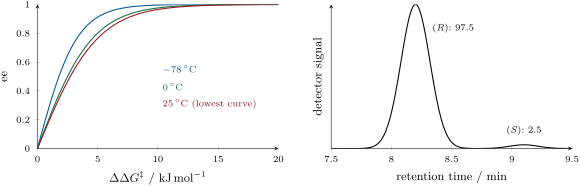
For a mixture of enantiomers in amounts , the enantiomeric excess is and the enantiomeric ratio ; for diastereomers, the diastereomeric excess de is defined in the same way. The optical purity is the ratio of the specific rotation of a sample to that of the pure enantiomer.
Proposition 28.2 (ee and er)
and .
Proof. Divide numerator and denominator of by ; solving for er gives the second form. ∎
An ee of 90 % is an er of 95 : 5, an ee of 98 % an er of 99 : 1. Optical purity equals ee only if rotation is proportional to composition; impurities, the solvent, concentration effects and the small rotations of many compounds make it unreliable, and ee is measured by separating the enantiomers.
Method 28.3 (ee from a chiral chromatogram)
- Inject the racemate first, to identify the two peaks and check their separation (baseline resolution) and equal areas.
- Inject the sample and integrate both peaks.
- The enantiomers have the same response in an achiral detector, so ; assign the peaks with an enantiopure standard.
NMR distinguishes enantiomers only in a chiral environment: a chiral solvating agent makes short-lived diastereomeric complexes whose signals differ, and a chiral alcohol or amine converted into its two diastereomeric esters with Mosher’s acid shows the configuration from the pattern of shift differences.
Method 28.4 (Configuration from Mosher esters, in outline)
- Make both the (R)- and the (S)-MTPA esters of the alcohol.
- Record their proton spectra and compute for the protons on each side of the carbinol carbon.
- In the preferred conformation the phenyl ring of the acid shields one side: protons with lie on one side, those with on the other, which places the two substituents and gives the configuration.
28.2 Topicity and stereoselective additions
Definition 28.5 (Stereoselective reactions)
An enantioselective reaction forms one enantiomer of a product in excess over the other; a diastereoselective reaction forms one diastereomer in excess.
Definition 28.6 (Topicity)
Two groups of a molecule are homotopic when exchanged by a rotation of the molecule (replacing either gives the same compound), enantiotopic when exchanged only by a reflection (replacing one or the other gives enantiomers), and diastereotopic when no symmetry operation exchanges them (replacing one or the other gives diastereomers).
The two hydrogens of a group next to a stereocentre are diastereotopic: they have different chemical shifts and couple to each other, which is why such a group often shows as two signals in NMR.
Definition 28.7 (Prochiral faces)
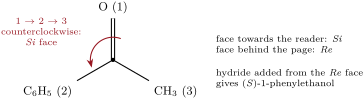
A trigonal carbon with three different substituents is prochiral: addition of a fourth, different group creates a stereocentre. Its face seen with the three substituents in decreasing CIP priority running clockwise is the Re face; counterclockwise, the Si face.
Method 28.8 (Assigning Re and Si faces)
- Rank the three substituents of the trigonal atom by the CIP rules (a double bond counts its partner twice).
- Look at the face of interest, the trigonal plane in the plane of the page.
- Clockwise 1 2 3: Re; counterclockwise: Si.
- To name the product, add the new group towards the viewer and apply the CIP rules to the new stereocentre; Re attack does not always give R.
Definition 28.9 (Felkin–Anh model and chelation control)
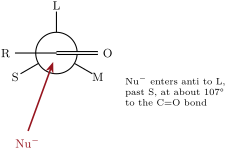
The Felkin–Anh model predicts the major diastereomer of a nucleophilic addition to a carbonyl group next to a stereocentre: the largest group on that centre lies perpendicular to the carbonyl plane, and the nucleophile approaches anti to it, past the smallest group, along the Bürgi–Dunitz trajectory. Under chelation control, a metal ion bound to both the carbonyl oxygen and a donor group on the stereocentre locks the conformation, and the nucleophile adds to the less hindered face of the chelate ring.
Proposition 28.10 (Felkin–Anh selectivity)
For an -chiral aldehyde or ketone without a chelating group, the major product is the one predicted by the Felkin–Anh model (an empirical model, supported by calculation).
Proof. Admitted at this level. ∎
28.3 Strategies
Definition 28.11 (Chiral pool)
The chiral pool is the set of cheap, enantiopure natural compounds (amino acids, sugars, terpenes, hydroxy acids) used as starting materials, their stereocentres carried into the target.
Definition 28.12 (Chiral auxiliary)
A chiral auxiliary is an enantiopure group attached temporarily to a substrate to control the stereochemistry of a reaction, then removed and recovered.
In Evans alkylations, an oxazolidinone made from an amino acid is acylated; the lithium or sodium enolate, chelated to the auxiliary’s carbonyl group, is attacked by an alkyl halide on the face away from the auxiliary’s substituent, giving one diastereomer, often with de above 95 %; hydrolysis then frees the chiral acid and the auxiliary.
Definition 28.13 (Resolutions)
The resolution of a racemate is its separation into enantiomers, classically by crystallising diastereomeric salts with an enantiopure acid or base. In a kinetic resolution the two enantiomers react at different rates with a chiral reagent or catalyst, with selectivity . In a dynamic kinetic resolution the substrate enantiomers interconvert fast while one of them reacts.
Theorem 28.14 (Kagan equation)
In a kinetic resolution of a racemate by first-order reactions of selectivity , the conversion and the ee of the remaining substrate are related by
Proof. Each enantiomer decays exponentially: the fractions left are and , so . Starting from equal amounts, and . Then and likewise . Hence is the stated ratio. ∎
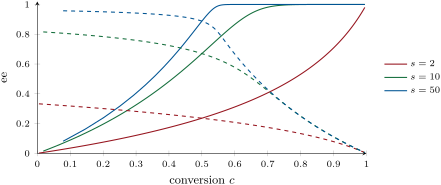
Proposition 28.15 (Dynamic kinetic resolution)
If the substrate enantiomers interconvert much faster than either reacts, the whole racemate can be converted into one product enantiomer, with ee set by : .
Proof. Fast racemisation keeps the two substrate enantiomers in equal amounts at all times. The products then form at rates in the ratio , and nothing stops the reaction before all the substrate, through the fast enantiomer mostly, is consumed: the yield can reach 100 % with . ∎
Method 28.16 (Choosing a strategy)
- If the target’s stereocentres exist in a cheap natural compound, start from the chiral pool.
- For a one-off synthesis, or to set a centre reliably next to a carbonyl group, use an auxiliary, at the cost of two extra steps.
- If the racemate is cheap and the unwanted enantiomer can be recycled or racemised, resolve it (classically, kinetically or dynamically).
- For large scale, look for an asymmetric catalyst: one stereocentre made per catalytic turnover, no stoichiometric chiral waste.
28.4 Asymmetric catalysis with metals
Definition 28.17 (Asymmetric catalysis)
Asymmetric catalysis is enantioselective synthesis with a chiral catalyst used in small amount; for metal catalysts, the chirality usually comes from a chiral ligand.
Theorem 28.18 (Selectivity from energy)
If two enantiomeric products are formed through diastereomeric transition states with equal pre-exponential factors, irreversibly, under kinetic control, , where is the difference of their Gibbs energies of activation.
Proof. By the Eyring equation (Chapter 12), ; both products form from the same reactants, so at every moment their rates are in the ratio , and so are the amounts formed. ∎
At an ee of 99 % (er 199) needs , about the energy of a single hydrogen bond; at , suffices.
Proposition 28.19 (-symmetric ligands)
A -symmetric chiral ligand halves the number of diastereomeric transition states to be compared, since the two coordination sites it leaves are equivalent.
Proof. The rotation of the catalyst maps one free site onto the other and leaves the catalyst unchanged; any transition state at one site is therefore identical to the rotated one at the other. Only the binding modes at one site (substrate face, orientation) need to be compared. ∎
Knowles used chiral monophosphines, then the -symmetric diphosphine DIPAMP, with rhodium to hydrogenate an enamide to the protected amino acid of L-DOPA; Noyori’s BINAP, with ruthenium, hydrogenates ketones and functionalised alkenes, and, combined with a chiral diamine, simple ketones with very high ee. In the rhodium enamide hydrogenation the major product comes from the less stable, minor catalyst–substrate complex, which reacts much faster with hydrogen: the selectivity is set at the transition states, not by the populations of the intermediates (the Curtin–Hammett principle).
Definition 28.20 (Sharpless epoxidation)
The Sharpless epoxidation is the enantioselective epoxidation of allylic alcohols by tert-butyl hydroperoxide, catalysed by titanium(IV) isopropoxide with an enantiopure diethyl tartrate; the alcohol binds to titanium, which delivers the oxygen to one face of the alkene, chosen by the tartrate.
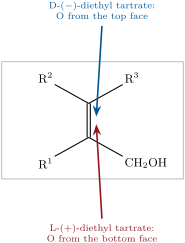
The same idea, a metal held in a chiral pocket by a cheap natural ligand, gives Sharpless’s asymmetric dihydroxylation of alkenes with osmium and cinchona alkaloid ligands. When the ligand is not enantiopure, the ee of the product need not be proportional to that of the ligand: aggregates of two ligands, with different activities for homochiral and heterochiral pairs, give non-linear effects, sometimes useful amplifications.
28.5 Organocatalysis
Definition 28.21 (Organocatalysis)
Organocatalysis is catalysis by small organic molecules without metals. In enamine catalysis a secondary amine turns a ketone or aldehyde into a nucleophilic enamine; in iminium catalysis it turns an -unsaturated aldehyde into an electrophilic iminium ion with a lowered LUMO.
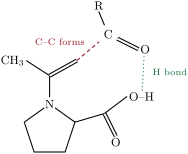
Proline, a cheap amino acid, catalyses intramolecular aldol reactions of triketones with high ee (the Hajos–Parrish and Wieland–Miescher ketones, used since the 1970s for steroid syntheses) and, as shown in 2000, intermolecular aldol reactions of acetone with aldehydes. Chiral imidazolidinones work through iminium ions in Diels–Alder reactions and conjugate additions; chiral phosphoric acids, strong Brønsted acids with a chiral pocket, activate imines by protonation. Organocatalysts are stable to air and water and leave no metal in the product.
In the lab — A chiral HPLC analysis
A chiral column, silica coated with a cellulose or amylose derivative, is equilibrated with a hexane–isopropanol mixture. The racemate is injected first and the solvent ratio adjusted until the two peaks are baseline-separated; then the sample, dissolved in the eluent at about a milligram per millilitre, is injected, and the peaks integrated at a wavelength where both absorb.
Safety


tert-Butyl hydroperoxide: flammable, self-reactive on heating, toxic in contact with skin, corrosive, sensitising, suspected of causing genetic defects; it is used as a solution, kept cool, never concentrated, and excess peroxide is destroyed before work-up. Titanium(IV) isopropoxide: flammable, irritant, decomposed by moisture.
History — Two prizes for asymmetric catalysis
William Knowles, Ryoji Noyori and Barry Sharpless shared the 2001 Nobel Prize in Chemistry for chirally catalysed hydrogenations and oxidations. Benjamin List and David MacMillan, who had shown in 2000 that small organic molecules could catalyse enantioselective reactions as broadly as metal complexes, received the 2021 prize.
28.6 Exercises
Exercise 28.1 ★
Convert: ee 80 % to er; er 99 : 1 to ee; ee 50 % to the percentage of each enantiomer.
Solution
Solution of Exercise 28.1.
ee 80 %: (90 : 10). er 99 : 1: %. ee 50 %: 75 % and 25 %.
Exercise 28.2 ★
A chiral HPLC trace shows peaks of areas 1840 and 60 for the two enantiomers. Compute the ee.
Solution
Solution of Exercise 28.2.
: ee 93.7 %, an er of .
Exercise 28.3 ★
Assign the Re and Si faces of propanal’s carbonyl carbon, and name the alcohol formed by addition of a methyl nucleophile to the Re face.
Solution
Solution of Exercise 28.3.
Priorities O ethyl H. Drawn with O up, ethyl lower left and H lower right, the front face is Si, the back face Re. A methyl group added from the Re face, with priorities OH ethyl methyl H in the product, gives (R)-butan-2-ol.
Exercise 28.4 ★
Are the two methylene protons of ethanol homotopic, enantiotopic or diastereotopic? And those of the group of 2-butanol?
Solution
Solution of Exercise 28.4.
Ethanol: enantiotopic (exchanged by the mirror plane of the molecule; same shift in an achiral solvent). Butan-2-ol: diastereotopic (next to a stereocentre; different shifts).
Exercise 28.5 ★★
Compute the needed for 99 % ee at and at , and the ee given at by a catalyst that gives 80 % ee at (same ).
Solution
Solution of Exercise 28.5.
er 199: at , at . 80 % ee at is er 9, ; at , , ee 93 %.
Exercise 28.6 ★★
A sample of an amine has under conditions where the pure (S) enantiomer has (data of the exercise). Give its optical purity and the percentages of the enantiomers, assuming rotation proportional to composition. Why is this measurement less reliable than chromatography?
Solution
Solution of Exercise 28.6.
Optical purity %: 90 % (S) and 10 % (R). A small rotation, impurities, concentration and solvent effects, and non-linear rotation–composition behaviour make it unreliable; chromatography separates and counts the enantiomers directly.
Exercise 28.7 ★★
In a lipase-catalysed acetylation of a racemic alcohol, the remaining alcohol has 90 % ee at 60 % conversion. Compute .
Solution
Solution of Exercise 28.7.
.
Exercise 28.8 ★★
Predict the epoxide formed from (E)-hex-2-en-1-ol with L-()-diethyl tartrate, and with D-()-diethyl tartrate.
Solution
Solution of Exercise 28.8.
With L-()-diethyl tartrate, (2S,3S)-2,3-epoxyhexan-1-ol; with D-()-diethyl tartrate, the enantiomer, (2R,3R).
Exercise 28.9 ★★
(S)-2-phenylpropanal is treated with methylmagnesium bromide. Use the Felkin–Anh model to predict the major diastereomer.
Solution
Solution of Exercise 28.9.
L = phenyl, M = methyl, S = H. For the (S) aldehyde the reactive conformer has phenyl perpendicular to the carbonyl plane and the hydrogen beside the path of the nucleophile, which attacks anti to phenyl. Working out the configurations gives (2S,3S)-3-phenylbutan-2-ol as the major diastereomer.
Exercise 28.10 ★★★
Show that in a kinetic resolution the product ee tends to at low conversion, and compute it for . Why is a kinetic resolution better at purifying the substrate than at making the product?
Solution
Solution of Exercise 28.10.
At the start the two enantiomers are present in equal amounts, so the products form in the ratio : , 0.905 for . As the reaction goes on the fast enantiomer is depleted and the product ee falls, while the substrate ee rises towards 1: the substrate can always be purified by going further; the product cannot.
Exercise 28.11 ★★★
A ketone with a racemisable stereocentre next to the carbonyl group is reduced by an enzyme with , while racemisation is fast. What yield and ee can be reached? Compare with the same enzyme without racemisation, stopped at 50 % conversion.
Solution
Solution of Exercise 28.11.
With fast racemisation: up to 100 % yield, , ee 98 %. Without it, at 50 % conversion: yield at most 50 %, and a product ee of 93 % (the substrate’s ee is the same, 93 %).
Exercise 28.12 ★★★
Explain with the Curtin–Hammett principle how the minor catalyst–substrate complex can give the major product, using two complexes in equilibrium ( in favour of A) that react with .
Solution
Solution of Exercise 28.12.
When the two complexes interconvert faster than they react, the product ratio is : the minor complex B gives 98 % of the product (ee 97 %). The selectivity is set by the difference between the two transition states, not by the populations of the intermediates.
28.7 Problem: The L-DOPA Route
Problem 28.1
Weekend problem — the L-DOPA route: the prochiral enamide and its faces, the energy behind 95 % ee, purification by crystallisation, and what a kinetic resolution would have needed
Data of the problem: the rhodium-catalysed hydrogenation of the enamide precursor at gives the protected (S)-amino acid with 95 % ee. The crude product, 100 g, is recrystallised: the mother liquor retains all of the minor enantiomer and 5.0 g of the major one.
Part I — The substrate.
- Why is the enamide prochiral? Which carbon becomes a stereocentre?
- What would an achiral catalyst give?
- Why does the amide group on the alkene matter for the catalyst?
- What does the chiral diphosphine do?
- Is the major product formed from the more stable catalyst–substrate complex?
- Why is hydrogen added to one face only in each complex?
Part II — Energy.
- Give the er for 95 % ee.
- Compute at .
- What ee would the same give at ?
- What ee would a larger by give at ?
- Compare with the energy of a hydrogen bond, and comment.
- Why is the reaction not simply run colder?
Part III — Crystallisation.
- Compute the masses of the two enantiomers in the crude product.
- Compute the mass and ee of the crystals.
- Compute the yield of the crystallisation.
- Why can crystallisation raise the ee of a sample but never create it from a racemate (for a compound that crystallises as a racemic compound)?
- How is the final ee checked?
Part IV — A kinetic resolution instead.
- What is the maximum yield of one enantiomer by a simple kinetic resolution?
- Compute the needed for 95 % ee of the remaining substrate at 55 % conversion.
- What yield of that substrate is obtained?
- How would a dynamic kinetic resolution change the yield?
- Why was asymmetric hydrogenation the better industrial choice?
- Why must the rhodium be removed from the drug, and how is it measured?
- State the result: the for 95 % ee at .
Solution
Solution of Problem 28.1.
1. The alkene carbon bearing the nitrogen has three different substituents and two different faces; hydrogen added to it makes the -carbon of the amino acid a stereocentre.
2. The racemate: both faces are attacked at the same rate.
3. Its carbonyl oxygen binds the rhodium with the C=C bond: the substrate is held as a chelate, in a fixed geometry that the ligand can discriminate.
4. It builds a chiral pocket around the metal (-symmetric): the two ways of binding the substrate, by one face or the other, are diastereomeric, with different energies and reactivities.
5. No: the minor complex reacts much faster with hydrogen (Curtin–Hammett).
6. The metal is on one face of the bound alkene, and the hydrogens are transferred from the metal.
7. .
8. .
9. : ee 99.3 %.
10. : ee 97.7 %.
11. Less than a typical hydrogen bond: a small difference in the steric contacts or one weak interaction between substrate and ligand decides the outcome, which is why such catalysts are hard to design from first principles.
12. The rate falls, hydrogen dissolves and the catalyst behaves differently at low temperature, and cooling a large reactor costs energy.
13. 97.5 g of the (S) and 2.5 g of the (R) enantiomer.
14. of crystals, practically enantiopure.
15. % of the crude (95 % of the (S) enantiomer).
16. The crystals take the excess enantiomer, the racemic part staying in solution with the minor one; from a racemate there is no excess to collect, and crystallisation gives racemic crystals.
17. By chiral HPLC against a racemic reference.
18. 50 %: only the slow enantiomer survives.
19. .
20. 45 % of the racemate (88 % of the desired enantiomer present at the start, at 95 % ee).
21. With fast racemisation of the substrate the yield could approach 100 %.
22. It converts all of the cheap achiral precursor into the right enantiomer, with a catalyst used in tiny amounts and no enantiomer thrown away.
23. Rhodium is toxic and its residues in drugs are limited to a few parts per million; they are measured by inductively coupled plasma mass spectrometry.
24. 95 % ee at corresponds to .