
All books

Professional

Apps About Coach Log in Start reading

Chemistry · Glossary

What is Fluorescence quencher, dynamic and static quenching?

Also known as: fluorescence quencher · dynamic quenching · static quenching

Definition 7.19 University Chemistry — Year 3 · Chapter 7 — Electronic Spectroscopy and Photophysics

A fluorescence quencher is a species that reduces fluorescence. In dynamic quenching it deactivates the excited molecule on collision, adding a rate kq[Q]k_q[Q] and shortening the lifetime; in static quenching it forms a non-fluorescent complex with the ground-state molecule, reducing the intensity without changing the lifetime of the molecules that still emit.
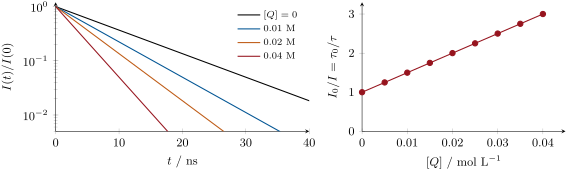
Dynamic quenching of a model fluorophore (_0 = 10\, ns, k_q = 5 × 10⁹\, L\, mol-1\, s-1). Left: fluorescence decays, straight lines on a log scale, steeper with more quencher. Right: the Stern–Volmer line, of slope K_SV = k_q _0 = 50\, L/ mol.
Dynamic quenching of a model fluorophore (τ0=10 ns\tau_0 = 10\,\mathrm{ns}, kq=5×10⁹ L mol−1 s−1k_q = 5 \times 10^{9}\,\mathrm{L}\,\mathrm{mol}^{-1}\,\mathrm{s}^{-1}). Left: fluorescence decays, straight lines on a log scale, steeper with more quencher. Right: the Stern–Volmer line, of slope KSV=kqτ0=50 L/molK_{SV} = k_q\tau_0 = 50\,\mathrm{L}/\mathrm{mol}.

Examples

Example 7.23 (Quinine and anthracene)

Quinine sulfate in 0.5 M0.5\,\mathrm{M} sulfuric acid absorbs at 349 nm349\,\mathrm{nm} with ε=5700 L mol−1 cm−1\varepsilon = 5700\,\mathrm{L}\,\mathrm{mol}^{-1}\,\mathrm{cm}^{-1} and fluoresces with ΦF=0.546\Phi_F = 0.546, which makes it the classic standard for relative quantum yields. Anthracene in cyclohexane absorbs at 356 nm356\,\mathrm{nm} and has ΦF=0.36\Phi_F = 0.36; most of the rest of its excited molecules cross to the triplet.

Read in context →