
সব বই

পেশাদার

1 Markets I: The Ecosystem and Exchange-Traded Marketsবাজার অনলাইন 2 Markets II: Rates, FX and Creditবাজার অনলাইন 3 Markets III: Commodities, Energy and Cryptoবাজার অনলাইন 4 Quantitative Methodsপদ্ধতি অনলাইন 5 Derivatives and Volatilityডেরিভেটিভস অনলাইন 6 Rates, Credit, XVA and Riskসুদহার, ঋণ ও ঝুঁকি অনলাইন 7 Research Craft: Predictors, Backtests, Measurement, Portfoliosগবেষণা অনলাইন 8 Strategies I: Equities and Futuresকৌশল অনলাইন 9 Strategies II: Volatility, Relative Value, Macro and the Bank Desksকৌশল অনলাইন 10 Microstructure and Executionএক্সিকিউশন অনলাইন 11 Market Making and High-Frequency Tradingমার্কেট মেকিং অনলাইন 12 Machine Learning for Marketsমেশিন লার্নিং অনলাইন 13 Low-Latency Softwareপ্রযুক্তি অনলাইন 14 Networks, Hardware and Trading Infrastructureপ্রযুক্তি অনলাইন 15 Research, Data and Risk Platformsপ্রযুক্তি অনলাইন 16 The Desk and the Firmপ্রতিষ্ঠান অনলাইন 17 The Industry: Firms, Roles and Careersক্যারিয়ার অনলাইন 18 Interviews I: Maths, Probability and Speedক্যারিয়ার অনলাইন 19 Interviews II: Markets, Trading Games and the Final Roundক্যারিয়ার অনলাইন 20 Interviews III: Codeক্যারিয়ার অনলাইন
অ্যাপ পরিচিতি Coach সাইন ইন পড়া শুরু করো

বইগুলো এখনো বাংলা ভাষায় পাওয়া যায় না — ইংরেজি সংস্করণ দেখানো হচ্ছে।

Chemistry · পরিভাষা

Fluorescence quencher, dynamic and static quenching কী?

অন্য নাম: fluorescence quencher · dynamic quenching · static quenching

Definition 7.19 University Chemistry — Year 3 · অধ্যায় 7 — Electronic Spectroscopy and Photophysics

A fluorescence quencher is a species that reduces fluorescence. In dynamic quenching it deactivates the excited molecule on collision, adding a rate kq[Q]k_q[Q] and shortening the lifetime; in static quenching it forms a non-fluorescent complex with the ground-state molecule, reducing the intensity without changing the lifetime of the molecules that still emit.
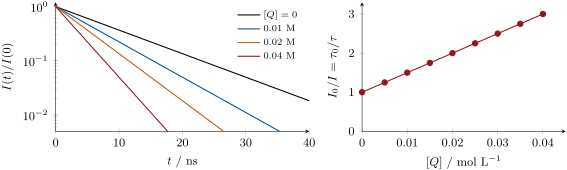
Dynamic quenching of a model fluorophore (_0 = 10\, ns, k_q = 5 × 10⁹\, L\, mol-1\, s-1). Left: fluorescence decays, straight lines on a log scale, steeper with more quencher. Right: the Stern–Volmer line, of slope K_SV = k_q _0 = 50\, L/ mol.
Dynamic quenching of a model fluorophore (τ0=10 ns\tau_0 = 10\,\mathrm{ns}, kq=5×10⁹ L mol−1 s−1k_q = 5 \times 10^{9}\,\mathrm{L}\,\mathrm{mol}^{-1}\,\mathrm{s}^{-1}). Left: fluorescence decays, straight lines on a log scale, steeper with more quencher. Right: the Stern–Volmer line, of slope KSV=kqτ0=50 L/molK_{SV} = k_q\tau_0 = 50\,\mathrm{L}/\mathrm{mol}.

উদাহরণ

Example 7.23 (Quinine and anthracene)

Quinine sulfate in 0.5 M0.5\,\mathrm{M} sulfuric acid absorbs at 349 nm349\,\mathrm{nm} with ε=5700 L mol−1 cm−1\varepsilon = 5700\,\mathrm{L}\,\mathrm{mol}^{-1}\,\mathrm{cm}^{-1} and fluoresces with ΦF=0.546\Phi_F = 0.546, which makes it the classic standard for relative quantum yields. Anthracene in cyclohexane absorbs at 356 nm356\,\mathrm{nm} and has ΦF=0.36\Phi_F = 0.36; most of the rest of its excited molecules cross to the triplet.

প্রসঙ্গসহ পড়ো →