
All books

Professional

Apps About Coach Log in Start reading

Chemistry · Glossary

What is Miscibility gap?

Also known as: heteroazeotrope

Definition 7.17 University Chemistry — Year 2 · Chapter 7 — Binary Liquid–Vapour Diagrams and Distillation

A miscibility gap is the range of overall compositions over which two liquids, at a given temperature, separate into two liquid layers, each saturated with the other component. A heteroazeotrope is the boiling point of such a two-layer liquid: the two liquid layers and the vapour coexist at a fixed temperature and with a fixed vapour composition.
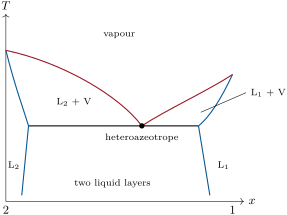
Schematic isobaric diagram of two partly miscible liquids. Below the heteroazeotrope temperature the liquid splits into two layers L_1 and L_2 over a wide range of compositions (the miscibility gap); on the horizontal line the two layers boil together into a vapour of fixed composition (dot).
Schematic isobaric diagram of two partly miscible liquids. Below the heteroazeotrope temperature the liquid splits into two layers L1_1 and L2_2 over a wide range of compositions (the miscibility gap); on the horizontal line the two layers boil together into a vapour of fixed composition (dot).
Read in context →