All books

Professional

Apps About Coach Log in Start reading

Chemistry · Glossary

What is Norrish reactions?

Also known as: Norrish type I reaction · Norrish type II reaction

Definition 14.9 University Chemistry — Year 3 · Chapter 14 — Photochemistry

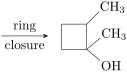
A Norrish type I reaction is the cleavage, by an excited ketone, of the bond between the carbonyl carbon and an α\alpha carbon, into an acyl and an alkyl radical. A Norrish type II reaction is the abstraction, by the oxygen of an excited ketone, of a hydrogen atom from the γ\gamma carbon, giving a 1,4-biradical that either cleaves into an enol and an alkene or closes into a cyclobutanol.


The Norrish type II reaction of hexan-2-one. The triplet ketone abstracts a hydrogen from the  carbon through a six-membered arrangement; the 1,4-biradical cleaves into the enol of acetone (which tautomerises to acetone) and propene, or closes into 1,2-dimethylcyclobutan-1-ol. The Norrish type II reaction of hexan-2-one. The triplet ketone abstracts a hydrogen from the  carbon through a six-membered arrangement; the 1,4-biradical cleaves into the enol of acetone (which tautomerises to acetone) and propene, or closes into 1,2-dimethylcyclobutan-1-ol. The Norrish type II reaction of hexan-2-one. The triplet ketone abstracts a hydrogen from the  carbon through a six-membered arrangement; the 1,4-biradical cleaves into the enol of acetone (which tautomerises to acetone) and propene, or closes into 1,2-dimethylcyclobutan-1-ol.
The Norrish type II reaction of hexan-2-one. The triplet ketone abstracts a hydrogen from the γ\gamma carbon through a six-membered arrangement; the 1,4-biradical cleaves into the enol of acetone (which tautomerises to acetone) and propene, or closes into 1,2-dimethylcyclobutan-1-ol.
Read in context →