
All books

Professional

Apps About Coach Log in Start reading

Chemistry · Glossary

What is Organocatalysis?

Also known as: enamine catalysis · iminium catalysis

Definition 28.21 University Chemistry — Year 3 · Chapter 28 — Asymmetric Synthesis

Organocatalysis is catalysis by small organic molecules without metals. In enamine catalysis a secondary amine turns a ketone or aldehyde into a nucleophilic enamine; in iminium catalysis it turns an α,β\alpha,\beta-unsaturated aldehyde into an electrophilic iminium ion with a lowered LUMO.
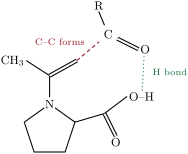
The proline-catalysed aldol reaction, schematic transition state: the enamine formed from acetone and the pyrrolidine nitrogen attacks the aldehyde, whose oxygen is held by a hydrogen bond to the carboxylic acid of the catalyst; that bond fixes which face of the aldehyde is attacked.
Read in context →