
All books

Professional

Apps About Coach Log in Start reading

Chemistry · Glossary

What is P, Q and R branches, band origin?

Also known as: P branch · R branch · Q branch · band origin

Definition 6.15 University Chemistry — Year 3 · Chapter 6 — Rotational and Vibrational Spectroscopy

In a rovibrational band, the lines with ΔJ=−1\Delta J = -1 form the P branch, those with ΔJ=+1\Delta J = +1 the R branch, and those with ΔJ=0\Delta J = 0, when allowed, the Q branch. The band origin ν~0\tilde\nu_0 is the vibrational energy difference without rotation.
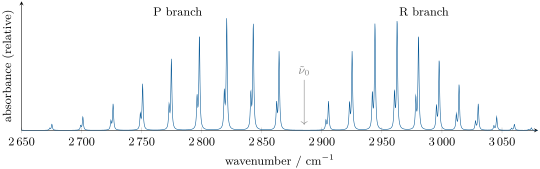
The fundamental band of gaseous HCl at 300\, K, computed from its spectroscopic constants: P and R branches either side of the gap at the band origin. Each line is a doublet, H35Cl and the weaker, slightly lower H37Cl (natural abundances 76 % and 24 %). The R lines close up, the P lines spread out, because B_1 < B_0.
The fundamental band of gaseous HCl\ce{HCl} at 300 K300\,\mathrm{K}, computed from its spectroscopic constants: P and R branches either side of the gap at the band origin. Each line is a doublet, HX35X2235Cl\ce{H^{35}Cl} and the weaker, slightly lower HX37X2237Cl\ce{H^{37}Cl} (natural abundances 76 % and 24 %). The R lines close up, the P lines spread out, because B1<B0B_1 < B_0.

Examples

Example 6.18 (The constants of HCl\ce{HCl} from its band)

With R(0)=2905.58 cm−1R(0) = 2905.58\,\mathrm{cm}^{-1} and P(2)=2842.94 cm−1P(2) = 2842.94\,\mathrm{cm}^{-1}, one finds 6B0=62.64 cm−16B_0 = 62.64\,\mathrm{cm}^{-1}, so B0=10.440 cm−1B_0 = 10.440\,\mathrm{cm}^{-1}. With R(1)=2925.23R(1) = 2925.23 and P(1)=2864.43 cm−1P(1) = 2864.43\,\mathrm{cm}^{-1}, B1=10.133 cm−1B_1 = 10.133\,\mathrm{cm}^{-1}. So αe=0.307 cm−1\alpha_e = 0.307\,\mathrm{cm}^{-1} and Be=10.593 cm−1B_e = 10.593\,\mathrm{cm}^{-1}, the values the band was built from: the method recovers them exactly.

Read in context →