All books

Professional

Apps About Coach Log in Start reading

Chemistry · Glossary

What is Phosphonates and the HWE reaction?

Also known as: phosphonate · Horner--Wadsworth--Emmons reaction

Definition 27.7 University Chemistry — Year 2 · Chapter 27 — Wittig and Other C=C Forming Reactions

A phosphonate is an ester of a phosphonic acid, (RO)2P(=O)−R′\mathrm{(RO)_2P({=}O){-}R'}, with a P−C\ce{P-C} bond. It is made by the Michaelis–Arbuzov reaction of a trialkyl phosphite with a halogenoalkane, P(OEt)3+R′Br→(EtO)2P(O)R′+EtBr\mathrm{P(OEt)_3 + R'Br \to (EtO)_2P(O)R' + EtBr}. In the Horner–Wadsworth–Emmons reaction (HWE), the anion of a phosphonate carrying an electron-withdrawing group on its CHX2\ce{CH2} adds to an aldehyde and gives an alkene and a dialkyl phosphate anion.

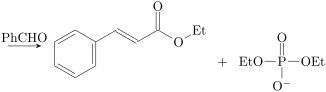
The Horner–Wadsworth–Emmons reaction of triethyl phosphonoacetate with benzaldehyde. Sodium hydride removes the hydrogen between the phosphonate and the ester; the anion adds to the aldehyde, and the four-membered intermediate collapses as in the Wittig reaction. The product is ethyl (E)-cinnamate; the by-product is the diethyl phosphate anion, soluble in water. The Horner–Wadsworth–Emmons reaction of triethyl phosphonoacetate with benzaldehyde. Sodium hydride removes the hydrogen between the phosphonate and the ester; the anion adds to the aldehyde, and the four-membered intermediate collapses as in the Wittig reaction. The product is ethyl (E)-cinnamate; the by-product is the diethyl phosphate anion, soluble in water.
The Horner–Wadsworth–Emmons reaction of triethyl phosphonoacetate with benzaldehyde. Sodium hydride removes the hydrogen between the phosphonate and the ester; the anion adds to the aldehyde, and the four-membered intermediate collapses as in the Wittig reaction. The product is ethyl (E)-cinnamate; the by-product is the diethyl phosphate anion, soluble in water.
Read in context →