
All books

Professional

Apps About Coach Log in Start reading

Chemistry · Glossary

What is Zeta potential?

Definition 17.18 University Chemistry — Year 3 · Chapter 17 — Interfaces, Surfactants and Colloids

The zeta potential ζ\zeta of a particle is the electric potential at its slipping plane, the boundary within the double layer between the liquid that moves with the particle and the liquid that does not; it is measured from the velocity of the particles in an electric field (electrophoresis).
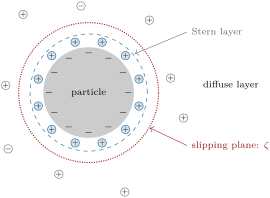
A negatively charged particle with its double layer: a compact Stern layer of counterions, the slipping plane just beyond it, where the zeta potential is defined, and the diffuse layer, in which counterions outnumber co-ions over a few Debye lengths.
DLVO interaction of two particles of radius 100\, nm (model: diffuse-layer potential -30\, mV, Hamaker constant 2 × 10-20\, J) in water with a 1:1 salt. At 1\, mM a barrier of about 40\,kT keeps the particles apart; at 10\, mM it is halved; near 50\, mM it disappears and every collision is sticky.
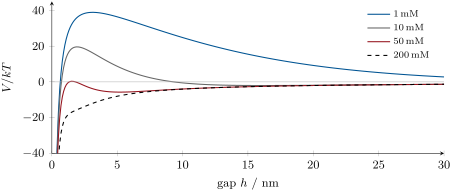
DLVO interaction of two particles of radius 100 nm100\,\mathrm{nm} (model: diffuse-layer potential −30 mV-30\,\mathrm{mV}, Hamaker constant 2×10⁻²⁰ J2 \times 10^{-20}\,\mathrm{J}) in water with a 1:1 salt. At 1 mM1\,\mathrm{mM} a barrier of about 40 kT40\,kT keeps the particles apart; at 10 mM10\,\mathrm{mM} it is halved; near 50 mM50\,\mathrm{mM} it disappears and every collision is sticky.
Read in context →