University Chemistry — Year 3 · Bachelor Year 3
17Interfaces, Surfactants and Colloids
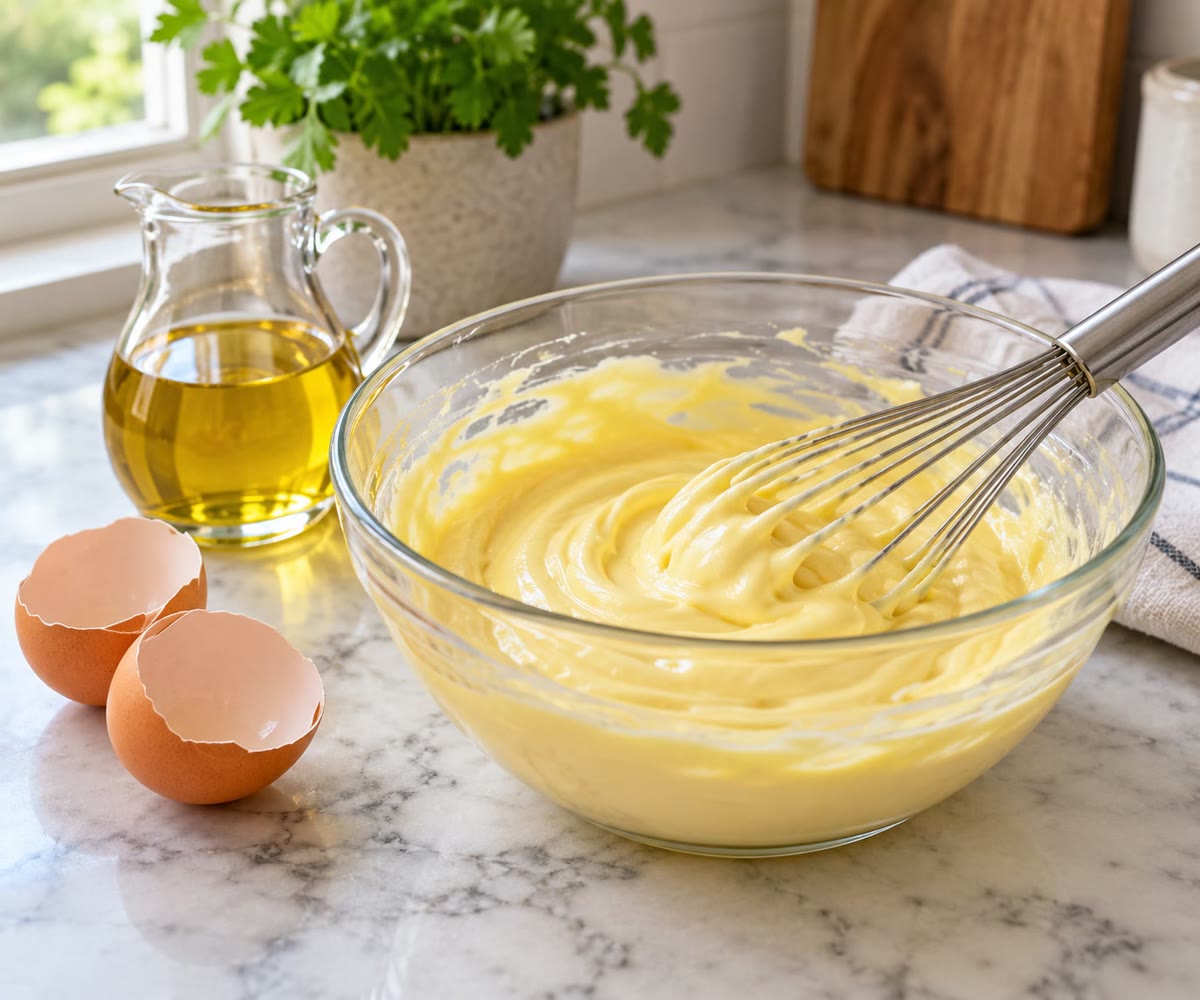
Mayonnaise is oil dispersed as droplets a few micrometres across in a little water and vinegar, held apart by the lecithin and proteins of egg yolk. Whisked too fast at the start, or with the oil poured too quickly, it splits into an oily layer and a watery one: the droplets merge, and the energy that kept them apart is gone. Milk, fog, ink, paint, blood and the muddy water of a river are the same kind of matter, particles or droplets far larger than molecules and far smaller than anything the eye sees, so many that most of their molecules are close to an interface. This chapter treats the energy of interfaces, the molecules that lower it, the colloids that interfaces make possible, and what keeps colloids dispersed or makes them coagulate.
You already know
The Year 1 volume called amphiphilic a molecule with a hydrophilic head and a hydrophobic tail, and described London interactions and the relative permittivity of solvents; the Grade 11 part of the first volume met micelles in soap. The Year 2 volume defined the chemical potential, ionic strength and activity. Chapter 16 treated adsorption on solids, Chapter 15 the electrical double layer and its Debye length. From physics: Brownian motion, and the pressure inside a curved surface.
17.1 Interfaces and surface tension
A molecule in the bulk of a liquid is attracted equally in all directions; at the surface it loses part of its neighbours. Creating surface costs energy.
Definition 17.1 (Surface tension)
The surface tension of a liquid is the Gibbs energy needed to create a unit area of its surface at constant temperature, pressure and composition: , in . For an interface between two phases it is the interfacial tension.
Water, held together by hydrogen bonds, has a high surface tension: at . Alkanes have about 20, mercury about 480.
Proposition 17.2 (Laplace pressure)
The pressure inside a spherical drop or bubble of radius exceeds the pressure outside by
Proof. Increase the radius by at equilibrium: the work done by the pressure difference, , equals the increase of surface Gibbs energy, . ∎
Definition 17.3 (Contact angle, wetting)
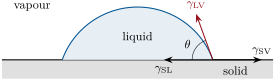
The contact angle of a drop on a solid is the angle, measured through the liquid, between the solid surface and the liquid surface at the line where solid, liquid and vapour meet. A liquid wets the solid when , and spreads completely when .
Theorem 17.4 (Young’s equation)
At equilibrium the three interfacial tensions and the contact angle satisfy
This is Young’s equation.
Proof. Move the contact line outwards by (per unit length of line): solid–vapour interface of area is replaced by solid–liquid interface, and the liquid–vapour interface grows by . The Gibbs energy changes by , which is zero at equilibrium. ∎
Theorem 17.5 (Kelvin equation)
The vapour pressure of a spherical drop of radius exceeds that of the flat liquid, :
with the molar volume of the liquid. This is the Kelvin equation.
Proof. The liquid in the drop is under the extra pressure , which raises its chemical potential by (with , the liquid incompressible). The vapour in equilibrium with it must have its chemical potential raised by the same amount: . ∎
For a water droplet of radius at , : its vapour pressure is 11 % above that of flat water. Small droplets evaporate while large ones grow, and clouds need nuclei to start; the same holds for the solubility of small crystals.
Definition 17.6 (Ostwald ripening)
Ostwald ripening is the growth of the larger particles or droplets of a dispersion at the expense of the smaller ones, driven by the higher solubility or vapour pressure of small particles.
17.2 Surfactants and micelles
Definition 17.7 (Surfactant)
A surfactant (surface-active agent) is an amphiphilic molecule that adsorbs at interfaces and lowers their tension. It is an anionic surfactant if its head is an anion (sodium dodecyl sulfate, soaps), a cationic surfactant if a cation (quaternary ammonium salts), a non-ionic surfactant if the head is a neutral polar group (a chain of ethylene oxide units).
Definition 17.8 (Surface excess concentration)
The surface excess concentration of a solute is the amount of solute at the interface per unit area, in excess of what the same volume would hold if the bulk concentration held right up to the interface.
Theorem 17.9 (Gibbs adsorption isotherm)
For a dilute solution of a non-ionic solute of concentration ,
for a 1:1 ionic surfactant without added salt, is replaced by . This is the Gibbs adsorption isotherm.
Proof. For the interface, the analogue of the Gibbs–Duhem relation at constant and is (the surface Gibbs energy plays the role of , admitted). Choosing the dividing surface so that the solvent has no excess, , and in a dilute solution . For an ionic surfactant, the cation and the anion are both adsorbed in equal excess and becomes . ∎
A surfactant whose surface tension falls linearly with has a constant surface excess: the interface is saturated, and is the area occupied by one adsorbed molecule.
Method 17.10 (Area per molecule from a – slope)
- Measure against below the CMC; plot against .
- Take the slope of the linear part just below the CMC; , for a non-ionic surfactant, 2 for a 1:1 ionic one without salt.
- Area per molecule ; typical values are 0.3 to .
Definition 17.11 (Micelle, critical micelle concentration, aggregation number)
A micelle is an aggregate of surfactant molecules in solution whose hydrophobic tails form a liquid-like core shielded from water by the heads. The critical micelle concentration (CMC) is the concentration above which micelles form; their mean number of molecules is the aggregation number.
Proposition 17.12 (Breaks at the CMC)
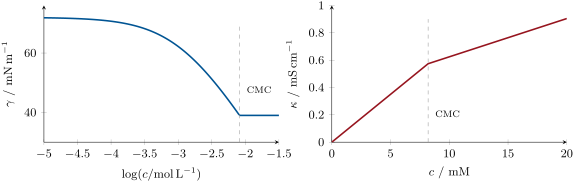
Above the CMC, the concentration of free surfactant, and with it the surface tension and the osmotic pressure, stay almost constant; properties that depend on the free molecules change slope at the CMC.
Partial proof. Treat the micelles as a separate phase: added surfactant goes into micelles once the chemical potential of the free molecules reaches that of a molecule in a micelle, and this chemical potential, hence the free concentration, then stays fixed. The surface tension, set by the free molecules through the Gibbs isotherm, stops falling; the conductivity keeps rising, but more slowly, since micelles carry less charge per surfactant than free ions (part of their counterions are bound). The model is a limit, since micelles of finite size form over a narrow range of concentration (admitted). ∎
Method 17.13 (The CMC from a break)
- Measure the surface tension (or, for an ionic surfactant, the conductivity) over a range of concentrations spanning the expected CMC.
- Fit straight lines to the two branches ( against , or against ).
- Their intersection is the CMC.
Definition 17.14 (Packing parameter)
The packing parameter of a surfactant is , where is the volume of its hydrophobic tail, the length of the extended tail and the optimal area per head group at the aggregate surface.
Proposition 17.15 (Shape of aggregates)
Spherical micelles need , cylindrical micelles , flat bilayers (vesicles, membranes) ; gives reversed structures.
Proof. In a sphere of radius made of molecules, and , so : . For a cylinder of radius and length , and : . For a bilayer of thickness and area , and : . ∎

Detergency combines these effects: the surfactant lowers the interfacial tension between water and an oily soil until the soil rolls up into drops, which micelles then solubilise in their cores.
17.3 Colloids
Definition 17.16 (Colloid)
A colloid is a dispersion of particles, droplets or bubbles, roughly to across (the dispersed phase), in a continuous dispersion medium. A sol is a dispersion of solid particles in a liquid, an emulsion of liquid droplets in another liquid, a foam of gas bubbles in a liquid or a solid, a gel a network of particles or polymers that spans the whole liquid and makes it solid-like, an aerosol of droplets or particles in a gas.
Colloidal particles are small enough to stay suspended by Brownian motion (the random kicks of solvent molecules, from physics) and large enough to scatter light.
Definition 17.17 (Tyndall effect)
The Tyndall effect is the scattering of light by the particles of a colloid, which makes a beam visible from the side when it crosses the colloid, while a true solution remains invisible.

17.4 Colloidal stability
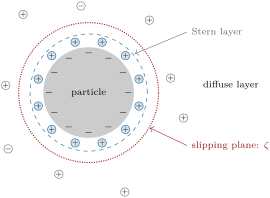
Two colloidal particles always attract each other at short range by van der Waals forces. In water, most particles also carry a charge (ionised surface groups, adsorbed ions), surrounded by a diffuse layer of counterions, the double layer of Chapter 15. When two particles approach, their diffuse layers overlap and repel.
Definition 17.18 (Zeta potential)
The zeta potential of a particle is the electric potential at its slipping plane, the boundary within the double layer between the liquid that moves with the particle and the liquid that does not; it is measured from the velocity of the particles in an electric field (electrophoresis).
Theorem 17.19 (DLVO theory)
For two spheres of radius separated by a gap , with diffuse-layer potential and Hamaker constant , the interaction energy is, for low potentials,
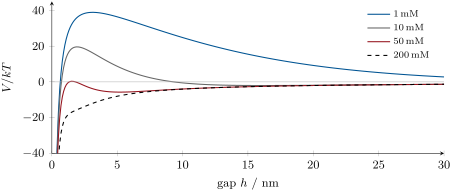
The first term, the double-layer repulsion, decays over the Debye length ; the second, the van der Waals attraction, does not depend on the salt. Their sum has an energy barrier at a few Debye lengths when the salt concentration is low, and none above a critical concentration.
Partial proof. Both forms are admitted (the repulsion from the overlap of two Gouy–Chapman layers in the Derjaguin approximation, the attraction from summing London interactions over the two bodies). Raising the ionic strength raises (Proposition 15.2): the repulsion then dies out at smaller , where the attraction, which grows as , is stronger; the maximum of decreases and finally vanishes. ∎
Definition 17.20 (Coagulation and stabilisation)
Coagulation is the aggregation of colloidal particles caused by the loss of their electrostatic repulsion; flocculation is aggregation into loose flocs, often bridged by adsorbed polymers. The critical coagulation concentration (CCC) of an electrolyte is the concentration above which a colloid coagulates rapidly. Steric stabilisation keeps particles apart with adsorbed or grafted polymer chains, whose overlap would cost entropy.
Proposition 17.21 (Schulze–Hardy rule)
For a highly charged colloid, the critical coagulation concentration of an electrolyte varies as the inverse sixth power of the charge of its counterions: , in the ratios for .
Partial proof. Treat two flat plates. At high surface potential the double-layer repulsion per unit area tends to , where is the number density of the electrolyte, independent of the potential (admitted); the attraction is . At the CCC the barrier just vanishes: and at the same gap. Since and , the two conditions give , so , and then , i.e. . With , and : hence . ∎
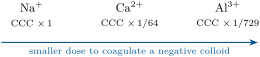
The rule explains why aluminium salts are so effective at clearing water, and why rivers drop their load of clay where they meet the salt water of the sea.
Method 17.22 (Choosing a coagulant dose)
- Measure the CCC of a reference electrolyte for the suspension (jar tests with increasing doses, watching the settling).
- Scale it to the counterion of the coagulant with the Schulze–Hardy rule.
- Convert to a mass of salt per cubic metre with its formula; add enough for the hydrolysis and the alkalinity it consumes.
- Avoid overdosing: highly charged counterions can reverse the sign of the particles’ charge and restabilise them.
17.5 Colloids at work
Definition 17.23 (Hydrophilic–lipophilic balance)
The hydrophilic–lipophilic balance (HLB) of a non-ionic surfactant is, in Griffin’s scale, times the mass fraction of its hydrophilic part: low values (3 to 6) suit water-in-oil emulsions, high values (8 to 18) oil-in-water emulsions and detergents.
Emulsions are thermodynamically unstable, since every droplet carries interfacial energy; emulsifiers make them kinetically stable by lowering that energy and by adding a repulsive layer, charged or steric, around each droplet. Mayonnaise is an oil-in-water emulsion with so much oil (about four fifths of the volume) that the droplets are squeezed against one another, which makes it a soft solid. Foams are stabilised by surfactants that slow the draining of the liquid films between bubbles; antifoams, often silicone oils, spread on those films and break them. In drinking-water plants, aluminium or iron(III) salts coagulate the clay and organic colloids that make river water turbid; the hydroxide they form sweeps the flocs down as it settles. Metal nanoparticles are kept dispersed by adsorbed citrate ions (electrostatic) or by thiol-bound polymer chains (steric).
In the lab — The du Noüy ring
A platinum ring, flamed to clean it, hangs from a balance and is immersed horizontally in the liquid, then slowly raised. The force needed to pull it through the surface passes a maximum; divided by twice the circumference of the ring and corrected for the shape of the lifted meniscus, it gives the surface tension. The measurement of a surfactant series starts from the most dilute solution, rinsing the ring between samples.
Safety


Sodium dodecyl sulfate powder: flammable solid, harmful if swallowed, causes serious eye damage, irritates the respiratory tract; weighed without raising dust, with eye protection. Aluminium sulfate ( ): causes serious eye damage.
History — Tyndall and the ultramicroscope
John Tyndall showed in 1869 that a beam of light becomes visible in air laden with fine particles and invisible in air freed of them, and that the scattered light is bluish and polarised. Richard Zsigmondy, studying the red colour of gold sols, built with Henry Siedentopf in 1903 the ultramicroscope, which lights the colloid from the side and shows each particle as a point of scattered light on a dark background, too small to be resolved but countable. He received the 1925 Nobel Prize in Chemistry for his work on colloids.
17.6 Exercises
Exercise 17.1 ★
Compute the pressure inside an air bubble of diameter in water at (outside: ).
Solution
Solution of Exercise 17.1.
: ; inside, .
Exercise 17.2 ★
Compute the vapour pressure of a water droplet of radius relative to flat water at ().
Solution
Solution of Exercise 17.2.
; .
Exercise 17.3 ★
A liquid with on a solid with and (data of the exercise): compute the contact angle. Does it wet?
Exercise 17.4 ★
Compute the Debye length in water at for of NaCl and of .
Solution
Solution of Exercise 17.4.
NaCl: , . : , .
Exercise 17.5 ★★
Just below its CMC, the surface tension of an ionic surfactant (1:1, no salt) falls by per unit of at . Compute the surface excess and the area per molecule.
Solution
Solution of Exercise 17.5.
; area per molecule.
Exercise 17.6 ★★
Surface tensions of a non-ionic surfactant: 52.0, 45.5, 39.1, 33.4, 33.3 and at , , , , and (data of the exercise). Estimate the CMC.
Solution
Solution of Exercise 17.6.
Below the CMC the slope is per unit of (from to ); the plateau is at 33.4. The line reaches it at : CMC .
Exercise 17.7 ★★
For sodium dodecyl sulfate, take , and ; for a lipid with two such chains, , the same and (data of the exercise). Predict the shape of their aggregates.
Solution
Solution of Exercise 17.7.
SDS: , at the border between spheres and short cylinders: spherical micelles near the CMC. Lipid: : bilayers, hence vesicles.
Exercise 17.8 ★★
A negatively charged sol coagulates at NaCl. Predict the CCC with and with . What would do?
Solution
Solution of Exercise 17.8.
: of ; : of . coagulates through its (at about of salt); the phosphate, a co-ion, may even adsorb and raise the negative charge.
Exercise 17.9 ★★
Compute Griffin’s HLB of hexaethylene glycol monododecyl ether, , whose hydrophilic part is . Is it suited to an oil-in-water emulsion?
Solution
Solution of Exercise 17.9.
Hydrophilic part of (book atomic weights): HLB , an oil-in-water emulsifier.
Exercise 17.10 ★★★
A dispersion contains droplets of radius 50 and . Using the Kelvin equation applied to solubility, explain which grow and which shrink, and why emulsions coarsen with time even without coalescence.
Solution
Solution of Exercise 17.10.
The oil of the small droplets is more soluble in the continuous phase (by the factor , ten times larger in the exponent for than for ): it diffuses to the large droplets, which grow while the small ones vanish. This Ostwald ripening coarsens an emulsion even if no two droplets ever merge.
Exercise 17.11 ★★★
Show from the Laplace pressure that the liquid rises to the height in a capillary of radius , and compute it for water (, radius).
Solution
Solution of Exercise 17.11.
The meniscus is a spherical cap of radius : the liquid just below it is at a pressure lower by , and the column rises until compensates. For water, .
Exercise 17.12 ★★★
Using the DLVO figure, explain why adding NaCl to a sol stable at makes it coagulate, while adding a non-adsorbing polymer does not change the barrier but a polymer grafted to the particles can keep them apart at any salt concentration.
Solution
Solution of Exercise 17.12.
At the Debye length is under and the repulsion dies out before the attraction: no barrier is left (beyond the curve). A free polymer does not act at the surface; a grafted polymer layer repels at contact whatever the salt, by the entropy lost when the chains overlap.
17.7 Problem: Clearing Muddy Water with Alum
Problem 17.1
Weekend problem — clearing muddy water with alum: the double layer of clay particles, the DLVO barrier, the Schulze–Hardy rule, and the dose of aluminium sulfate
A water-treatment plant receives soft, turbid water: clay particles of radius and density , with a diffuse-layer potential of , in water containing of . Jar tests show that the particles coagulate rapidly above of NaCl (data of the problem). The plant treats per hour with aluminium sulfate, ().
Part I — A stable colloid.
- Why do clay particles in water carry a negative charge?
- Compute the ionic strength of the water.
- Compute its Debye length.
- Compare it with the particle radius. Which approximation of the DLVO formula does this justify?
- Compute the settling velocity of a particle by Stokes’ law, (), in millimetres per day.
- Why do the particles not stick together when they collide?
Part II — The DLVO barrier.
- Write the DLVO energy of two particles.
- Read on the figure the barrier at , in units of .
- How often would two colliding particles cross such a barrier?
- What happens to the barrier near ?
- Explain why adding salt lowers the barrier.
Part III — Schulze–Hardy.
- State the rule.
- Predict the CCC of .
- Predict the CCC of .
- Why do only the cations of the coagulant matter for this colloid?
- Why is the sulfate of alum nearly irrelevant to the coagulation?
Part IV — The dose.
- Compute the amount of needed per cubic metre.
- Deduce the amount of per cubic metre.
- Deduce its mass per cubic metre.
- Deduce the mass used per hour by the plant.
- In water, hydrolyses and reacts with the hydrogencarbonate. Write the balanced equation forming .
- What fraction of the hydrogencarbonate does the dose consume? Does the pH change much?
- Why can an overdose make the water turbid again?
- State the result: the minimum mass of aluminium sulfate per cubic metre.
Solution
Solution of Problem 17.1.
1. Substitutions in the crystal lattice ( for , for ) leave a permanent negative charge, compensated by exchangeable cations. 2. . 3. . 4. : the double layer is thin compared with the particle, the condition of the Derjaguin approximation. 5. , about per day. 6. Their diffuse layers repel before van der Waals attraction takes over. 7. . 8. About . 9. A fraction of order of the collisions: practically never. 10. It vanishes: every collision leads to contact. 11. A shorter Debye length confines the repulsion to small gaps, where the attraction, growing as , dominates. 12. The CCC varies as of the counterion charge. 13. . 14. . 15. The cations are the counterions of the negative particles: they accumulate in the double layer and screen it. 16. Sulfate is a co-ion, repelled from the particles. 17. of per cubic metre. 18. of . 19. . 20. per hour. 21. . 22. of the : a fifth. The remaining hydrogencarbonate and the dissolved buffer the water: the pH falls only modestly. 23. The highly charged aluminium species adsorb and reverse the charge of the particles, which repel each other again. 24. About of aluminium sulfate per cubic metre (), before the extra needed for hydrolysis in practice.