全部书籍

专业

应用 关于 Coach 登录 开始阅读

书籍暂未推出简体中文版——当前显示英文版。

Earth and Space Sciences · 术语表

什么是 Geopotential?

Definition 3.1 University Earth and Space Sciences — Year 3 · 第 3 章 — Gravity and the Figure of the Earth

The geopotential is the potential energy per unit mass, in the frame rotating with the Earth at the angular velocity ω\omega, of gravitation and the centrifugal force together:

W(r)=V(r)+Φ(r),V(r)=−G∫Earthdm′∣r−r′∣,Φ(r)=−12ω2s2,W(\mathbf r) = V(\mathbf r) + \Phi(\mathbf r),\qquad V(\mathbf r) = -G\int_{\text{Earth}}\frac{\mathrm dm'}{|\mathbf r - \mathbf r'|},\qquad \Phi(\mathbf r) = -\tfrac12\omega^2 s^2,

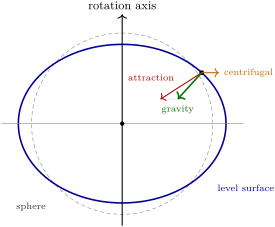
where ss is the distance from the rotation axis. Gravity is g=−∇W\mathbf g = -\nabla W, and the surfaces W=constW = \text{const} are its level surfaces: gravity is everywhere normal to them.

A level surface of a rotating planet (schematic, the flattening greatly exaggerated). At each point, gravity, the sum of the attraction and the centrifugal force, is normal to the level surface; it does not point at the centre, except at the poles and on the equator.
在原文中阅读 →