
全部书籍

专业

应用 关于 Coach 登录 开始阅读

书籍暂未推出简体中文版——当前显示英文版。

Earth and Space Sciences · 术语表

什么是 Hanging wall, footwall, slip vector, net slip, rake?

又称: hanging wall · footwall · slip vector · net slip · rake

Definition 17.1 University Earth and Space Sciences — Year 1 · 第 17 章 — Faults, Folds and Fabrics

Let a fault be locally a plane that is not vertical. The hanging wall is the block above it, the footwall the block below it. Let AA be a point of the footwall and A′A' the point of the hanging wall that was in contact with it before the movement. The slip vector AA′→\overrightarrow{AA'} is the displacement of the hanging wall relative to the footwall; its length is the net slip. The rake rr (also called the pitch) of the slip vector is the angle, measured in the plane of the fault, from the strike direction given by the right-hand rule to the slip vector, positive when the slip vector points up the plane and negative when it points down it: −180∘<r≤180∘-180{}^{\circ} < r \le 180{}^{\circ}. This is the seismologists’ convention, used again for earthquakes in Chapter 18; many field geologists record instead an angle between 0 and 180∘180{}^{\circ}, measured clockwise from the strike seen from above, and add the sense of movement in words.
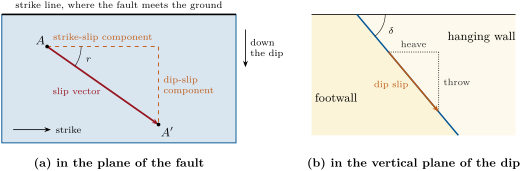
The elements of a fault, drawn to scale for a fault dipping = 50 and a slip vector of rake r = -35. (a) The fault plane seen face-on: the slip vector AA' splits into a component along the strike and one down the dip. (b) The vertical section perpendicular to the strike: the dip-slip component splits into the throw and the heave.
The elements of a fault, drawn to scale for a fault dipping δ=50∘\delta = 50{}^{\circ} and a slip vector of rake r=−35∘r = -35{}^{\circ}. (a) The fault plane seen face-on: the slip vector AA′→\overrightarrow{AA'} splits into a component along the strike and one down the dip. (b) The vertical section perpendicular to the strike: the dip-slip component splits into the throw and the heave.
在原文中阅读 →