
全部书籍

专业

应用 关于 Coach 登录 开始阅读

书籍暂未推出简体中文版——当前显示英文版。

Earth and Space Sciences · 术语表

什么是 Latent heat; sensible heat?

又称: latent heat · sensible heat

Definition 3.10 High School Earth and Space Sciences · 第 3 章 — The Earth’s Energy Budget

The latent heat of a substance is the energy it absorbs when it changes state without changing temperature — melting, or evaporating — and gives back when it changes back. For water evaporating at 15∘C15{}^{\circ}\mathrm{C} it is about 2.47 MJ2.47\,\mathrm{MJ} per kilogram. In the energy budget, the latent heat flux is the energy that evaporation takes from the surface and that the water vapour releases in the air where it condenses into clouds. The sensible heat flux is the energy that the surface passes to the air in contact with it, warming it, and that rising air carries upwards.
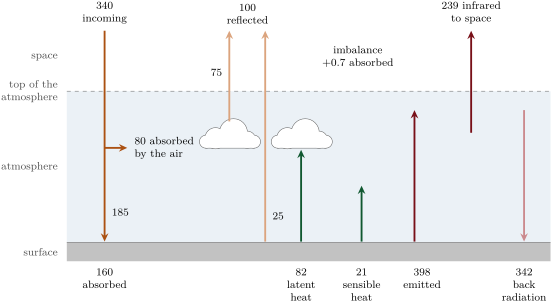
The global mean energy budget of the Earth at the beginning of the 21st century, in W/ m2 averaged over the whole surface. Orange: sunlight; green: heat carried by evaporation and by warm air; red: infrared. Of the 100 reflected, 25 come from the surface and 75 from clouds, the air and its dust. The infrared to space includes the part of the surface’s emission that escapes straight through the air. Data: IPCC, Sixth Assessment Report, Working Group I, Figure 7.2.
The global mean energy budget of the Earth at the beginning of the 21st century, in W/m2\mathrm{W}/\mathrm{m}^{2} averaged over the whole surface. Orange: sunlight; green: heat carried by evaporation and by warm air; red: infrared. Of the 100 reflected, 25 come from the surface and 75 from clouds, the air and its dust. The infrared to space includes the part of the surface’s emission that escapes straight through the air. Data: IPCC, Sixth Assessment Report, Working Group I, Figure 7.2.

示例

Example 3.13 (A metre of water a year)

The latent heat flux, 82 W/m282\,\mathrm{W}/\mathrm{m}^{2}, evaporates every second 82/2.47×106≈3.3×10−5 kg82/2.47\times 10^6 \approx 3.3 \times 10^{-5}\,\mathrm{kg} of water per square metre. Over a year, 3.16×1073.16\times10^7 seconds, this makes about 1050 kg1050\,\mathrm{kg}, a layer of water 1.05 m1.05\,\mathrm{m} thick over the whole Earth. The air holds only a little water at a time, so practically all of it falls back as rain and snow: the latent heat flux and the yearly rainfall of the planet are two faces of the same water cycle.

在原文中阅读 →