সব বই

পেশাদার

1 Markets I: The Ecosystem and Exchange-Traded Marketsবাজার অনলাইন 2 Markets II: Rates, FX and Creditবাজার অনলাইন 3 Markets III: Commodities, Energy and Cryptoবাজার অনলাইন 4 Quantitative Methodsপদ্ধতি অনলাইন 5 Derivatives and Volatilityডেরিভেটিভস অনলাইন 6 Rates, Credit, XVA and Riskসুদহার, ঋণ ও ঝুঁকি অনলাইন 7 Research Craft: Predictors, Backtests, Measurement, Portfoliosগবেষণা অনলাইন 8 Strategies I: Equities and Futuresকৌশল অনলাইন 9 Strategies II: Volatility, Relative Value, Macro and the Bank Desksকৌশল অনলাইন 10 Microstructure and Executionএক্সিকিউশন অনলাইন 11 Market Making and High-Frequency Tradingমার্কেট মেকিং অনলাইন 12 Machine Learning for Marketsমেশিন লার্নিং অনলাইন 13 Low-Latency Softwareপ্রযুক্তি অনলাইন 14 Networks, Hardware and Trading Infrastructureপ্রযুক্তি অনলাইন 15 Research, Data and Risk Platformsপ্রযুক্তি অনলাইন 16 The Desk and the Firmপ্রতিষ্ঠান অনলাইন 17 The Industry: Firms, Roles and Careersক্যারিয়ার অনলাইন 18 Interviews I: Maths, Probability and Speedক্যারিয়ার অনলাইন 19 Interviews II: Markets, Trading Games and the Final Roundক্যারিয়ার অনলাইন 20 Interviews III: Codeক্যারিয়ার অনলাইন
অ্যাপ পরিচিতি Coach সাইন ইন পড়া শুরু করো

বইগুলো এখনো বাংলা ভাষায় পাওয়া যায় না — ইংরেজি সংস্করণ দেখানো হচ্ছে।

Earth and Space Sciences · পরিভাষা

The layers of the Earth কী?

অন্য নাম: crust · mantle · core · outer core · inner core

Definition 16.3 Primary & Middle School Earth and Space Sciences · অধ্যায় 16 — Inside the Earth

The Earth is made of three main layers, from the surface to the centre:

  • the crust, a thin outer layer of solid rock, a few kilometres to a few tens of kilometres thick;
  • the mantle, a thick layer of hot, dense, solid rock, down to a depth of about 2900 km;
  • the core, made of metal, mostly iron with some nickel, from about 2900 km down to the centre. The core has two parts: the outer core, which is liquid, and the inner core, a solid ball at the centre, about 1220 km in radius.
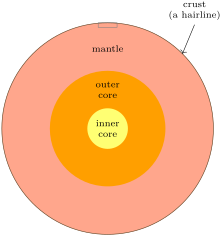
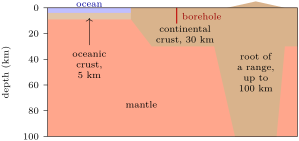
Left: the Earth cut open, to scale; the small grey box at the top marks the part enlarged on the right. Right: the top 100 km, enlarged about 60 times: thin crust under the oceans, thicker crust under the continents, thickest under high mountain ranges; the record borehole in red.
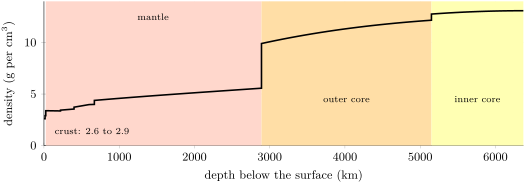
How dense the Earth is at each depth, from a reference model built from earthquake measurements. The density jumps from about 5.6 to about 9.9 g per cm3 where the rock of the mantle gives way to the metal of the core.
How dense the Earth is at each depth, from a reference model built from earthquake measurements. The density jumps from about 5.6 to about 9.9 g per cm3^3 where the rock of the mantle gives way to the metal of the core.
প্রসঙ্গসহ পড়ো →