Primary & Middle School Earth and Space Sciences · Grades 1–9
16Inside the Earth
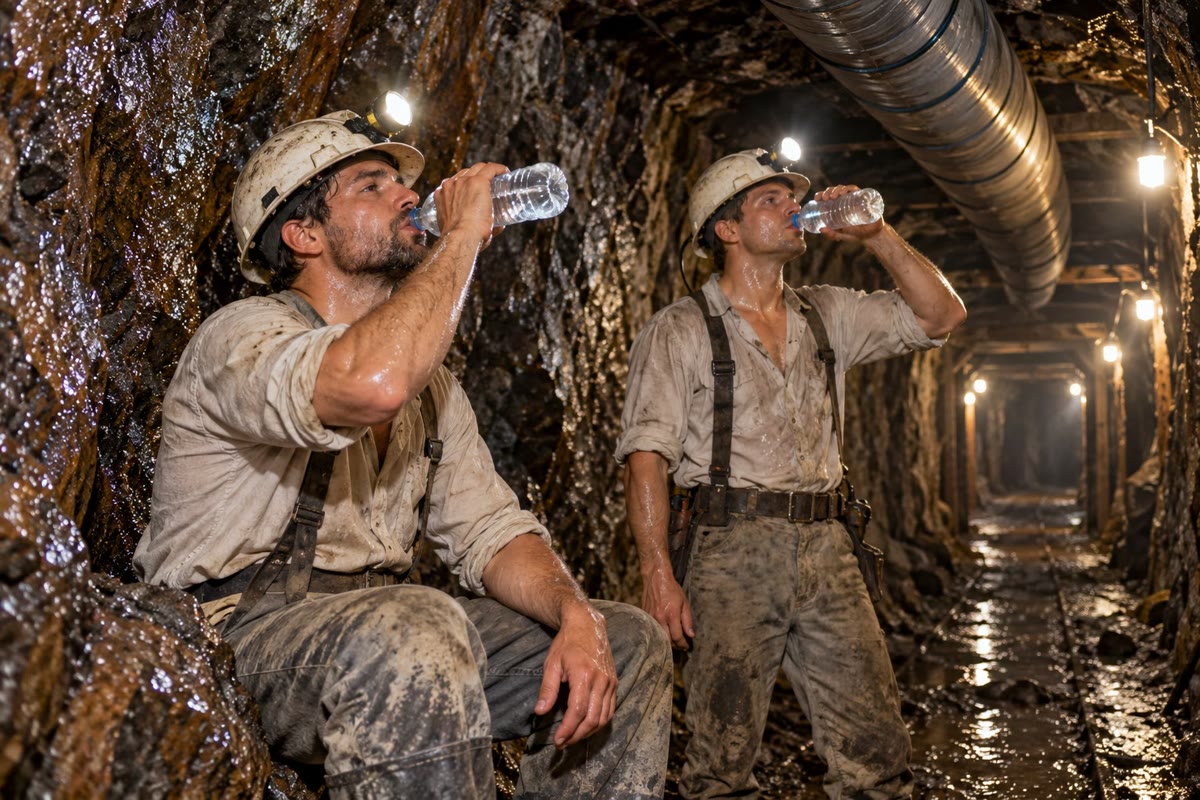
In the far north-west of Russia, not far from the border with Norway, a metal cap is welded onto the ground among abandoned buildings. Under it, a hole only about 23 centimetres wide goes straight down for more than 12 kilometres: it is the deepest hole ever dug. Drilling it took about 20 years. The drillers hoped to go deeper still, but at the bottom the rock was at about 180 degrees Celsius, almost twice as hot as expected: the heat bent the drill bits and the pipes, and the work stopped in 1992. Yet the centre of the Earth is more than 500 times deeper than the bottom of that hole. How can we know what lies down there?
You already know
The Earth is a rocky planet, a ball about 12 742 km across: its radius, from the surface to the centre, is about 6371 km (Chapter 13). Its rocks belong to three families, igneous, sedimentary and metamorphic (Chapter 15). At a volcano, molten rock comes up from below and pours out as lava; in an earthquake, the ground shakes (Chapter 8).
16.1 How deep have we been?
People have long dug into the Earth, for water, stone and metals. Two kinds of holes go the deepest.
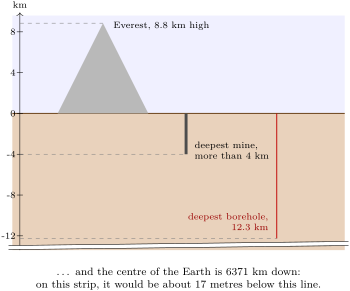
Mines. The deepest mine in the world is a gold mine near Johannesburg, in South Africa. Its galleries go down more than 4 km below the surface. Down there, the rock walls reach about 60 degrees Celsius: the mine is cooled by pumping down thousands of tonnes of ice mixed with water, and by giant fans that blow air through the galleries.
Boreholes. A borehole is a narrow hole drilled from the surface by a machine; nobody goes down it. The deepest one is the borehole of the opening story, dug for science on the Kola Peninsula, in the north-west of Russia: 12 262 metres, that is about 12.3 km.
These depths look enormous. Compared with the size of the Earth, they are tiny. The figure below shows them on one strip, next to the highest mountain, Mount Everest (8849 m).
Method 16.1 (Comparing a depth with the radius of the Earth)
- Write the depth and the radius in the same unit (kilometres).
- Divide the depth by the radius, then multiply by 100: this gives the depth as a percentage of the way to the centre.
- To say how many times deeper the centre is, divide the radius by the depth.
Example 16.2 (The deepest borehole)
The borehole is 12.3 km deep and the radius is 6371 km. , and : the borehole went about 0.2 % of the way to the centre. The other way round, : the centre is more than 500 times deeper than the bottom of the hole.
For the deepest mine, about 4 km: , that is 0.06 %: three times less than the borehole.
So no one has ever seen, touched or sampled the deep inside of the Earth. What we know of it comes from other clues, above all from the waves of earthquakes (section 16.3).
16.2 Crust, mantle and core
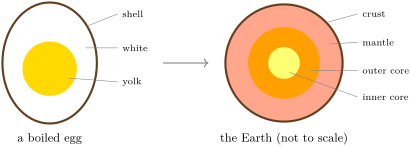
The Earth is built in layers, a little like a boiled egg: a thin brittle shell, a thick “white”, and a “yolk” in the middle.
Definition 16.3 (The layers of the Earth)
The Earth is made of three main layers, from the surface to the centre:
- the crust, a thin outer layer of solid rock, a few kilometres to a few tens of kilometres thick;
- the mantle, a thick layer of hot, dense, solid rock, down to a depth of about 2900 km;
- the core, made of metal, mostly iron with some nickel, from about 2900 km down to the centre. The core has two parts: the outer core, which is liquid, and the inner core, a solid ball at the centre, about 1220 km in radius.
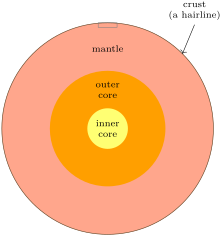
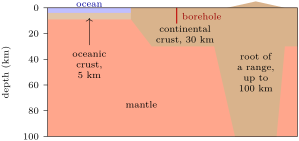
The drawing below shows the layers to scale, with the boundaries measured by earthquake waves.
| layer | from (km) | to (km) | thickness (km) | made of |
|---|---|---|---|---|
| crust | 0 | 5 to 100 | 5 to 100 | solid rock |
| mantle | bottom of the crust | 2891 | about 2860 | solid rock, very hot |
| outer core | 2891 | 5150 | about 2260 | liquid metal |
| inner core | 5150 | 6371 (centre) | about 1220 | solid metal |
The crust is the only layer we can walk on and dig into. It is very thin compared with the others: under the oceans, it is only about 5 km thick; under the continents, about 30 km on average; under high mountain ranges such as the Alps, its base can be as deep as 100 km, like the root of a tooth. Even the record borehole, 12.3 km deep, went less than half way through an average continental crust. On the drawing to scale, the crust is thinner than the line around the disc.
The mantle is the thickest layer: it goes from the base of the crust down to 2891 km, about 45 % of the way to the centre. Its rock is solid, but very hot and denser than the rock of the crust. Over millions of years, the hot rock of part of the mantle can creep very slowly, like a very stiff paste.
The core begins at 2891 km and goes down to the centre. It is made not of rock but of metal: an alloy of iron and nickel, nearly twice as dense as the mantle. Its outer part is liquid: an ocean of molten metal more than 2000 km deep. Its inner part, from 5150 km down to the centre, is a solid ball of metal, about 1220 km in radius: about 70 % as wide as the Moon. As the Earth turns, the liquid metal of the outer core moves, and this motion makes the Earth’s magnetic field, the one that turns a compass needle.
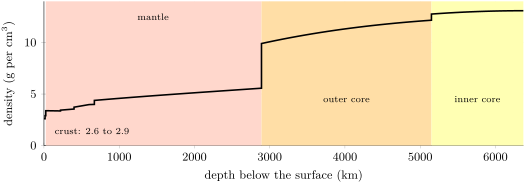
The deeper, the denser. Water has a density of 1 gram per cubic centimetre: the rock of the crust is between 2.6 and 2.9 times as dense, the rock at the bottom of the mantle more than 5 times, and the metal at the centre about 13 times (see the graph below). The heaviest materials are at the centre and the lightest on top: the Earth is sorted, from the light crust to the heavy metal core.
In the lab — Layers in a glass (in class, with the teacher)
The teacher pours, slowly and one after the other, into a tall glass: some honey, some water coloured with a drop of ink, and some cooking oil. Whatever the order of pouring, after a moment the honey lies at the bottom, the water in the middle and the oil on top: each liquid settles below the lighter ones and above the denser ones. Shaken, the glass turns cloudy; left alone, it sorts itself again. The Earth is layered in the same way: the densest material, the metal of the core, is at the centre, and the lightest rock is on top.
Remark 16.4 (How thin is the crust?)
On a school globe 30 cm across, the continental crust (30 km) would be about 0.7 millimetre thick, and the oceanic crust (5 km) about the thickness of a sheet of paper. The crust is less than half of one percent of the radius: , that is 0.47 %.
16.3 How earthquake waves tell us the rest
If no one has been deeper than 12 km, how can we draw the core? The answer comes from earthquakes. When an earthquake shakes the ground, waves leave it in all directions and travel through the whole Earth, like the sound of a knock travels through a wall. Instruments in many places around the world record when each wave arrives (you will meet them in Chapter 20).
The waves do not travel at the same speed in every material. When they reach the boundary between two layers, their speed changes suddenly: some waves bounce back, others bend as they cross, a little like light entering water. By timing the waves of many earthquakes, at stations all around the globe, scientists have found where these boundaries are, and which layers are solid or liquid. Seismologists call the two main kinds of waves P waves (the faster ones, which push and pull the rock) and S waves (the slower ones, which shake it from side to side); later volumes study them closely. The S waves have one remarkable property: they cannot travel through a liquid.
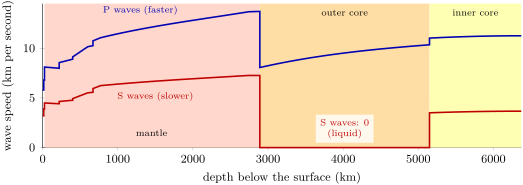
Reading the graph from left to right: in the mantle, both kinds of waves go faster and faster with depth. At 2891 km, the S waves disappear and the P waves suddenly slow down: this is the top of the liquid outer core. At 5150 km, the P waves speed up again and S waves exist once more: this is the solid inner core.
History — Inge Lehmann and the inner core
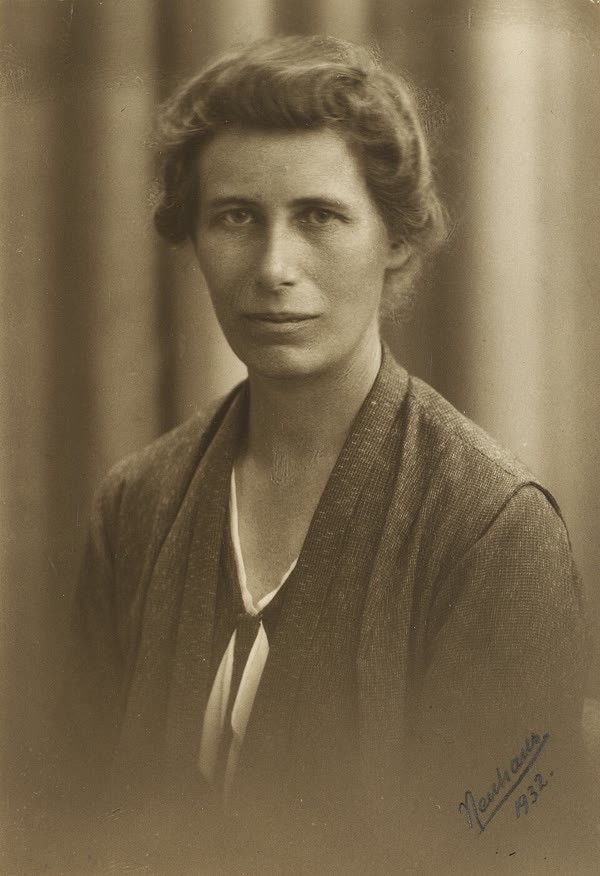
In the early 1930s, seismologists thought that the Earth had two layers: a solid mantle around a liquid core. The Danish seismologist Inge Lehmann studied the waves of a strong earthquake that struck New Zealand in 1929, recorded at stations far away. Some waves arrived where, for a fully liquid core, they should not have arrived at all. In an article of 1936, simply called “P ”, she proposed an explanation: inside the liquid core there is a smaller solid inner core, which sends these waves back. She wrote modestly that the data were “quite insufficient” to be sure, but that the interpretation “seems possible”, and she asked other researchers to test it. They did, and today the solid inner core is part of every reference model of the Earth, like the one used in the graphs of this chapter.
16.4 The deeper, the hotter
Every deep mine and every deep borehole shows the same thing: the deeper you go, the hotter the rock. In the deepest mine, the rock walls reach about 60 degrees Celsius, more than 4 km down; at the bottom of the record borehole, 12.3 km down, the rock was at about 180 degrees.
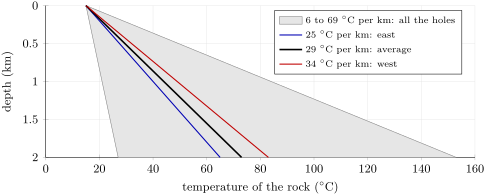
Near the surface, the temperature rises at a fairly steady rate. In the United States, scientists gathered the measurements of 284 drill holes, most of them deeper than 600 m. On average, the temperature rose by 29 degrees for each kilometre of depth: about 25 degrees per kilometre in the east of the country and 34 in the west. But the rate varies a lot from place to place: in those holes, it went from 6 to 69 degrees per kilometre.
Method 16.5 (Temperature at a depth)
- Take the temperature of the ground near the surface.
- Multiply the depth, in kilometres, by the rate, in degrees per kilometre: this is how much warmer it gets.
- Add the two. Use it only over the range where the rate was measured: a few kilometres.
Example 16.6 (Two kilometres down)
The ground is at 15 C and the rate is 29 degrees per kilometre. At 2 km: degrees warmer, so C: hotter than the hottest bath, and already far too hot to touch.
Can the same rate be used all the way to the centre? No. At 29 degrees per kilometre, the centre would be at about 185 000 degrees, which is impossible: the rate measured in the first kilometres does not hold deep down, where the rise must be much slower. Scientists estimate the temperature of the core in another way: in the laboratory, they squeeze tiny grains of iron between two diamonds, to millions of times the pressure of the air, and heat them with lasers until they melt. In this way, they found that at the edge of the solid inner core the temperature is about 6000 degrees Celsius, and yet the iron of the inner core stays solid, because the pressure there, about 3.3 million times the pressure of the air, keeps it from melting.
Remark 16.7 (Hot, and still solid)
Squeezing a substance hard makes it melt only at a higher temperature. The mantle is very hot, yet it stays solid; the outer core is liquid; the inner core, hotter still, is solid again, because it is squeezed hardest of all. What melts or not depends on the temperature and on the pressure.
16.5 Exercises
Exercise 16.1 ★
Name the four layers of the Earth in order, from the surface to the centre. Which one is liquid? Which ones are made of metal?
Solution
Solution of Exercise 16.1.
The crust, the mantle, the outer core, the inner core. The outer core is liquid. The outer and inner core are made of metal (mostly iron, with some nickel); the crust and the mantle are made of rock.
Exercise 16.2 ★
True or false? Correct the false sentences. (a) The crust is thicker under the oceans than under the continents. (b) The core is made of rock. (c) The inner core is solid. (d) The deepest borehole ever dug is about 12 km deep.
Solution
Solution of Exercise 16.2.
(a) False: the crust is thicker under the continents (about 30 km) than under the oceans (about 5 km). (b) False: the core is made of metal, an alloy of iron and nickel. (c) True. (d) True: 12 262 m, about 12.3 km.
Exercise 16.3 ★
Use the table of the layers. (a) At what depth does the core begin? (b) At what depth does the inner core begin? (c) How thick is the outer core?
Solution
Solution of Exercise 16.3.
(a) At 2891 km, about 2900 km. (b) At 5150 km. (c) : about 2260 km.
Exercise 16.4 ★
The Earth is often compared with a boiled egg. Copy and complete: “The shell is like the …, the white is like the … and the yolk is like the …. But unlike the yolk, the … has two parts: a liquid … and a solid ….”
Solution
Solution of Exercise 16.4.
“The shell is like the crust, the white is like the mantle and the yolk is like the core. But unlike the yolk, the core has two parts: a liquid outer core and a solid inner core.”
Exercise 16.5 ★★
Mount Everest is 8.849 km high and the radius of the Earth is 6371 km. As a percentage of the radius, how high is Everest? Round to two decimal places. Is the Earth’s surface very bumpy, seen from far away?
Solution
Solution of Exercise 16.5.
, and : Everest is only about 0.14 % of the radius. Seen from far away, the Earth is a very smooth ball: its highest mountain is a tiny bump.
Exercise 16.6 ★★
The continental crust is 30 km thick on average and the oceanic crust 5 km. (a) How many times thicker is the continental crust? (b) Under a high mountain range, the crust can reach 100 km. How many times thicker than the oceanic crust is that?
Solution
Solution of Exercise 16.6.
(a) : six times thicker. (b) : twenty times thicker.
Exercise 16.7 ★★
In a region, the ground is at 12 C and the temperature rises by 25 degrees per kilometre. What is the temperature (a) at 1 km, (b) at 1.5 km, (c) at 2 km?
Solution
Solution of Exercise 16.7.
(a) C. (b) C. (c) C.
Exercise 16.8 ★★
In a borehole, the rock is at 14 C near the surface and at 74 C at a depth of 2 km. By how many degrees does the temperature rise for each kilometre? Is this rate between the eastern and western averages of the measurements of the chapter?
Solution
Solution of Exercise 16.8.
The rise is degrees over 2 km, so degrees per kilometre. Yes: 30 is between the eastern average (25) and the western average (34).
Exercise 16.9 ★★
Use the graph of the wave speeds. (a) What is the speed of the P waves just above the core, at about 2890 km, and just below the top of the core? (b) Between which depths is the speed of the S waves zero? (c) What does this tell us about that layer?
Solution
Solution of Exercise 16.9.
(a) Just above the core, about 13.7 km per second; just below its top, about 8.1 km per second: the P waves suddenly slow down. (b) Between 2891 km and 5150 km, in the outer core. (c) S waves cannot travel through a liquid: the outer core is liquid.
Exercise 16.10 ★★
The record borehole is 12.3 km deep. (a) What percentage of an average continental crust (30 km) did it go through? (b) Did it reach the mantle?
Exercise 16.11 ★★★
Leo says: “Near the surface, the temperature rises by 29 degrees per kilometre, so at the centre, 6371 km down, it must be degrees.” (a) Compute Leo’s number. (b) Compare it with the temperature found in the laboratory for the edge of the inner core. (c) What is wrong with Leo’s reasoning?
Solution
Solution of Exercise 16.11.
(a) , and : about 185 000 degrees. (b) The laboratory gives about 6000 degrees at the edge of the inner core: Leo’s number is about 30 times too large (). (c) The rate of 29 degrees per kilometre was measured only in the first 2 km or so. Leo uses it thousands of kilometres beyond the measurements; deep down the temperature rises much more slowly. A rate may only be used where it was measured.
Exercise 16.12 ★★★
The whole Earth has an average density of about 5.5 grams per cubic centimetre (Chapter 13), but the rocks of the crust have a density of only 2.6 to 2.9. (a) What does this tell us about the material deeper down? (b) Use the density graph: in which layers is the density higher than 5.5 everywhere? (c) Why is it sensible that the heavy metal lies at the centre and not at the surface?
Solution
Solution of Exercise 16.12.
(a) If the crust is lighter than the average, the material deeper down must be denser than 5.5, to bring the average up. (b) In the outer core and the inner core (from about 9.9 to about 13 grams per cubic centimetre); the mantle only just reaches 5.6 at its very bottom. (c) Denser materials sink below lighter ones, as a stone sinks in water: the heavy metal ended up in the middle and the lighter rocks on top.
16.6 Problem: A journey to the centre, to scale
Problem 16.1
Weekend problem — a model Earth 2 metres across: the layers, the deepest holes and the hot inside, drawn to scale
For the school fair, a class builds a model of the Earth cut in half, as big as possible: the flat face of the half-ball is a disc 2 metres across, painted with the layers. Everything must be to scale. Use: radius of the Earth 6371 km; top of the outer core 2891 km; top of the inner core 5150 km; continental crust 30 km; oceanic crust 5 km; Everest 8.849 km; record borehole 12.3 km.
Part I — The model.
- What is the diameter of the Earth, in kilometres? Write the diameter of the model in millimetres.
- How many kilometres of the real Earth does 1 millimetre of the model stand for? (Divide the real diameter by the model diameter.)
- On the model, how high is Everest, in millimetres? Round to one decimal place.
- How deep is the record borehole on the model? Compare it with the distance from the surface to the centre of the model.
Part II — The layers.
- At what distance below the surface of the model must the students paint the top of the outer core? Round to the nearest millimetre.
- Same question for the top of the inner core. What is the radius of the inner core on the model?
- Which layer takes up the most room along a radius of the model: the mantle, the outer core or the inner core? Give its thickness on the model.
- How thick must the continental crust be painted? Round to one decimal place. Is that easy with a brush?
Part III — The hot inside.
- The students write the temperature at 2 km, using a ground at 15 C and 29 degrees per kilometre. What do they write? At what distance below the surface of the model is 2 km?
- The deepest mine goes down more than 4 km. Is the mine deeper or shallower than the record borehole on the model? By about how many millimetres?
- Near the edge of the inner core, the label says “about 6000 C, solid”. A visitor is surprised: why is the outer core liquid but the inner core, hotter still, solid?
- The oceanic crust is the thinnest layer. How thick must it be on the model, in millimetres? Round to two decimal places, and compare it with the thickness of a sheet of paper (about 0.1 mm).
Solution
Solution of Problem 16.1.
1. km. The model is 2 m across, that is 2000 mm.
2. : 1 mm of the model stands for about 6.37 km of the real Earth.
3. : Everest is about 1.4 mm high on the model, a grain of sand.
4. mm. The centre of the model is 1000 mm (1 m) below the surface: the borehole is about 520 times shorter ().
5. : the top of the outer core is painted about 454 mm below the surface.
6. : about 808 mm below the surface. The inner core’s radius on the model is mm.
7. The mantle: from about 5 mm to 454 mm, about 449 mm. The outer core takes mm and the inner core 192 mm.
8. mm: a thin band, which can be painted with a fine brush.
9. C. On the model, 2 km is mm below the surface: hardly the thickness of three sheets of paper.
10. mm, against about 1.9 mm for the borehole: the mine is shallower, by about mm.
11. Whether a substance melts depends on the temperature and on the pressure. The inner core is squeezed hardest of all, by about 3.3 million times the pressure of the air: squeezed iron melts only at a higher temperature, so the iron of the inner core stays solid although it is hotter than the outer core.
12. : the oceanic crust must be painted only 0.78 mm thick on the 2-metre model, the thickness of about eight sheets of paper ().