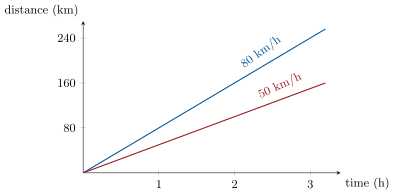
The average speed of a journey is the quotient
v=td(distance divided by duration),
in kilometers per hour (km/h), meters per second (m/s), … The formula turns around: d=v×t and t=vd.
Examples
Example 61.2
A train covers 270 km in 1 h 30 min. First convert the time: 1 h 30 min =1.5 h. Then
v=1.5270=180 km/h.
Distance at 90 km/h during 2 h 20 min =37 h: d=90×37=210 km. Time for 35 km at 14 km/h: t=1435=2.5 h =2 h 30 min.
Example 61.6 (Flow, density, price per kilo)
Speed has many cousins, all treated the same way:
- a tap fills 48 L in 4 min: flow rate 448=12 L/min, so filling a 150 L tub takes 12150=12.5 min;
- 0.6 kg of cheese costs 9 euros: price 0.69=15 euros per kg;
- a car uses 6.3 L for 90 km: consumption 906.3×100=7 L per 100 km.
Identify the quotient, and the three-way formula (q=ba, a=qb, b=qa) does the rest.
Example 61.9 (Average speed over two legs)
A cyclist rides 30 km at 30 km/h, then 30 km at 15 km/h. The average speed over the whole trip is not 230+15=22.5 km/h. Compute with the definition:
- times: 3030=1 h, then 1530=2 h; total 3 h;
- total distance 60 km, so v=360=20 km/h.
The slow leg lasts longer, so it weighs more — an average of speeds must be weighted by time.
 Coach
Coach