Primary & Middle School Mathematics · Grades 1–9
61Proportionality, Speed and Averages
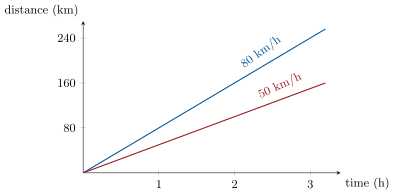
Proportionality (Chapter 49) now meets the physical world: speed, flow rates, unit conversions — quantities that are quotients of two others. The chapter closes with weighted averages, where proportional thinking prevents a classic mistake.
61.1 Average speed
Definition 61.1 (Average speed)
The average speed of a journey is the quotient
in kilometers per hour (km/h), meters per second (m/s), … The formula turns around: and .
Example 61.2
A train covers km in h min. First convert the time: h min h. Then
Distance at km/h during h min h: km. Time for km at km/h: h h min.
Remark 61.3 (Minutes are not decimals)
h min is h, but h min is not h: it is h. Always convert minutes to a fraction of an hour ( min h) before dividing.
Method 61.4 (Converting speeds)
To convert km/h into m/s: km m and h s, so
To convert m/s into km/h, multiply by .
Example 61.5
km/h m/s. A sprinter running m in s moves at m/s km/h.
61.2 Quotient quantities
Example 61.6 (Flow, density, price per kilo)
Speed has many cousins, all treated the same way:
- a tap fills L in min: flow rate L/min, so filling a L tub takes min;
- kg of cheese costs euros: price euros per kg;
- a car uses L for km: consumption L per km.
Identify the quotient, and the three-way formula (, , ) does the rest.
61.3 Weighted averages
Definition 61.7 (Weighted average)
When values come with counts (or weights) , their weighted average is
total of the values, divided by total of the weights.
Example 61.8
A test was taken by two groups: group 1, students, average ; group 2, students, average . Average of the whole class:
Not : the larger group pulls the average towards its own — the weights matter.
Example 61.9 (Average speed over two legs)
A cyclist rides km at km/h, then km at km/h. The average speed over the whole trip is not km/h. Compute with the definition:
- times: h, then h; total h;
- total distance km, so km/h.
The slow leg lasts longer, so it weighs more — an average of speeds must be weighted by time.
61.4 Exercises
Exercise 61.1 ★
Compute the average speed: km in h; km in min; m in s.
Solution
Solution of Exercise 61.1.
km/h. min h: km/h. m/s.
Exercise 61.2 ★
Compute the distance: h at km/h; min at km/h. Compute the time: km at km/h (in h and min).
Solution
Solution of Exercise 61.2.
km. min h: km. h h min.
Exercise 61.3 ★
Convert: km/h into m/s; m/s into km/h; km/h into m/s.
Solution
Solution of Exercise 61.3.
m/s. km/h. m/s.
Exercise 61.4 ★
A tap delivers L/min. How long to fill a L tank? How many liters in h ?
Solution
Solution of Exercise 61.4.
min. h min: L.
Exercise 61.5 ★
Which is the better buy: kg of apples for euros, or kg for euros? Compare prices per kilogram.
Solution
Solution of Exercise 61.5.
euros/kg against euros/kg: the second offer is (slightly) the better buy.
Exercise 61.6 ★
A class of students has an average of on a test; another class of students has an average of . Compute the average of the two classes together.
Solution
Solution of Exercise 61.6.
Exercise 61.7 ★
Sound travels at about m/s. You see a lightning flash and hear the thunder seconds later. How far away did the lightning strike (to the nearest m)?
Solution
Solution of Exercise 61.7.
m km.
Exercise 61.8 ★★
A hiker walks h at km/h, rests min, then walks h at km/h. Compute the total distance and the average speed including the rest (total distance over total elapsed time).
Solution
Solution of Exercise 61.8.
Distances: km, then km: total km. Elapsed time: h. Average speed: km/h.
Exercise 61.9 ★★
Marks with coefficients: a student got (coefficient ), (coefficient ) and (coefficient ). Compute the weighted average. What plain (unweighted) average would she have, and why do they differ?
Solution
Solution of Exercise 61.9.
Weighted: . Unweighted: . They differ because the coefficients give the mark three times the weight of the mark .
Exercise 61.10 ★★
A car drives km at km/h and then km at km/h.
- Compute the duration of each leg, then the average speed over the whole trip.
- Explain why the answer is less than km/h, the midpoint of the two speeds.
Solution
Solution of Exercise 61.10.
1. Times: h and h. Average speed: km/h.
2. The car spends more time at km/h ( h) than at km/h ( h): the slow speed weighs more in the time-weighted average, pulling it below the midpoint .
Exercise 61.11 ★★★
Two villages are km apart. Anna leaves the first at walking at km/h towards the second; Boris leaves the second at the same time walking at km/h towards the first. At what time do they meet, and at what distance from Anna’s village? (Together they close the gap at km/h.)
Solution
Solution of Exercise 61.11.
The gap of km closes at km/h: they meet after h, at . Anna has then walked km: they meet km from Anna’s village (and km from Boris’s — check: ).
61.5 Problem: The harmonic mean, or why the return trip ruins the average
Problem 61.1
Weekend problem — the average speed over equal distances is , and it never beats the midpoint of the speeds
Example 61.9 and Exercise 61.10 both ended with the same surprise: ride out at one speed, ride back at another, and the average speed lands below the midpoint of the two. This problem finds the exact formula behind the surprise — a new kind of average, the harmonic mean — proves that the surprise is a theorem, and pushes it to its logical extreme: a catch-up that no speed in the world can achieve.
Part I — The formula for a round trip. A journey covers a distance at speed , then the same distance again at speed (all positive numbers).
- Express the two durations, then the total duration, as fractions involving , , .
The average speed of the whole journey is — a double-decker fraction (Example 55.8). Simplify it and prove:
- Check the formula against both computations quoted above: , km/h (Example 61.9), and , km/h (Exercise 61.10).
- The distance has disappeared from the formula. What does that mean, concretely, for the cyclist?
- Now suppose the journey instead spends the same time at each speed. Show that the average speed is then , the plain midpoint. In the language of Definition 61.7: by what quantity must an average of speeds always be weighted, and what changes between the two scenarios?
Part II — Harmonic against arithmetic. For two positive numbers , , set
- Compute and for the pairs and . Which of the two means wins each time?
Put over the common denominator , expand the numerator with the remarkable identities (Problem 57.1), and prove:
- Deduce the theorem behind all the surprises: for positive speeds, always, with equality exactly when . Why does a square in the numerator settle the matter?
- Prove the elegant identity : the two means multiply back to the original product.
- A car covers km at km/h and km at km/h. Predict the average speed with the formula, then confirm it the long way, with times and total distance.
Part III — The impossible catch-up.
- A cyclist enters a km race hoping to average km/h. What total time may the race take her, at most? She rides the first km at km/h: how much of that time budget is left?
- Show that the hoped-for average has become literally impossible: compute her average speed if she rides the second half at km/h, and explain why even an arbitrarily enormous speed leaves her short of km/h.
- She lowers her goal to km/h. What speed on the second km achieves it? Check your answer with the harmonic-mean formula.
- A cold tap alone fills a tub in min; a hot tap alone fills it in min. What fraction of the tub do both taps together fill per minute, and how long do they take? Compare your answer with — what do you notice?
- A plane flies the same route out and back: km/h with the wind, km/h against it. Compute the round-trip average speed, and explain in one sentence why a wind, however it blows, always lengthens a round trip.
Solution
Solution of Problem 61.1.
1. By Definition 61.1, and ; the whole journey lasts for a distance of .
2. Factor out of the denominator and simplify it away:
Common denominator inside: , and dividing means multiplying by the inverse (Theorem 55.6):
3. km/h, as in Example 61.9; and km/h, as found in Exercise 61.10.
4. The average depends only on the two speeds, not on : a km round trip and a km round trip at the same two speeds have exactly the same average speed. (That is why the formula could be checked on journeys of different lengths.)
5. In time at each speed, the distances are and , so
An average of speeds is always weighted by time (Definition 61.7). With equal times the two speeds carry equal weights: plain midpoint. With equal distances the slower speed occupies more time, hence more weight — and the average slides toward it.
6. For : and . For : and . The arithmetic mean wins both times.
7. Over the common denominator :
and the numerator expands with the identities of Problem 57.1:
8. A square is never negative, and is positive: so , that is , for every pair of positive speeds. Equality requires , i.e. : the moment the two speeds differ, the round trip’s average drops strictly below the midpoint — the surprise is a theorem.
9. Multiply:
after cancelling the factor and the factor .
10. Formula: km/h. The long way: h and h, so km in h: km/h. They agree.
11. Averaging km/h over km means a total time of at most h. The first km at km/h already take h: the entire time budget is spent, with half the course to go.
12. At km/h the second half takes h, so the race takes h and
Whatever the second-half speed, its duration is a positive number, so the total time exceeds h and the average stays strictly below km/h. (With the formula: would force , i.e. — no speed works.)
13. A km/h average allows h; after the first hour, km remain for h: she needs km/h. Check: km/h.
14. Per minute, the taps fill and of the tub; together
of the tub per minute: the tub fills in min. And : the two taps together take exactly half the harmonic mean of their solo times — rates add, so it is again harmonic-mean territory.
15. Same distance each way, so
below the still-air km/h. In one sentence: the plane spends longer flying against the wind than with it, so the slow leg gets the larger weight in the time-weighted average — a wind can only lengthen a round trip.