Mathematics · Glossary

What is cosh⁡, sinh⁡, tanh⁡?

Also known as: hyperbolic functions

Definition 4.17 University Mathematics — Year 1 · Chapter 4 — Standard Functions

For xRx \in \R:

coshx=ex+ex2,sinhx=exex2,tanhx=sinhxcoshx\cosh x = \frac{\eu^x + \eu^{-x}}{2}, \qquad \sinh x = \frac{\eu^x - \eu^{-x}}{2}, \qquad \tanh x = \frac{\sinh x}{\cosh x}

(hyperbolic cosine, sine, tangent). cosh\cosh is even, sinh\sinh and tanh\tanh are odd.

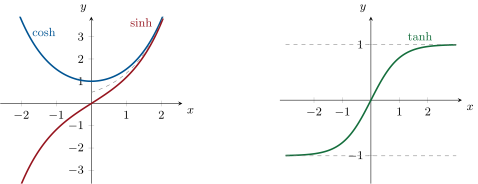
Left:  and , asymptotically glued to x/2 (dashed). Right: , increasing from -1 to 1.
Left: cosh\cosh and sinh\sinh, asymptotically glued to ex2\frac{\eu^x}{2} (dashed). Right: tanh\tanh, increasing from 1-1 to 11.

Examples

Example 4.20 (The addition formula for tanh\tanh)

Dividing the two addition formulas of Proposition 4.18 (3) by coshxcoshy\cosh x\cosh y:

tanh(x+y)=sinhxcoshy+coshxsinhycoshxcoshy+sinhxsinhy=tanhx+tanhy1+tanhxtanhy,\tanh(x + y) = \frac{\sinh x\cosh y + \cosh x\sinh y} {\cosh x\cosh y + \sinh x\sinh y} = \frac{\tanh x + \tanh y}{1 + \tanh x\,\tanh y} ,

the hyperbolic sibling of the tangent addition formula — with a ++ where trigonometry has a -. A dividend: since tanh<1\abs{\tanh} < 1, the right-hand side is a “velocity addition” rule that never leaves (1,1)\intoo{-1}1: if u,v(1,1)u, v \in \intoo{-1}1 then u+v1+uv(1,1)\frac{u + v}{1 + uv} \in \intoo{-1}1 as well (write u=tanhau = \tanh a, v=tanhbv = \tanh b, possible by bijectivity, and read the formula backwards). Checking that algebraically, without hyperbolic functions, is a slightly painful exercise; parametrizing by tanh\tanh makes it one line — the same strategy that circular functions provide for the unit circle.

Example 4.22 (Closed forms at work)

The solution of cosht=2\cosh t = 2 with t0t \geq 0 is, by the closed form, t=arcosh2=ln(2+3)1.317t = \operatorname{arcosh} 2 = \ln(2 + \sqrt3) \approx 1.317; the other solution is t-t, by evenness — and indeed ln(23)=ln12+3=ln(2+3)\ln(2 - \sqrt3) = \ln\frac1{2 + \sqrt3} = -\ln(2 + \sqrt3): the two roots u=etu = \eu^t of the quadratic u24u+1=0u^2 - 4u + 1 = 0 are reciprocals, as their product 11 (Vieta) demands. This tiny computation displays the general pattern: hyperbolic equations convert to quadratics in et\eu^t, and the symmetry ttt \mapsto -t appears as the symmetry u1/uu \mapsto 1/u of the quadratic — worth remembering when solving Exercise 4.7.

Read in context →