Mathematics · Glossary

What is eigenvalue?

Also known as: spectrum

Definition 3.1 University Mathematics — Year 2 · Chapter 3 — Reduction of Endomorphisms

λK\lambda \in K is an eigenvalue of uu when u(x)=λxu(x) = \lambda x for some x0x \neq 0 (an eigenvector); the eigenspace is Eλ(u)=ker(uλid)E_\lambda(u) = \ker(u - \lambda\,\mathrm{id}). The set of eigenvalues is the spectrum Sp(u)\operatorname{Sp}(u). A subspace FF is stable when u(F)Fu(F) \subseteq F; eigenspaces are stable, and stable subspaces allow induced endomorphisms uFu|_F.

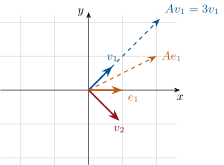
The matrix A = psmallmatrix2 & 1\\ 1 & 2 psmallmatrix acting on the plane: the generic vector e_1 is knocked off its line, but the eigendirections v_1 = (1,1) and v_2 = (1,-1) are merely stretched — by 3 and by 1 (so Av_2 = v_2: the dashed image coincides with v_2). Diagonalization is the change to the basis (v_1, v_2), where A becomes diag(3, 1).
The matrix A=(2112)A = \left(\begin{smallmatrix}2 & 1\\ 1 & 2\end{smallmatrix}\right) acting on the plane: the generic vector e1e_1 is knocked off its line, but the eigendirections v1=(1,1)v_1 = (1,1) and v2=(1,1)v_2 = (1,-1) are merely stretched — by 33 and by 11 (so Av2=v2Av_2 = v_2: the dashed image coincides with v2v_2). Diagonalization is the change to the basis (v1,v2)(v_1, v_2), where AA becomes diag(3,1)\operatorname{diag}(3, 1).

Examples

Example 3.4 (Same χ\chi, different geometry)

The matrices

(2002)and(2102)\begin{pmatrix}2 & 0\\ 0 & 2\end{pmatrix} \qquad\text{and}\qquad \begin{pmatrix}2 & 1\\ 0 & 2\end{pmatrix}

share the characteristic polynomial (X2)2(X - 2)^2, the trace, the determinant, the spectrum — yet are not similar: the first has E2E_2 of dimension 22 (geometric multiplicity 22), the second of dimension 11. The characteristic polynomial sees only algebraic multiplicities; the eigenspace dimensions are the finer invariant, and the minimal polynomial arbitrates (X2X - 2 versus (X2)2(X - 2)^2). Moral for all diagonalizability discussions: χ\chi shortlists the candidates, but kernels cast the votes.

Example 3.8 (Diagonalization put to work)

A=I+J=(211121112)A = I + J = \left(\begin{smallmatrix}2 & 1 & 1\\ 1 & 2 & 1\\ 1 & 1 & 2\end{smallmatrix}\right), with JJ the all-ones matrix: from Sp(J)={3,0}\operatorname{Sp}(J) = \{3, 0\} (Example 2.19), Sp(A)={4,1}\operatorname{Sp}(A) = \{4, 1\}, with eigenspaces R(1,1,1)\R(1,1,1) and the plane {x+y+z=0}\{x + y + z = 0\}: dimensions 1+2=31 + 2 = 3, diagonalizable (Theorem 3.6 (2)). Powers without any change-of-basis matrix: with Π=J/3\Pi = J/3 the projector onto R(1,1,1)\R(1,1,1),

A=4Π+1(IΠ)Ak=4kΠ+(IΠ)=4k13J+I.A = 4\,\Pi + 1\cdot(I - \Pi) \quad\Longrightarrow\quad A^k = 4^k\,\Pi + (I - \Pi) = \frac{4^k - 1}{3}\,J + I .

(Check k=1k = 1: 413J+I=A\frac{4-1}3 J + I = A.) The closing insight: when the eigenspaces are visible, spectral projectors compute powers faster than PDP1PDP^{-1} ever will — and the formula displays the dynamics: AkA^k grows like 4k4^k along (1,1,1)(1,1,1) and stays put on the orthogonal plane.

Example 3.10 (Trigonalizing by hand)

B=(3111)B = \begin{pmatrix}3 & -1\\ 1 & 1\end{pmatrix}: χB=X24X+4=(X2)2\chi_B = X^2 - 4X + 4 = (X - 2)^2, and ker(B2I)=ker(1111)\ker(B - 2I) = \ker\left(\begin{smallmatrix}1 & -1\\ 1 & -1\end{smallmatrix}\right) is the line spanned by e1=(1,1)e_1' = (1, 1): one eigenvalue, a one-dimensional eigenspace — not diagonalizable, but trigonalizable (Theorem 3.9). Complete the basis with e2=(1,0)e_2' = (1, 0) and compute:

u(e1)=(2,2)=2e1,u(e2)=(3,1)=1e1+2e2,u(e_1') = (2, 2) = 2e_1', \qquad u(e_2') = (3, 1) = 1\cdot e_1' + 2\, e_2' ,

so in the basis (e1,e2)(e_1', e_2') the matrix is T=(2102)T = \left(\begin{smallmatrix}2 & 1\\ 0 & 2\end{smallmatrix}\right). The closing insight: the diagonal of TT was forced (both entries must be the double eigenvalue 22); only the corner entry depended on the choice of e2e_2', and rescaling e2e_2' can make it any nonzero value — the resistant “11” is the shadow of the nilpotent part that Dunford will isolate.

Read in context →