 Coach
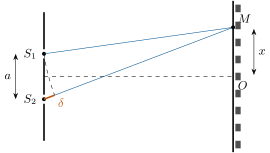
CoachTwo wave sources are coherent when they have the same frequency and vibrate in step — in practice, when they are two copies of one wave, obtained by splitting it. For a point reached by both, the path difference is .
Examples
Example 22.12 (Young’s two-slit experiment)
Pierce two fine slits , , a fraction of a millimetre apart, in an opaque plate, and light both with one laser: two coherent sources. On a screen a couple of metres away the overlap is striped: at the center , bright; climbing the screen, grows through (dark), (bright) … darkness where light added to light cancels.
Example 22.18 (Soap films and oil slicks)
Light striking a soap film reflects partly off its front face, partly off its back: two coherent copies whose path difference is set by the thickness and the viewing angle. Each thickness returns some wavelengths reinforced, others canceled: the film reflects a color that slides as it drains and thins. An oil slick on wet asphalt plays the same trick.