High School Physics · Grades 10–12
22Light as a Wave: Diffraction and Interference
Tilt a soap film toward a window: colors slide across it, though nothing in soap or water is colored. Point a laser at a single hair: the wall behind shows not a hair-thin shadow but a bright streak, barred with dark lines, thousands of times wider than the hair. Straight-marching rays (Chapter 3) explain neither sight. This chapter promotes light to a full wave — half a micrometre from crest to crest — then cashes the idea in: a laser and a bare wall will measure a hair, a wavelength, a CD’s grooves.
22.1 Light is a wave
Definition 22.1 (Light waves)
Monochromatic light — one pure color, which no prism can split further (Chapter 2) — is a periodic light wave: it crosses vacuum at and is characterized by its frequency or its wavelength in vacuum , the crest-to-crest distance of Chapter 20. The eye responds from about (violet) to (red); white light mixes the whole range.
Example 22.2 (Orders of magnitude)
A helium–neon laser emits red light of , so : no electronics counts that fast — every wavelength in this chapter will be measured by geometry. For scale, a hair (about ) is a hundred wavelengths across. What waves? Not the air: an electric and magnetic field, honestly described in the Year 2 volume; only the wavelength matters below.
22.2 Diffraction
Definition 22.3 (Diffraction)
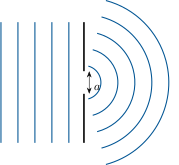
When a wave meets an aperture or an obstacle of size comparable to its wavelength, it spreads into the region that rays would leave dark. This spreading is diffraction — negligible while is tiny, dominant as shrinks toward .
Proposition 22.4 (Angular half-width of the spread)
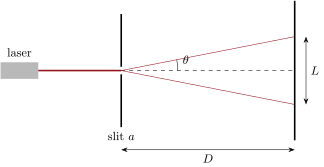
A slit of width , lit with wavelength , spreads the light about the incident direction within the angular half-width (radians); a screen at distance shows a central bright band of width , twice (small angle):
Proof. Admitted at this level. ∎
Remark 22.5 (Read the formula backwards)
The narrower the slit, the wider the spread — the opposite of the ray prediction. The honest derivation (summing wavelets re-emitted across the slit) lives in the Year 2 volume; here the formula is a measuring tool.
Example 22.6 (A laser through a slit)
Red laser, ; slit ; screen at . Then — a third of a degree, but the central band on the wall is wide, flanked by dark lines and fainter side bands. Halve the slit and the band doubles.
Proposition 22.7 (An obstacle diffracts like a slit)
A thin opaque obstacle of width — a wire, a hair — produces, outside the incident beam, the same pattern as a slit of width (Babinet’s principle, derived in the Year 2 volume).
Proof. Admitted at this level. ∎
Method 22.8 (Measuring a tiny width)
Remark 22.9 (Diffraction limits every instrument)
Light enters a camera, a telescope or an eye through an aperture of width , so even a perfect lens blurs a point into a spot of angular size about : closer details merge. A visible-light microscope thus resolves nothing much below (bacteria yes, viruses no); telescope mirrors are built wide for the same reason.
22.3 Interference
Definition 22.10 (Coherent sources, path difference)
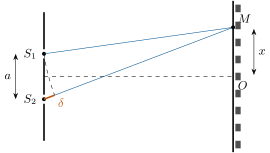
Two wave sources are coherent when they have the same frequency and vibrate in step — in practice, when they are two copies of one wave, obtained by splitting it. For a point reached by both, the path difference is .
Proposition 22.11 (Interference conditions)
Where two coherent waves of wavelength overlap they add — they interfere:
- ( integer): in step, reinforcing — constructive interference (bright);
- : crest on trough, canceling — destructive interference (dark).
Proof. Shifting a periodic wave by whole wavelengths changes nothing: crests pile on crests. Half a wavelength more puts crest on trough: equal waves cancel. ∎
Example 22.12 (Young’s two-slit experiment)
Pierce two fine slits , , a fraction of a millimetre apart, in an opaque plate, and light both with one laser: two coherent sources. On a screen a couple of metres away the overlap is striped: at the center , bright; climbing the screen, grows through (dark), (bright) … darkness where light added to light cancels.
Definition 22.13 (Fringes and interfringe)
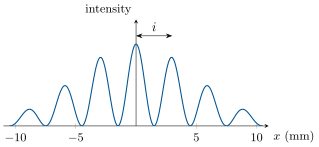
The pattern’s alternating bright and dark bands are its interference fringes; the distance between consecutive bright centers is the interfringe.
Proposition 22.14 (The interfringe)
For slits a distance apart and a screen at distance , the point of the screen at distance from the center has path difference (admitted geometry); by Proposition 22.11, bright fringes sit at , evenly spaced with interfringe
With , , : — the setup magnifies by . The geometry behind it is worked out in the Year 2 volume.
Proof. Admitted at this level. ∎
Method 22.15 (Measuring a wavelength)
- Send the unknown laser through a double slit of known spacing ; place the screen at a measured distance .
- Measure the span of interfringes; divide by : the interfringe , with the ruler error shrunk tenfold.
- Then .
Remark 22.16 (Why two lamps never interfere)
Two desk lamps lighting one wall produce no fringes: each emits short, uncorrelated wave trains whose relative timing jumps randomly a billion times a second, so the fringes shift just as fast and the eye averages them into uniform light. Interference demands coherence — one wave split in two, as Young’s slits do; the laser is the modern shortcut, one clean long wave.
22.4 Colors painted by interference
Definition 22.17 (Iridescence)
Colors that shift with the viewing angle — soap bubbles, oil slicks, peacock feathers, the back of a CD — are iridescence: no pigment, but interference in white light, reinforcing some wavelengths and canceling others.
Example 22.18 (Soap films and oil slicks)
Light striking a soap film reflects partly off its front face, partly off its back: two coherent copies whose path difference is set by the thickness and the viewing angle. Each thickness returns some wavelengths reinforced, others canceled: the film reflects a color that slides as it drains and thins. An oil slick on wet asphalt plays the same trick.
Remark 22.19 (Monochromatic versus white light)
In white light every wavelength draws its own Young fringes with its own : at the center all colors are bright (one white fringe); a few fringes out the patterns drift apart — iridescent edges, then blur. Monochromatic light gives crisp fringes without end: hence the laser in every sharp measurement here.
22.5 Exercises
Exercise 22.1 ★
Compute the frequency of red light () and of violet light (). Which is higher?
Solution
Solution of Exercise 22.1.
: red ; violet — violet is higher (shorter wavelength, same speed ).
Exercise 22.2 ★
A green laser () crosses a slit of width : compute , then the central-band width on a screen away.
Solution
Solution of Exercise 22.2.
; .
Exercise 22.3 ★
A doorway is wide: compute for a voice () and for light. Why do you hear, but not see, around the corner?
Solution
Solution of Exercise 22.3.
Voice: , so — maximal diffraction, sound floods the corridor. Light: — negligible spread: light keeps straight, so the corner hides it.
Exercise 22.4 ★
Two loudspeakers driven by one generator emit, in step, sound of wavelength . Path difference at : ; at : . Loud or silent at each? Justify.
Solution
Solution of Exercise 22.4.
At : , constructive — loud. At : , destructive — (nearly) silent.
Exercise 22.5 ★
Young’s slits: , , . Compute the interfringe. How many bright fringes fit in the screen’s central ?
Solution
Solution of Exercise 22.5.
. Within : , so : five bright fringes.
Exercise 22.6 ★★
A hair in a beam, screen at , gives a central band wide. Compute the hair’s diameter.
Solution
Solution of Exercise 22.6.
.
Exercise 22.7 ★★
An unknown laser through Young’s slits (, ): ten interfringes span . Find and the color. Why measure ten rather than one?
Solution
Solution of Exercise 22.7.
, so : red. Measuring ten interfringes divides the ruler’s reading error by ten.
Exercise 22.8 ★★
Two identical desk lamps light the same wall; the beams overlap, yet no fringes appear, ever. Which coherence condition (Definition 22.10) fails, and how does Young’s arrangement repair it?
Solution
Solution of Exercise 22.8.
The lamps have (broadly) matching frequencies but are not in step: each emits short wave trains with randomly jumping phase, so the sources are incoherent and the instantaneous fringes shift billions of times per second — the eye sees the average, uniform. Young lights both slits from one wave: the two copies inherit every phase jump together and stay in step.
Exercise 22.9 ★★
On a two-slit pattern (, ), the first and seventh bright-fringe centers are apart: find the interfringe, then .
Solution
Solution of Exercise 22.9.
First to seventh , so ; .
Exercise 22.10 ★★
A CD’s tracks form a grating of spacing . Admitting ( integer), find the beam directions for . Highest order ?
Solution
Solution of Exercise 22.10.
: , ; , , ; would need : impossible. Highest order .
Exercise 22.11 ★★
A telescope of aperture at : compute its diffraction blur . Can it separate two headlights apart, away?
Solution
Solution of Exercise 22.11.
. The headlights subtend , about three times the blur: separated, just.
Exercise 22.12 ★★★
A vertical soap film drains, thicker at the bottom, and shows horizontal colored bands creeping downward. Explain: why colors, why bands, why moving. (No computation.)
Solution
Solution of Exercise 22.12.
Front- and back-face reflections interfere; in white light each thickness reinforces some wavelengths and cancels others, hence a color. The film’s thickness depends only on height, so equal-color points form horizontal bands. Draining thins the film, so the thickness that painted a given color sits ever lower: the bands creep down.
Exercise 22.13 ★★★
Young’s slits in white light, , : compute the interfringe for violet () and red (), then deduce what the screen shows at the center, a few millimetres out, and far out.
Solution
Solution of Exercise 22.13.
: violet ; red . Center: all colors bright — one white fringe. A few millimetres out the color patterns have slid apart: iridescent fringes. Farther, maxima of all colors overlap everywhere: uniform white blur.
Exercise 22.14 ★★★
A surveillance satellite carries a mirror at . Using at , find the smallest ground detail it resolves; judge the claim that it “reads newspapers over your shoulder”.
Solution
Solution of Exercise 22.14.
; at that is . It can count cars and spot a person, but newsprint (millimetre letters) is twenty times below the diffraction limit: the claim is myth.
Exercise 22.15 ★★★
A Young’s setup shows in air, then is immersed in water (). Recalling Chapter 3: does the frequency change? The wavelength? Compute the new interfringe.
Solution
Solution of Exercise 22.15.
The frequency is fixed by the source: unchanged. The speed drops to , so and : the fringes tighten.
22.6 Problem: Measuring with Light
Problem 22.1
Weekend problem — measuring with light: a laser, a ruler and a bare wall become a micrometre workshop gauging a slit, a human hair, an unknown wavelength and the grooves of two silver discs
Your kit: a red laser (, from the label), a green laser of unknown wavelength, a calibrated slit , a double slit of spacing , a tape measure, two hairs, a CD and a DVD.
Part I — Calibrating on the known slit. Red laser, slit, wall at .
- Compute the angular half-width of the diffracted beam.
- Show that the central band has width ; compute it.
- You measure : compute the relative deviation. Is the method validated?
- A second slit is half as wide, : predict its . State the rule linking slit width and pattern width.
- Justify question 2’s step : compare and at this angle.
Part II — The hair. Same laser and wall; a stretched hair replaces the slit.
- Which admitted result lets you keep the slit formula for a hair, and what does it say?
- The central band is wide: compute the hair’s diameter .
- Your ruler reads to : give the resulting range for , as .
- Your friend’s hair gives : its diameter? Whose hair is finer, and why does finer mean wider?
- Could a desk lamp replace the laser? Give two reasons.
Part III — The green laser’s wavelength. Green laser, double slit, wall at .
- Why must both slits be lit by the same laser?
- Why is the central fringe bright whatever the wavelength?
- Ten interfringes span . Give , and the reason for measuring ten at once.
- Deduce the wavelength of the green laser.
- The maker’s label says : consistent? What color do you expect?
Part IV — Reading silver discs. The red laser hits a CD at normal incidence; its tracks act as a reflection grating obeying (admitted) . On the wall at , each first-order beam makes a spot at from the central one.
- For the CD, : compute . Why is the small-angle shortcut of Part I now forbidden?
- Deduce the CD’s track spacing .
- The DVD sends its first-order spot to : compute its and its track spacing.
- Compare the two spacings. Why does a DVD store more than a CD?
- Close the notebook: list the lengths measured this weekend, and state in one sentence what made light a ruler for all.
Solution
Solution of Problem 22.1.
1. .
2. Half-width , so .
3. : within a ruler’s precision — validated.
4. : halving doubles , so . Narrower obstacle-or-slit, wider pattern.
5. : they agree to about relative — the approximation is far better than any measurement here.
6. By Proposition 22.7: an obstacle of width diffracts like a slit of width , so still holds.
7. .
8. ; : so .
9. : the friend’s is finer — and , so the finer hair throws the wider pattern.
10. No: a lamp is white (each wavelength paints a different pattern, and they blur) and incoherent-and-wide (no single clean beam to diffract). The laser is monochromatic and directional.
11. Only copies of one wave are coherent; two independent sources drift out of step and the fringes wash out (Remark 22.16).
12. At the center for every : constructive regardless of wavelength.
13. ; one span of ten is read with the same ruler error as one interfringe, so the error on is divided by ten.
14. .
15. lies inside : consistent; that wavelength is green.
16. , so . Here while : at the small-angle identification of , and is off by almost — use the exact functions.
17. .
18. , , : .
19. : DVD tracks are twice as dense, and its pits are correspondingly smaller (read with a shorter-wavelength laser) — several times the data in the same disc.
20. Hair ; friend’s hair ; green laser ; CD tracks ; DVD tracks — a known wavelength turns every pattern’s geometry into a length, so light of half a micrometre is a ruler graduated at half a micrometre.