 Coach
CoachForces acting on a body compensate when their combined effect is nil: tip to tail, their arrows return to the start. Two forces compensate exactly when they share the same line of action with equal magnitudes and opposite ways.
Examples
Example 6.11 (The hockey puck)
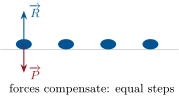
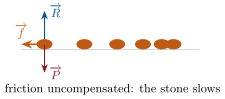
Released by the stick, a puck crosses of smooth ice in , straight at the constant . Inventory: weight and normal reaction (friction negligible). They compensate, and the principle predicts exactly the observed motion: nothing pushes the puck forward — and nothing needs to.
Example 6.16 (The book on the table)
A book of mass rests on a table: weight and normal reaction . At rest, compensates : vertical, upward, . Add a second book and adjusts — a support pushes exactly as hard as needed.