 Coach
CoachFour contact forces cover most everyday situations:
- the normal reaction of a support, perpendicular to its surface, pushing away from it;
- the tension of a wire, rope or chain, directed along it, pulling toward it;
- friction from a surface, the air or water, opposing the sliding or the motion;
- the thrust of an engine, jet or hand, pushing along the effort.
Examples
Example 6.5 (Inventory on a towed sled)
A sled towed across the snow: weight (distance), normal reaction of the snow, tension of the rope, friction opposing the sliding. Nothing else touches the sled: the inventory is complete — weight always, then one contact force per touching object.
Example 6.11 (The hockey puck)
Released by the stick, a puck crosses of smooth ice in , straight at the constant . Inventory: weight and normal reaction (friction negligible). They compensate, and the principle predicts exactly the observed motion: nothing pushes the puck forward — and nothing needs to.
Example 6.16 (The book on the table)
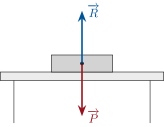
A book of mass rests on a table: weight and normal reaction . At rest, compensates : vertical, upward, . Add a second book and adjusts — a support pushes exactly as hard as needed.