High School Physics · Grades 10–12
6Forces and the Principle of Inertia
Stop pedaling and the bicycle coasts to a halt; stop pulling and the sled stands still. Experience whispers that motion must be fed by an effort — and for two thousand years physics agreed. This chapter builds the force, an arrow measured in newtons, and states the first great law of mechanics: left truly alone, a moving body keeps its motion, straight and steady, forever.
6.1 Modeling an action as a force
Definition 6.1 (Force)
A force models a mechanical action (a push, a pull, an attraction) exerted on a body. It is characterized by:
- its point of application;
- its direction — the line along which it acts and the way along that line;
- its magnitude, measured in newtons (symbol ).
A force is drawn as an arrow (a vector, as in the mathematics volume) from its point of application, with length proportional to the magnitude at a stated scale.
Example 6.2 (The weight of a schoolbag)
A schoolbag of mass is pulled downward by the Earth with its weight (Chapter 4): — one newton is about an apple’s weight. At the scale : a vertical arrow long, applied at the bag’s center of gravity, pointing down.
6.2 An inventory of forces
Definition 6.3 (Contact and distance forces)
A contact force is exerted at the points where two bodies touch. A force at a distance needs no contact: weight — the gravitational pull of Chapter 4 — is the only one used in this chapter.
Definition 6.4 (The common contact forces)
Four contact forces cover most everyday situations:
- the normal reaction of a support, perpendicular to its surface, pushing away from it;
- the tension of a wire, rope or chain, directed along it, pulling toward it;
- friction from a surface, the air or water, opposing the sliding or the motion;
- the thrust of an engine, jet or hand, pushing along the effort.
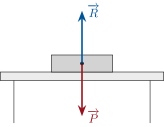
Example 6.5 (Inventory on a towed sled)
A sled towed across the snow: weight (distance), normal reaction of the snow, tension of the rope, friction opposing the sliding. Nothing else touches the sled: the inventory is complete — weight always, then one contact force per touching object.
6.3 The principle of inertia
Definition 6.6 (Straight uniform motion)
A body is in straight uniform motion in a frame when its trajectory is a straight line traveled at constant speed: its velocity vector is the same at every instant. Rest is the special case .
Definition 6.7 (Compensating forces)
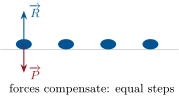
Forces acting on a body compensate when their combined effect is nil: tip to tail, their arrows return to the start. Two forces compensate exactly when they share the same line of action with equal magnitudes and opposite ways.
Theorem 6.8 (Principle of inertia)
In the ground frame, a body subject to no force, or to forces that compensate, stays at rest or keeps a straight uniform motion; conversely, a body at rest or in straight uniform motion is subject to compensating forces (or to none).
Proof. Admitted at this level. ∎
Remark 6.9
No experiment can fully isolate a body, so the principle is a postulate — glimpsed by Galileo, stated by Newton. A later chapter upgrades it to a law relating forces to changes of velocity; the Year 1 volume asks in which frames it actually holds.
Proposition 6.10 (Reading motion from forces, and back)
In the ground frame:
- if the velocity of a body changes — in magnitude or in direction — the forces on it do not compensate;
- if a body is at rest or in straight uniform motion, its inventoried forces must cancel — determining unknowns.
Proof. The first statement is the contrapositive of Theorem 6.8, the second its converse part applied to a completed inventory. ∎
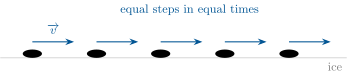
Example 6.11 (The hockey puck)
Released by the stick, a puck crosses of smooth ice in , straight at the constant . Inventory: weight and normal reaction (friction negligible). They compensate, and the principle predicts exactly the observed motion: nothing pushes the puck forward — and nothing needs to.
Remark 6.12 (Galileo against Aristotle)
Aristotle taught that every motion needs a mover, and daily life — friction in every contact — seems to agree. Galileo idealized the friction away: ever smoother surfaces need ever less push to maintain motion. Persistence, not rest, is the natural state.
Remark 6.13 (The lurching passenger)
When a bus brakes sharply, standing passengers pitch forward. No force throws them: by inertia their bodies keep their velocity while the bus loses its own. The seat belt supplies the backward force the inventory lacks.
6.4 Balanced forces: statics off a drawing
Definition 6.14 (Force diagram)
The force diagram of a body shows the body alone, with every force acting on it drawn to scale from its point of application; forces exerted by the body never appear.
Method 6.15 (Analysing a static situation)
- Choose the body to study; work in the ground frame.
- Inventory: weight always, one contact force per contact.
- Draw the force diagram.
- The body is at rest, so the forces compensate (Theorem 6.8): read unknown magnitudes off the drawing (equal lengths in 1D, components in 2D).
Example 6.16 (The book on the table)
A book of mass rests on a table: weight and normal reaction . At rest, compensates : vertical, upward, . Add a second book and adjusts — a support pushes exactly as hard as needed.
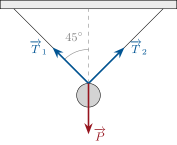
Example 6.17 (The lamp on two wires)
A lamp of mass () hangs from two wires, each at from the vertical. By symmetry the tensions are equal () and their horizontal components cancel; the vertical components, each , carry the weight:
— more than half the weight per wire: pulling at an angle costs tension.
6.5 Exercises
Exercise 6.1 ★
Inventory and classify (contact or distance) the forces on: (a) a book at rest on a table; (b) a lamp hanging from its wire; (c) a puck gliding on smooth ice; (d) an apple falling (air resistance negligible).
Solution
Solution of Exercise 6.1.
(a) Weight (distance), normal reaction of the table (contact). (b) Weight (distance), tension of the wire (contact). (c) Weight (distance), normal reaction of the ice (contact); friction negligible. (d) Weight only — nothing touches the apple.
Exercise 6.2 ★
Compute the weight of a book and of a person. At the scale , how long is the book’s arrow, and why is the scale hopeless for the person?
Solution
Solution of Exercise 6.2.
Book: , an arrow about long. Person: — an arrow of . Pick a scale to fit the largest force on the page.
Exercise 6.3 ★
On a diagram at the scale , a force is a horizontal arrow long pointing left, applied at a point . Give its three characteristics.
Solution
Solution of Exercise 6.3.
Point of application ; direction horizontal, pointing left; magnitude .
Exercise 6.4 ★
A dictionary of mass lies on a shelf. Draw its force diagram and give the magnitude and direction of each force.
Solution
Solution of Exercise 6.4.
Weight : vertical, downward, . Normal reaction of the shelf: same line, upward, (the dictionary is at rest, so the two compensate).
Exercise 6.5 ★
True or false — correct the false ones: (a) a body always ends up stopping unless a force keeps pushing it; (b) straight uniform motion requires no uncompensated force; (c) a body at rest is subject to no force; (d) if a body’s velocity changes, the forces on it do not compensate.
Solution
Solution of Exercise 6.5.
(a) False: friction stops things; with no force at all the body keeps its straight uniform motion. (b) True (principle of inertia). (c) False: it is subject to forces that compensate (e.g. weight and reaction). (d) True — the contrapositive reading of the principle.
Exercise 6.6 ★★
After release, a puck covers of ice in , straight at constant speed. Compute its speed; do the forces on it compensate? On concrete the same puck stops within metres: what changed in the inventory, and what does Proposition 6.10 conclude?
Solution
Solution of Exercise 6.6.
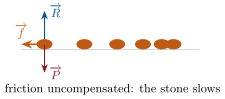
1. . Forces: weight and normal reaction; they compensate (straight uniform motion, friction negligible). 2. Friction from the concrete is no longer negligible: the inventory gains an uncompensated backward force, and indeed the velocity changes — the puck slows and stops.
Exercise 6.7 ★★
A passenger stands in an elevator rising at the constant . List the forces on the passenger; do they compensate? Give the magnitude of the floor’s force. Would anything change with the elevator at rest?
Solution
Solution of Exercise 6.7.
Weight down; force from the floor up. Straight uniform motion, so they compensate: the floor pushes with . Nothing changes at rest — rest and uniform motion give the same force diagram.
Exercise 6.8 ★★
A lamp of mass hangs at rest from a single vertical wire. Compute the tension of the wire. The wire is replaced by two vertical wires sharing the load equally: what is the tension of each?
Solution
Solution of Exercise 6.8.
1. At rest, tension compensates weight: . 2. Each vertical wire carries half: .
Exercise 6.9 ★★
A bus brakes sharply and a standing passenger lurches forward; in a curve at constant speed, the same passenger leans outward. Explain both without inventing a “forward” or “outward” force.
Solution
Solution of Exercise 6.9.
Braking: the passenger’s body keeps its velocity (inertia) while the bus loses its own, so the passenger moves forward relative to the bus. Turning: the body tends to continue straight while the bus turns underneath, so it drifts toward the outside of the curve. In both cases the “force” is fictitious; what is missing is a real force (grip, handrail) to change the passenger’s velocity along with the bus’s.
Exercise 6.10 ★★
A parachutist of total mass descends vertically at the constant . Draw the force diagram and compute the air resistance on the canopy.
Solution
Solution of Exercise 6.10.
Straight uniform motion, so weight and air resistance compensate: drag , vertical and upward.
Exercise 6.11 ★★
A water-skier is towed straight at constant speed; the horizontal rope pulls with . What is the water’s horizontal drag on the skis (justify)? Which two vertical forces compensate each other?
Solution
Solution of Exercise 6.11.
1. Straight uniform motion: horizontal forces compensate, so the drag is , opposite the rope. 2. The skier’s weight and the upward push of the water on the skis.
Exercise 6.12 ★★★
A lamp of mass hangs from two wires at from the vertical (). Compute each tension. Why does the tension grow as the wires approach the horizontal, and why could two exactly horizontal wires never hold the lamp?
Exercise 6.13 ★★★
A curling stone is pushed, released, glides while slowing very gradually, then rests. For each phase (push, glide, rest), draw the force diagram and state whether the forces compensate, quoting Theorem 6.8 or Proposition 6.10.
Solution
Solution of Exercise 6.13.
Push: weight, reaction, thrust of the hand, small friction; the speed increases, so the forces do not compensate (Proposition 6.10). Glide: weight, reaction, small friction; the stone slows, so again no compensation — friction is the uncompensated leftover (on ideal ice it would glide forever). Rest: weight and reaction alone, compensating (Theorem 6.8).
Exercise 6.14 ★★★
The probe Voyager 1 coasts through interstellar space at , engines off. Why does it need no fuel to keep its speed, and what would Aristotle predict? How far does it travel in a year, in then in astronomical units ()? Why must it fire a thruster even to change direction without changing speed?
Solution
Solution of Exercise 6.14.
1. By the principle of inertia, keeping a constant velocity requires no force at all — and in interstellar space almost none acts. Aristotle would predict the probe stops when the “mover” quits. 2. One year , so . 3. Velocity is a vector: changing its direction changes the velocity, which requires an uncompensated force.
Exercise 6.15 ★★★
Three ropes pull on a ring at rest. On a grid where one square is , two forces read and . Find the third force’s components, magnitude and direction.
Solution
Solution of Exercise 6.15.
At rest the three forces compensate: , so , magnitude , pointing opposite the resultant of the first two (down-left on the grid).
6.6 Problem: Inertia in three acts
Problem 6.1
Weekend problem — the airport walkway, the ice rink and the parachute: constant velocity as the signature of compensated forces, and why a parachute does not reduce the drag but the speed
Three scenes — a suitcase on a moving walkway, a puck on an ice rink, a parachutist in the evening air — and one law talking in all three.
Part I — The airport walkway. A suitcase stands on a walkway moving at the constant speed .
- Ground-frame motion of the suitcase? Inventory the forces on it.
- Do these forces compensate? Justify; compute both magnitudes.
- Compare its force diagram with the same suitcase’s on the floor. What deep statement does the comparison illustrate?
- The walkway jerks to a halt. Describe what the suitcase does, without inventing a forward force.
- Its owner walks at relative to the walkway. Her ground-frame speed? Do the forces on her compensate?
Part II — The ice rink.
- A puck glides straight at the constant . Draw its force diagram with magnitudes.
- Aristotle claims the puck needs a mover. What does the rink reply, and why do everyday surfaces seem to side with him?
- The puck crosses a rough patch and slows. Conclusion about the forces there? Which force is the culprit?
- A skater curves smoothly at constant speed. Do the forces on her compensate? Careful: what kind of quantity is velocity?
- Match diagram to motion: (a) compensated forces; (b) an extra force opposite ; (c) an extra force perpendicular to — (i) slowing straight; (ii) turning at constant speed; (iii) straight uniform motion.
Part III — The parachute. A jumper’s total mass, gear included, is .
- Leaving the plane, vertical speed and drag are still zero. Compute the forces; do they compensate? What must happen next?
- Drag grows with speed. Describe the fall while drag weight.
- Before the canopy opens, the jumper reaches a steady (“terminal speed”). Compute the drag. What is the motion, and why is it “inertia in disguise”?
- The canopy opens: the drag now far exceeds the weight. What happens to the velocity? (The jumper moves down throughout.)
- A new steady is reached. Compute the drag; compare with question 13.
- The punchline: what did the parachute change — the terminal drag, or the speed at which the drag reaches the weight?
Part IV — Verdicts.
- Complete and justify: “at rest or in straight uniform motion …”. Why does rest deserve no separate law?
- In which act would Aristotle’s “motion needs a mover” have failed most visibly, and what would Galileo point at?
- An exam script claims: “the parachutist falls at constant speed, so no force acts on him”. Correct it in one line.
- Finale: for each act, name the pair of forces that compensate, and state the one law used twenty times in this problem.
Solution
Solution of Problem 6.1.
1. Straight uniform motion at . Forces: weight and the normal reaction of the belt (no friction needed: the suitcase does not slide on the belt). 2. Yes — straight uniform motion (Theorem 6.8). , so . 3. The diagrams are identical. Rest and straight uniform motion are one and the same mechanical state: inertia does not distinguish them. 4. The suitcase keeps its while the belt stops: it slides or tips forward until friction absorbs its motion. Nothing pushed it — it merely kept the velocity it had. 5. Speeds along the same direction add: . Her velocity is constant, so the forces on her compensate. 6. down, up, and no horizontal force. 7. The puck keeps with no mover whatsoever. Everyday surfaces hide friction — an uncompensated backward force — so motion seems to die by itself. 8. Its velocity changes, so the forces no longer compensate (Proposition 6.10); the culprit is the friction of the rough ice. 9. No: velocity is a vector, and its direction is changing, so the forces do not compensate — the ice pushes sideways on her blades. 10. (a)–(iii), (b)–(i), (c)–(ii). 11. Weight , drag zero: nothing compensates the weight, so the velocity must change — the jumper speeds up downward. 12. While drag weight the forces still do not compensate: the speed keeps growing, and the drag grows with it. 13. Steady speed: weight and drag compensate, so the drag is . The motion is straight and uniform — a falling body in the exact mechanical state of the suitcase on the walkway: inertia in disguise. 14. Drag now exceeds weight: the forces do not compensate, so the velocity changes — the jumper, still descending, slows down; as the speed drops, the drag shrinks back toward the weight. 15. Steady again: drag — exactly the same as at . 16. The terminal drag is always equal to the weight, canopy or not. The parachute changes the speed at which the drag reaches : instead of . 17. “…the forces acting on the body compensate (or none act)” — the two readings of Theorem 6.8. Rest is just , a straight uniform motion like any other. 18. The rink: the puck cruises with no mover in sight. Galileo points at the ever-smoother surface — friction, not nature, is what stops things. 19. Forces do act — weight down and drag up; they compensate, which is precisely why the speed is constant. 20. Walkway: weight and normal reaction. Rink: weight and normal reaction. Parachute: weight and drag. The one law: the principle of inertia, in its direct and converse readings.