 Coach
CoachA constraint is a geometric condition imposed on the positions of a system — a bead stays on its wire, a pendulum’s rod keeps a fixed length, two wheels of an axle turn together. A constraint expressible as an equation among the coordinates (and possibly the time) is called holonomic. The number of independent ways the configuration can still vary is the number of degrees of freedom ; any set of independent quantities that fixes the configuration completely is a set of generalized coordinates — angles, lengths, or any convenient mixture. Their time derivatives are the generalized velocities.
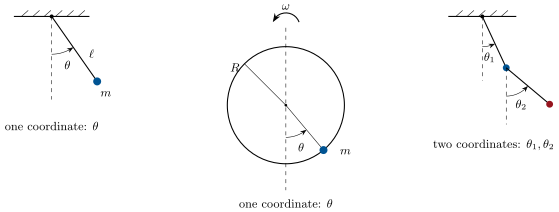
Examples
Example 1.2 (Counting degrees of freedom)
A point on a table: . A plane pendulum of fixed length: one angle, . A double pendulum: two angles, . A bead on a rigid hoop: one angle, — even if the hoop itself is forced to rotate, since the imposed rotation adds no freedom. A rigid body free in space: three coordinates of its centre plus three angles, . A gas of free molecules (points): . Each holonomic constraint removes one degree of freedom: two points joined by a rod have .