 Coach
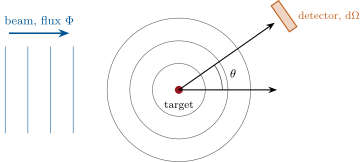
CoachSend a uniform beam of flux (particles per unit area per second) onto one target particle. The rate of projectiles scattered into the solid angle around the direction defines the differential cross-section,
and its integral is the total cross-section: the area the target effectively presents. For a thin slab with targets per unit volume, a beam attenuates as : cross-sections are measured by counting what emerges. Units: nuclear physics uses the barn, — about a uranium nucleus’s geometric size, “as big as a barn” to a neutron.
Examples
Example 15.4 (From Yukawa to Rutherford)
For the screened Coulomb potential the Born integral is elementary (Exercise 15.5) and, as the screening radius ,
the Rutherford cross-section. By a coincidence unique to , the classical calculation, the Born approximation and the exact quantum answer all agree — which is why Rutherford, computing classically in 1911, got the right formula and, from its verification flash by flash, the nucleus (Problem 15.1).