University Physics — Year 3 · Bachelor Year 3
15Scattering Theory
Almost everything we know about the small is learned by throwing things at it and watching what bounces. Rutherford discovered the nucleus by counting alpha-particle flashes on a zinc-sulfide screen; fifty years later the same experiment, run with electrons at higher energy, found quarks inside the proton; between and since, every cross-section in nuclear, particle, atomic and condensed-matter physics has been read through the theory of this chapter. The language is the cross-section — an effective target area; the quantum object is the scattering amplitude, whose Born approximation says something unforgettable: a diffuse target is probed in Fourier space, angle by angle. At low energy the partial waves take over, collapsing every complicated potential into a single number — the scattering length — that today tunes ultracold quantum gases; and where a projectile can linger in a quasi-bound state, the cross-section spikes into resonances, the spectroscopy of the otherwise invisible.
15.1 Cross-sections
Definition 15.1 (Cross-section)
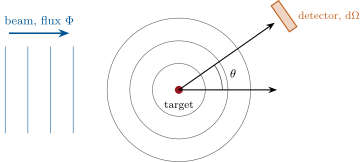
Send a uniform beam of flux (particles per unit area per second) onto one target particle. The rate of projectiles scattered into the solid angle around the direction defines the differential cross-section,
and its integral is the total cross-section: the area the target effectively presents. For a thin slab with targets per unit volume, a beam attenuates as : cross-sections are measured by counting what emerges. Units: nuclear physics uses the barn, — about a uranium nucleus’s geometric size, “as big as a barn” to a neutron.
15.2 The amplitude and the Born approximation
Theorem 15.2 (Scattering states and the amplitude)
For a particle of energy meeting a localised potential , the stationary scattering state behaves at large distance as
an incident plane wave plus an outgoing spherical wave modulated by the scattering amplitude (a length), and
Partial proof. The fall-off makes the outgoing flux through any large sphere finite; computing the probability currents (Proposition 7.2) of the two terms, the radial outgoing current per solid angle is against the incident flux : the ratio is the definition of . That solutions of this asymptotic form exist is admitted. ∎
Theorem 15.3 (Born approximation)
For a weak potential (or fast projectile), first-order perturbation theory in gives
the amplitude is, up to constants, the Fourier transform of the potential evaluated at the momentum transfer . Scattering experiments are Fourier analysers of matter: small angles read long wavelengths (coarse structure), large angles the fine detail — the deepest reason why “higher energy” means “smaller distances”.
Partial proof. This is Fermi’s golden rule (Theorem 13.5) run between plane waves : the matrix element is , the density of final states supplies the kinematic factors, and the bookkeeping (admitted) assembles them into . Elasticity gives , whence by the isoceles triangle of . ∎
Example 15.4 (From Yukawa to Rutherford)
For the screened Coulomb potential the Born integral is elementary (Exercise 15.5) and, as the screening radius ,
the Rutherford cross-section. By a coincidence unique to , the classical calculation, the Born approximation and the exact quantum answer all agree — which is why Rutherford, computing classically in 1911, got the right formula and, from its verification flash by flash, the nucleus (Problem 15.1).
15.3 Partial waves and the scattering length
Theorem 15.5 (Phase shifts)
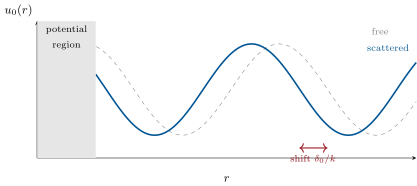
For a central potential, decompose the scattering state over angular momenta: each partial wave leaves the potential region with its radial oscillation shifted by a phase — attraction advances it, repulsion delays it — and the observable amplitude reassembles as
At low energy, classical intuition ( for impact parameter ) says only penetrates: scattering becomes isotropic and one number rules,
where is the scattering length. Whatever its inner complexity, a target at low energy is its scattering length — the great simplification on which cold-atom physics runs.
Proof. Admitted at this level. ∎
Example 15.6 (Neutron meets proton)
Slow neutrons scatter off protons with — an area forty times the deuteron’s geometric size. The explanation: the low-energy collision is pure wave with two spin channels, whose measured scattering lengths, (triplet) and (singlet), are both far larger than the force range. Large means a state almost at zero energy: the triplet’s barely bound deuteron (Example 7.9), and in the singlet a “virtual” partner that just fails to bind — its failure written in . A twenty-barn puzzle, solved by two nearly-there bound states (Exercise 15.7).
15.4 Resonances
Proposition 15.7 (Breit–Wigner resonances)
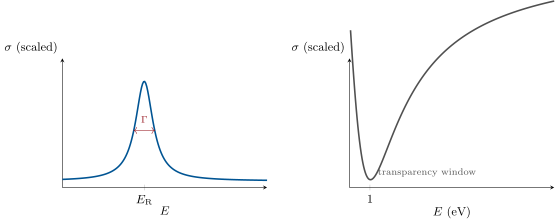
If the projectile can be temporarily captured into a quasi-bound state of energy and lifetime , the corresponding phase shift sweeps through and the partial cross-section spikes:
a Lorentzian peak of width at the ceiling the wave can reach (the “unitarity limit” ). Read backwards, a resonance in a cross-section is the discovery of a state: its position is an energy level, its width a lifetime. Most of the particle zoo of Chapter 26 was discovered as exactly such bumps.
Proof. Admitted at this level. ∎
Method 15.8 (Reading a scattering problem)
(1) Kinematics first: , and the accessible -range — what structure scales are visible? (2) Fast and weak: Born — Fourier-transform the potential; check the smallness. (3) Slow: partial waves, usually only; think scattering length, and expect (bosonic identical particles: ). (4) Peaks in : fit Breit–Wigner, report a level and a lifetime; dips: a phase passing . (5) Extended targets: multiply the point amplitude by the form factor — the Fourier transform of the density (Exercise 15.12).
15.5 Exercises
Exercise 15.1 ★
A proton beam ( protons/s) of section crosses a gold foil (). (a) The areal target density. (b) With per nucleus, what fraction of the beam scatters? (c) The rate into a detector of solid angle if scattering were isotropic. (d) Why is “cross-section” a well-defined property of the pair (projectile, target, energy) rather than of the target alone?
Solution
Solution of Exercise 15.1.
(a) . (b) . (c) Scattered rate ; into of the sphere: . (d) The “area” encodes the interaction and the wavelength: the same gold nucleus presents different areas to alphas, electrons and neutrons, and at different energies.
Exercise 15.2 ★
Classical hard spheres of radii : (a) show . (b) For air molecules (, ), the mean free path : evaluate, and compare with the kinetic-theory value of the Year 1 volume. (c) Why does a classical hard sphere show no angular structure ( constant — accept or derive)? (d) Which feature of quantum hard-sphere scattering (Exercise 15.6) has no classical counterpart?
Solution
Solution of Exercise 15.2.
(a) Centres closer than collide: . (b) : — the kinetic-theory scale (the of relative motion refines it). (c) A hard sphere reflects each impact-parameter ring uniformly over angle: isotropic in the classical limit. (d) The factor-of-four cross-section at low energy — pure wave diffraction, no classical shadow logic survives it.
Exercise 15.3 ★
Momentum transfer. (a) Draw the triangle of , and derive . (b) For alphas (): the range of over , and the smallest resolvable structure . (c) For electrons (): the same. (d) Read off the moral connecting beam energy to microscope power.
Solution
Solution of Exercise 15.3.
(a) Isoceles triangle with apex angle : . (b) runs from to : structures down to are in principle encoded (the Coulomb barrier, in practice, keeps alphas outside). (c) : resolution — inside the proton. (d) Resolution : buying energy is buying a shorter ruler.
Exercise 15.4 ★
From Theorem 15.2: (a) check that has the dimensions of an area per solid angle; (b) show the scattered flux through a sphere is ; (c) why must generally be complex (which conservation law does its phase guard)? (d) State the optical theorem and its meaning (the forward wave must be depleted by exactly what scatters away).
Solution
Solution of Exercise 15.4.
(a) is a length; an area — per steradian by construction. (b) Integrate over the sphere: . (c) Probability conservation: the outgoing wave must interfere destructively with the forward beam to pay for what scatters; that bookkeeping lives in ’s phase. (d) The optical theorem states exactly that shadow-audit: total removal forward interference deficit.
Exercise 15.5 ★★
Born for Yukawa. With : (a) carry out the Born integral (angular part first, then ) to get . (b) Let with and recover Rutherford. (c) Why does the total Rutherford cross-section diverge, and which physical ingredient (screening by atomic electrons) restores a finite answer? (d) In particle physics the Yukawa form with models the nuclear force: compute its range for .
Solution
Solution of Exercise 15.5.
(a) The angular integral gives ; then, since , one finds . (b) : ; with and this is Rutherford’s formula. (c) The divergence integrates to infinity: every passing particle is deflected a little by the infinite-range force; in matter, atomic electrons screen the nucleus beyond and cut the divergence. (d) — the nuclear force’s reach, predicted from the pion’s mass.
Exercise 15.6 ★★
The quantum hard sphere (radius ), wave: outside, with . (a) Show . (b) Show as : four times the geometric shadow. (c) Give the wave explanation of the factor (diffraction has no sharp shadow at long wavelength). (d) At high energy the answer tends to — still twice geometric (shadow diffraction): why never simply ?
Solution
Solution of Exercise 15.6.
(a) with the smallest choice: . (b) . (c) At the wave feels the sphere as a point defect and rebuilds itself by diffraction all around it — “shadow” is a short-wavelength concept, and the wave answer counts the full sphere surface . (d) Even at short wavelengths, removing a disc of wave requires diffractive filling-in — the shadow itself scatters ( of blocking of shadow diffraction).
Exercise 15.7 ★★
The twenty barns of hydrogen. Slow unpolarised neutrons on protons sample the triplet channel with weight and the singlet with : . (a) Evaluate with , and compare with the measured . (b) Which channel dominates, despite its smaller statistical weight? (c) Relate ’s size and sign to the deuteron’s near-zero binding; what does say about the singlet system? (d) Why is water such an effective moderator of reactor neutrons — and why does this cross-section matter for it?
Solution
Solution of Exercise 15.7.
(a) — the measured value. (b) The singlet: its huge outweighs its weight. (c) large and positive: a real bound state (the deuteron) barely below threshold; large and negative: a “virtual” level barely above — almost a second deuteron that nature declined to bind. (d) Hydrogen’s nuclei are the best momentum-matched partners for neutrons (equal masses), and twenty barns of elastic scattering per proton makes water a superbly compact moderator.
Exercise 15.8 ★★
Ramsauer–Townsend. Model the argon atom, for an incoming electron, as an attractive square well of range . (a) Inside, the wave number is : matching can make the outside wave emerge with exactly — what is then the -wave cross-section? (b) Why does the atom become nearly invisible at that energy although the well is strong? (c) Estimate the that puts the transparency near (make the well hold half a wavelength: ). (d) Why do helium and neon not show the effect at comparable energies (their wells are too shallow for to reach ) — and what does the effect’s mere existence prove about matter waves?
Solution
Solution of Exercise 15.8.
(a) : the wave exits exactly as if no atom were there. (b) The wave is strongly distorted inside, but emerges with an integer number of extra half-waves: no observable phase offset, no scattering — destructive interference of the scattered wavelets. (c) with : — an atomic-scale well. (d) Their shallower wells never wind the phase through at eV energies. The effect is un-mimickable classically: a transparent window in a strong attraction exists only for waves.
Exercise 15.9 ★★
For a pure -wave amplitude : (a) compute ; (b) compute and verify the optical theorem; (c) show the maximal -wave cross-section is (the unitarity limit) and evaluate it for thermal neutrons () in barns; (d) why can a resonance never push beyond that ceiling, however strong the interaction?
Solution
Solution of Exercise 15.9.
(a) . (b) : — verified. (c) : ceiling barns for thermal neutrons — room above even the most monstrous absorbers (xenon-135’s millions of barns). (d) The ceiling is unitarity: a wave cannot remove more flux than interference allows; strength saturates the sine, never exceeds it.
Exercise 15.10 ★★★
A neutron resonance. Uranium-238 shows a famous resonance for neutrons at with total width . (a) Compute the resonance’s lifetime. (b) Compute at that energy, in barns, and compare with the measured peak of (the difference is the branching factor between elastic and capture channels — comment). (c) The width in temperature units: why does Doppler broadening of this resonance with fuel temperature matter for reactor stability (which sign of feedback)? (d) In two sentences: how do such resonances make U a neutron absorber in the epithermal range, and why is that central to reactor design.
Solution
Solution of Exercise 15.10.
(a) — long on nuclear timescales: a compound nucleus that “forgets” its formation. (b) b; the observed b is the ceiling times the branching fraction of the entrance channel () — resonances sell tickets by partial widths. (c) : heating the fuel Doppler-widens the resonance, catching more neutrons during slow-down — absorption grows with temperature, a prompt negative feedback built into uranium itself. (d) Between thermal and fast energies, U’s resonance forest devours neutrons; fuel geometry and moderators are designed to sneak neutrons past it, and its Doppler feedback is a pillar of reactor safety.
Exercise 15.11 ★★★
Cold atoms live on one number. (a) For identical bosons the low-energy cross-section is (constructive exchange interference — accept): evaluate for rubidium with . (b) At , check that (compute from , ): the gas genuinely forgets everything but . (c) Near a “Feshbach” resonance a magnetic field drags a molecular level through zero energy and diverges and changes sign, exactly as in Example 15.6: what becomes of the gas’s interactions at will? (d) Why is this tunability — interaction strength on a dial — a physicist’s dream instrument (name one use: making molecules, simulating strongly-coupled matter, collapsing condensates)?
Solution
Solution of Exercise 15.11.
(a) : . (b) : . (c) The gas can be dialled from ideal () through strongly repulsive to attractive and unstable — interactions as an experimental knob. (d) Sweeping across the resonance pairs atoms into molecules; at the gas becomes as strongly coupled as neutron-star matter in tabletop form — quantum simulation by scattering length.
Exercise 15.12 ★★★
Form factors: weighing charge clouds. For an extended charge density , the Born amplitude multiplies the point answer by . (a) Show . (b) Expand for small : : measuring the low- fall-off weighs . (c) Electron–proton scattering fits : which independent measurement from Problem 11.1 (muonic hydrogen) cross-checks it, and why was their historical disagreement (“the proton radius puzzle”) taken so seriously? (d) At the elastic form factor collapses but hard scattering persists off point-like constituents: state in one sentence what 1968’s deep-inelastic version of Rutherford’s experiment found inside the proton.
Solution
Solution of Exercise 15.12.
(a) . (b) Expand the exponential; the linear term averages to zero, the quadratic gives . (c) Muonic hydrogen’s Lamb shift (Problem 11.1) weighs the same by a wholly different method; their disagreement at the level (0.877 versus ) implied either subtle systematics or new physics — hence a decade of re-measurement (systematics, mostly, as it settled). (d) The proton is a soft cloud with hard grains inside: quarks — Rutherford’s argument, one level down.
15.6 Problem: The flash counters who found the nucleus
Problem 15.1
Weekend problem — Rutherford scattering, from geometry to quarks
In 1909 Geiger and Marsden sat in the dark counting scintillation flashes: alpha particles fired through gold foil, a few bouncing nearly backwards — “as if a shell had rebounded off tissue paper”. Rutherford’s 1911 analysis of those counts created the nuclear atom. This problem rebuilds it. Data: alpha energy , charge ; gold , foil thickness , ; .
Part I — One alpha, one nucleus.
- In the plum-pudding picture (charge spread over the atom, ), estimate the maximum deflection a single atom could give a alpha (field of a smeared sphere: force time / momentum in radians). Could any accumulation of such kicks send alphas backwards?
- Now let the charge be a point. Write the distance of closest approach for a head-on collision (all kinetic energy into Coulomb energy) and evaluate it.
- What does a measurable rate of near-backward scattering therefore immediately imply about how concentrated the atom’s positive charge is?
- For a general impact parameter , the classical orbit gives (admitted — the hyperbola of the Year 1 volume’s gravity chapter, with repulsion): check its limits at and .
- Compute the impact parameter that scatters an alpha by more than , and the fraction of alphas passing the foil that come within it of some nucleus ().
- Geiger and Marsden found about 1 in 8000 alphas deflected beyond : compare.
Part II — The cross-section.
Alphas with impact parameter in scatter into : from and the orbit relation, derive
- Verify this matches the Born/quantum answer of Example 15.4 (rewrite in terms of ).
- Evaluate at , , (in barns per steradian).
- Geiger and Marsden’s 1913 counts at fixed geometry scale as : compute the predicted count ratio between and and note that their data followed such ratios over five orders of magnitude of rate.
- Why does the same formula’s let the experiment weigh the nuclear charge — and how did such fits help pin (gold: 79) as the atomic number?
- The : what happens to the whole angular pattern when the alpha energy is doubled?
Part III — The size of the nucleus.
- Closest approach at angle : (admitted). Evaluate for and .
- As long as exceeds the nuclear radius, the point-charge formula holds: what upper bound on the gold nucleus’s size did Rutherford’s verified points establish?
- With higher-energy projectiles the counts at large angle fall below Rutherford: what does the departure signal (which new force, at which distance)?
- Modern electron scattering gives nuclear radii with : evaluate for gold () and compare with your bound.
- The : what does it say about nuclear matter’s density (constant? growing?) — a fact Chapter 25 will build on.
- Why did the (charge-blind) plum-pudding model die from this experiment rather than from spectroscopy?
Part IV — Rutherford’s grandchildren.
- List the exact translation table between 1911 and 1968: alpha electron beam, gold atom proton, nucleus quarks — what played the role of the “unexpected large-angle events” at SLAC?
- Why are electrons the cleaner probe (what complication of alpha–nucleus scattering do they not have)?
- In Born language: elastic scattering at high measures the form factor’s collapse (a soft cloud), while deep-inelastic rates stayed large and quasi-point-like: state the conclusion drawn.
- A century’s arc in three rows: give (probe energy, distance resolved) for 1911 alphas (), 1968 SLAC (, ), and the LHC (TeV scale, ) — using the rule “resolution ”.
- Neutrons, uncharged, scatter only off nuclei (and off magnetic moments): name two things neutron scattering therefore maps in materials that X-rays see poorly (light atoms such as hydrogen; magnetic order).
- Discovery cross-sections at the LHC are measured in femtobarns (): from the barn to the femtobarn is fifteen orders of magnitude — what does that say about how rare the interesting collisions are, and why luminosity (delivered flux) is as precious as energy?
- Summarise the named result: a law, verified flash by flash, put of the atom’s mass into a volume of its size — and the same experiment, repeated ever harder, has never stopped finding the next layer.
Solution
Solution of Problem 15.1.
1. rad per atom; even a random walk through atomic layers accumulates only a few degrees: backward scattering is impossible in the pudding. 2. : — forty femtometres. 3. That the full positive charge sits inside : ten thousand times smaller than the atom. 4. : ; : — head-on rebounds, distant grazes. 5. needs : fraction — one alpha in thirty thousand for this foil. 6. The same order as Geiger and Marsden’s one in eight thousand (their foils were thicker): the “impossible” rebounds arrive exactly as often as a point nucleus demands. 7. with : , and ; assembling, the cancellations leave . 8. : the Born result — the coincidence. 9. : , and at , , . 10. : their counts tracked such ratios across five decades of rate — the law, not a trend. 11. The rate scales as at fixed geometry: comparing foils calibrates the nuclear charge itself, feeding the identification of with the atomic number. 12. Every rate drops fourfold; the angular shape is untouched — a clean experimental signature of . 13. ; . 14. The formula held at the largest angles: the gold nucleus is smaller than . 15. The projectile begins to touch the nucleus: the short-range strong force (and absorption) sets in at femtometre distances — the departure measures the nuclear edge. 16. — comfortably inside Rutherford’s bound. 17. Volume : nuclear matter has a fixed density () — nuclei are droplets of an incompressible liquid, the starting picture of Chapter 25. 18. Spectroscopy interrogated the electrons; only a projectile that penetrates the atom could testify where the positive charge and the mass sit. 19. Electrons at GeV scattering at improbably large angles and energy losses — too many hard events for a soft proton: Rutherford’s rebound, re-enacted. 20. Electrons feel no strong force and have no known substructure: a point probe reading charge alone, with none of the alpha’s own compositeness. 21. The elastic form factor’s collapse says the proton is a diffuse cloud; the persistence of hard inelastic scattering says the cloud contains point-like constituents — quarks (partons). 22. 1911: ; SLAC: ; LHC: — five orders of magnitude of ruler in one century. 23. Hydrogen positions (in ice, polymers, proteins) and magnetic structures (antiferromagnets, spin spirals) — both nearly invisible to X-rays, both bread and butter for neutrons. 24. The processes worth discovering occur once per ordinary encounters: only colossal luminosity turns femtobarns into events per year — collider design is cross-section arithmetic. 25. A law, checked flash by flash, concentrated the atom’s mass into of its volume; run at ever higher , the same experiment found the nucleus’s size, then its constituents, and is still looking.