Physics · Glossary

What is Ideal and real sources?

Definition 6.8 University Physics — Year 1 · Chapter 6 — DC Circuits: Kirchhoff’s Laws and Theorems

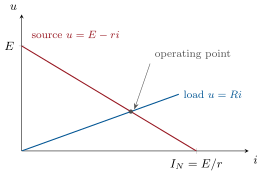
An ideal voltage source imposes u=Eu = E whatever the current; EE is its electromotive force (emf). An ideal current source imposes i=INi = I_N whatever the voltage. A real source (battery, generator, power supply) is modeled, in the generator convention, by

u=Eri(Theˊvenin model: ideal emf E in series with r)u = E - r\,i \quad (\text{Thévenin model: ideal emf } E \text{ in series with } r)

or, equivalently, by i=INu/ri = I_N - u/r (Norton model: ideal current source IN=E/rI_N = E/r in parallel with rr); rr is the internal resistance. EE is the open-circuit voltage, IN=E/rI_N = E/r the short-circuit current.

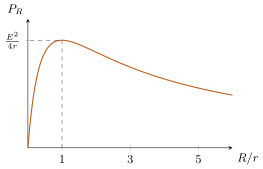
Left: the characteristics of a real source (u = E - ri) and of a resistive load (u = Ri) meet at the operating point. Right: the power delivered to the load peaks at R = r, where half of the source’s power is wasted in its own resistance. Left: the characteristics of a real source (u = E - ri) and of a resistive load (u = Ri) meet at the operating point. Right: the power delivered to the load peaks at R = r, where half of the source’s power is wasted in its own resistance.
Left: the characteristics of a real source (u=Eriu = E - ri) and of a resistive load (u=Riu = Ri) meet at the operating point. Right: the power delivered to the load peaks at R=rR = r, where half of the source’s power is wasted in its own resistance.
Read in context →