সব বই

পেশাদার

1 Markets I: The Ecosystem and Exchange-Traded Marketsবাজার অনলাইন 2 Markets II: Rates, FX and Creditবাজার অনলাইন 3 Markets III: Commodities, Energy and Cryptoবাজার অনলাইন 4 Quantitative Methodsপদ্ধতি অনলাইন 5 Derivatives and Volatilityডেরিভেটিভস অনলাইন 6 Rates, Credit, XVA and Riskসুদহার, ঋণ ও ঝুঁকি অনলাইন 7 Research Craft: Predictors, Backtests, Measurement, Portfoliosগবেষণা অনলাইন 8 Strategies I: Equities and Futuresকৌশল অনলাইন 9 Strategies II: Volatility, Relative Value, Macro and the Bank Desksকৌশল অনলাইন 10 Microstructure and Executionএক্সিকিউশন অনলাইন 11 Market Making and High-Frequency Tradingমার্কেট মেকিং অনলাইন 12 Machine Learning for Marketsমেশিন লার্নিং অনলাইন 13 Low-Latency Softwareপ্রযুক্তি অনলাইন 14 Networks, Hardware and Trading Infrastructureপ্রযুক্তি অনলাইন 15 Research, Data and Risk Platformsপ্রযুক্তি অনলাইন 16 The Desk and the Firmপ্রতিষ্ঠান অনলাইন 17 The Industry: Firms, Roles and Careersক্যারিয়ার অনলাইন 18 Interviews I: Maths, Probability and Speedক্যারিয়ার অনলাইন 19 Interviews II: Markets, Trading Games and the Final Roundক্যারিয়ার অনলাইন 20 Interviews III: Codeক্যারিয়ার অনলাইন
অ্যাপ পরিচিতি Coach সাইন ইন পড়া শুরু করো

বইগুলো এখনো বাংলা ভাষায় পাওয়া যায় না — ইংরেজি সংস্করণ দেখানো হচ্ছে।

Physics · পরিভাষা

Ideal and real sources কী?

Definition 6.8 University Physics — Year 1 · অধ্যায় 6 — DC Circuits: Kirchhoff’s Laws and Theorems

An ideal voltage source imposes u=Eu = E whatever the current; EE is its electromotive force (emf). An ideal current source imposes i=INi = I_N whatever the voltage. A real source (battery, generator, power supply) is modeled, in the generator convention, by

u=E−r i(Theˊvenin model: ideal emf E in series with r)u = E - r\,i \quad (\text{Thévenin model: ideal emf } E \text{ in series with } r)

or, equivalently, by i=IN−u/ri = I_N - u/r (Norton model: ideal current source IN=E/rI_N = E/r in parallel with rr); rr is the internal resistance. EE is the open-circuit voltage, IN=E/rI_N = E/r the short-circuit current.

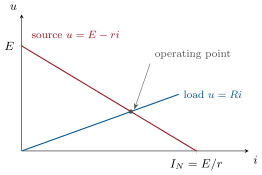
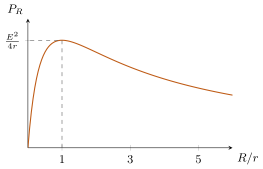
Left: the characteristics of a real source (u = E - ri) and of a resistive load (u = Ri) meet at the operating point. Right: the power delivered to the load peaks at R = r, where half of the source’s power is wasted in its own resistance. Left: the characteristics of a real source (u = E - ri) and of a resistive load (u = Ri) meet at the operating point. Right: the power delivered to the load peaks at R = r, where half of the source’s power is wasted in its own resistance.
Left: the characteristics of a real source (u=E−riu = E - ri) and of a resistive load (u=Riu = Ri) meet at the operating point. Right: the power delivered to the load peaks at R=rR = r, where half of the source’s power is wasted in its own resistance.
প্রসঙ্গসহ পড়ো →