
Physics · Glossary

What is Incandescent sources?

Also known as: incandescence

Definition 11.12 High School Physics · Chapter 11 — Color and Light Sources

A source glowing because it is hot — flame, filament, star — shines by incandescence. Its spectrum is the continuous thermal spectrum of Chapter 2, and its peak obeys Wien’s law (Proposition 2.7),

λmax×T=2.90×10³mK,\lambda_{\max} \times T = 2.90 \times 10^{-3}\,\mathrm{m}\,\mathrm{K},

our quantitative tool from now on: peak measured, temperature known.
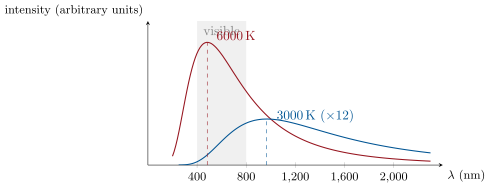
Thermal spectra at 6000\, K and 3000\, K, peaks _ dashed at 483 and 967\, nm; the cooler curve, magnified twelve times, would otherwise hug the axis.
Thermal spectra at 6000K6000\,\mathrm{K} and 3000K3000\,\mathrm{K}, peaks λmax\lambda_{\max} dashed at 483483 and 967nm967\,\mathrm{nm}; the cooler curve, magnified twelve times, would otherwise hug the axis.

Examples

Example 11.13 (A very inefficient lamp)

A tungsten filament at T=2700KT = 2700\,\mathrm{K} peaks at λmax=2.90×10³mK/2700K=1.07×106m=1070nm\lambda_{\max} = 2.90 \times 10^{-3}\,\mathrm{m}\,\mathrm{K}/2700\,\mathrm{K} = 1.07 \times 10^{-6}\,\mathrm{m} = 1070\,\mathrm{nm}, deep in the infrared: most of the electric power leaves as invisible radiation, only about 5%5\% as light — the incandescent bulb was mainly a heater.

Read in context →