High School Physics · Grades 10–12
11Color and Light Sources
Ask a physicist for the color of a tomato and you get a counter-question: under which light? The tomato only diffuses what it is given, the lamp only gives what its spectrum contains, and the eye compresses whatever arrives into three numbers. Color is a negotiation between source, object and eye — this chapter interrogates all three parties in turn.
11.1 Seeing in three numbers
Definition 11.1 (Cones and trichromatic vision)
The retina (Chapter 10) carries two families of light-sensitive cells: the rods, which respond to faint light but ignore wavelength (night vision, in gray), and the cones, in three types most sensitive near (blue), (green) and (red). Human color vision is trichromatic: whatever the spectrum, the brain receives only three cone responses, and color is what it makes of that triple.
Definition 11.2 (Color as a perception)
Color is therefore a perception, not a property of light alone: a spectrum specifies an intensity at every wavelength, the eye keeps three numbers. Lights with different spectra but the same three cone responses look strictly the same: they are metamers.
Example 11.3 (Two yellows)
The line of a sodium lamp excites the red and green cones almost equally: the brain says yellow. A screen lighting its red () and green () subpixels gives the same yellow with no light near . A prism separates the two instantly; the eye never can.
11.2 Adding lights
Definition 11.4 (Additive synthesis)
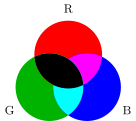
Superposing light beams on a white screen adds their spectra: this is additive synthesis. Three well-chosen lights, red, green and blue — the additive primaries — mix into almost every perceivable color: R G yellow, R B magenta, G B cyan, and R G B white.
Proposition 11.5 (Complementary colors)
Two lights whose sum is perceived as white are complementary. The three pairs yellow/blue, cyan/red and magenta/green are complementary.
Proof. Yellow is R G; adding blue completes the triple to white. The other two pairs are the same argument, one primary at a time. ∎
Example 11.6 (Screens)
Each pixel of a phone screen is three subpixels — red, green, blue, under wide — too close for the eye to separate, so their lights add on the retina: yellow is R and G lit, orange is R at full power and G at half, white is all three. A magnifying glass on a white area reveals the trick: no white anywhere, only R, G, B.
11.3 Subtracting from white light
Definition 11.7 (Subtractive synthesis)
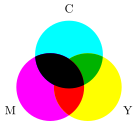
A filter (colored glass, a gel, a layer of ink or paint) transmits part of the spectrum it receives and absorbs the rest. Producing colors by removing bands from white light is subtractive synthesis. Its primaries, complements of the additive ones, each subtract one band: cyan white R, magenta white G, yellow white B. Stacked filters subtract jointly: cyan yellow leaves green, cyan magenta blue, magenta yellow red, all three black. Printing and painting work this way, with C, M, Y inks.
Method 11.8 (Spectrum bookkeeping)
To predict a color through any chain of sources, filters and objects, track the three primary bands: write the source’s light as its content in R, G, B; at each filter or surface, delete the absorbed bands; name the color of what survives (nothing left black).
Example 11.9 (A filter chain)
White light crosses a yellow filter: the blue band is absorbed, leaving — yellow. A cyan filter then absorbs the red band, leaving : green. Swapping the filters changes nothing: each absorbs its own band regardless of order.
11.4 The color of an object
Definition 11.10 (Diffusion and object color)
An opaque object absorbs part of the light it receives and diffuses the rest — re-emits it in every direction, toward our eyes among others. The color of an object is the color of the light it diffuses under the given illumination: the object supplies its absorption habits, the source the raw material. Change the lamp, change the color.
Example 11.11 (The red shirt)
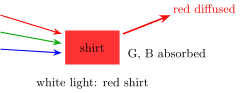
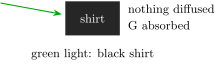
A shirt looks red in daylight: it absorbs the green and blue bands and diffuses the red one. Under a pure green light there is no red band to diffuse: the shirt absorbs everything and appears black. Under magenta light it diffuses the red band alone: still red. A white object diffuses every band it receives (under green light it looks green); a black object absorbs them all under every light — which is also why black clothing heats up in the sun.
11.5 Light sources and color temperature
Definition 11.12 (Incandescent sources)
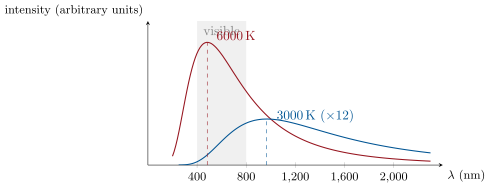
A source glowing because it is hot — flame, filament, star — shines by incandescence. Its spectrum is the continuous thermal spectrum of Chapter 2, and its peak obeys Wien’s law (Proposition 2.7),
our quantitative tool from now on: peak measured, temperature known.
Example 11.13 (A very inefficient lamp)
A tungsten filament at peaks at , deep in the infrared: most of the electric power leaves as invisible radiation, only about as light — the incandescent bulb was mainly a heater.
Definition 11.14 (Spectral lamps and lasers)
A spectral lamp — a low-pressure gas excited by a discharge: sodium, mercury, neon — emits a line spectrum (Chapter 2): a few isolated wavelengths, nothing in between. A laser goes further: one single wavelength, monochromatic light, in one narrow beam.
Definition 11.15 (LEDs)
A light-emitting diode (LED) emits a quasi-monochromatic band a few tens of nanometers wide: narrow enough to look a definite color, far broader than a laser line. A white LED is a blue LED (peak near ) coated with a phosphor, a material absorbing part of the blue and re-emitting it as a broad yellow band: blue and yellow being complementary (Proposition 11.5), the mixture reads as white.
Definition 11.16 (Color temperature)
The color temperature of a white-ish source is the temperature of the incandescent body whose hue its light matches: candle , incandescent bulb , halogen , midday sun , overcast daylight . It is a color label, not a thermometer reading — a LED runs at room temperature — and vocabulary runs backwards: low color temperature reads “warm” orange, high “cool” bluish.

11.6 Exercises
Exercise 11.1 ★
Give the color perceived when a white screen receives simultaneously: (a) red and green light; (b) green and blue light; (c) all three primaries. Which light is complementary to blue?
Solution
Solution of Exercise 11.1.
(a) yellow; (b) cyan; (c) white. Complementary to blue: yellow (blue yellow blue red green white).
Exercise 11.2 ★
Which subpixels (R, G, B) does a screen light up to display: yellow, magenta, white, black, orange?
Exercise 11.3 ★
White light crosses a magenta filter. Which band is absorbed, and what color emerges? A cyan filter is then added behind it: what emerges now?
Solution
Solution of Exercise 11.3.
Magenta absorbs the green band: emerges, magenta light. The cyan filter then absorbs the red band: only survives — blue.
Exercise 11.4 ★
Under white light a flag shows a yellow stripe. Which bands does it diffuse, which does it absorb? Its color under (a) red; (b) blue light?
Exercise 11.5 ★
A star’s continuous spectrum peaks at . Compute its surface temperature.
Solution
Solution of Exercise 11.5.
.
Exercise 11.6 ★★
A candle flame sits at about . (a) Compute and give its domain. (b) The flame nevertheless looks orange: explain.
Exercise 11.7 ★★
A cyclist wears a red jacket and cyan gloves. Using Method 11.8, give the apparent color of each item under (a) white light; (b) red light; (c) green light.
Solution
Solution of Exercise 11.7.
Jacket (diffuses R): (a) red; (b) red; (c) black. Gloves (diffuse G and B, absorb R): (a) cyan; (b) black; (c) green.
Exercise 11.8 ★★
An old street is lit by low-pressure sodium lamps (a single line at ). (a) What type of spectrum is this, and what colors can any object take under it? (b) A car looks black under these lamps and blue in daylight: explain.
Solution
Solution of Exercise 11.8.
(a) An emission line spectrum. Every object can only diffuse or nothing: the street is shades of yellow-orange and black.
(b) The blue car diffuses only the blue band. Daylight contains it: blue car. The sodium line carries no blue: everything is absorbed, the car looks black.
Exercise 11.9 ★★
A green laser pointer emits at . (a) Its beam crosses a prism: compare the outcome with that of a white beam, and name the property illustrated. (b) It then meets a red filter: what comes out?
Solution
Solution of Exercise 11.9.
(a) The white beam fans out into a rainbow; the laser beam is deviated but stays a single beam of the same green: it is monochromatic — one wavelength, nothing for the prism to sort.
(b) The red filter transmits only the red band and absorbs : almost nothing comes out; the spot disappears.
Exercise 11.10 ★★
Describe the spectrum of a white LED (blue diode plus phosphor), and explain why its light is perceived as white. Why does a deep red object look duller under a cheap white LED than in daylight?
Solution
Solution of Exercise 11.10.
Spectrum: a narrow blue peak near plus the phosphor’s broad yellow band (roughly –). Blue and yellow are complementary, so the cone triple reads white. The band fades toward deep red, so a deep red object receives little it can diffuse: it looks duller than in daylight, whose continuous spectrum feeds it fully.
Exercise 11.11 ★★
Compute for an incandescent body at (a) a candle’s color temperature (); (b) overcast daylight’s (). Which of the two lights is called “warm”? Comment.
Exercise 11.12 ★★★
A sodium lamp () and a screen displaying yellow (subpixels at and ) look exactly the same color. (a) What are two such lights called, and what does their existence prove about color? (b) Propose two different experiments that tell them apart, and predict the outcome of each.
Solution
Solution of Exercise 11.12.
(a) Metamers. Their existence proves that color is a perception — three cone responses — and not the spectrum itself: infinitely many spectra map to the same triple.
(b) Prism or spectroscope: one line at against two bands at and . Red filter: it absorbs , the sodium spot goes dark, while the screen’s subpixel survives — the screen patch turns red.
Exercise 11.13 ★★★
A theater halogen spot runs at . (a) Compute : is this light warmer or cooler than daylight? (b) To imitate daylight, the spot is covered with a pale blue gel. What does the gel remove, and why does the stage get dimmer? (c) Explain why no gel could instead strengthen the blue end of the spot’s spectrum.
Solution
Solution of Exercise 11.13.
(a) . Color temperature : warmer (more orange) than daylight.
(b) The gel absorbs part of the red-orange excess to rebalance the spectrum toward blue; since a filter only removes light, the total power on stage drops.
(c) A filter is passive: it can absorb at each wavelength but never emit, so no gel can raise the blue intensity above what the spot already produces.
Exercise 11.14 ★★★
A butcher lights the meat display with LEDs of color temperature ; the fishmonger next door uses . (a) Describe the hue of each lighting and its effect on red meat and on white fish. (b) Has either merchant changed his goods? Say exactly where the change happens (Definition 11.10).
Solution
Solution of Exercise 11.14.
(a) : warm, red-rich light — the meat’s red band is well fed, the meat looks vividly fresh. : cool bluish-white — the fish diffuses the full triple and looks bright white, freshly iced.
(b) Neither changed his goods: the absorption habits of meat and fish are untouched. What changed is the illumination, hence the diffused light — the color of an object is defined only under a given illumination.
Exercise 11.15 ★★★
A town next to an observatory must relight its streets and hesitates between low-pressure sodium lamps and broad-spectrum white LEDs. (a) Which choice do the astronomers prefer, and why? (Think of what a single filter can remove from their images.) (b) Which choice do drivers and pedestrians prefer? Justify with object colors. (c) Propose a compromise, phrased with color temperature.
Solution
Solution of Exercise 11.15.
(a) Sodium: all the city’s glow sits in one line at , which a single narrow filter removes from telescope images. A broad LED spectrum cannot be filtered out without discarding the starlight too.
(b) Drivers and pedestrians prefer the LED: under its full spectrum objects keep distinguishable colors (a red coat stays red), while sodium light makes everything yellow-orange or black.
(c) Warm white LEDs, around : acceptable color rendering for the street, and a spectrum poor in the blue end, the part that pollutes the night sky most.
11.7 Problem: Engineering color
Problem 11.1
Weekend problem — stage lights, sodium streets and the white LED: how color is engineered, from three spotlights that can paint any hue to the chip that lights this page
A lighting designer owns only red, green and blue spotlights; a street engineer owns a lamp that emits one single wavelength; a chip maker owns a diode that only shines blue. All three sell color. This problem runs their trades in turn — additive mixing on stage, monochrome economy in the street, phosphor alchemy in the chip — and ends by choosing the light for a bedroom and for a jeweler’s window.
Part I — The stage: painting with three spotlights.
- The three spots overlap on a white backdrop. Name the color of each pairwise overlap and of the triple overlap.
- How does the designer make orange? And a pale pink? (Describe the spot powers qualitatively.)
- A dancer stands before the backdrop, lit by the red and green spots only. Two colored shadows appear: color of each? Explain.
- The backdrop is repainted deep blue. What does it look like under the red spot alone? Under all three?
- Why can three spots reproduce “almost every” color? Which piece of anatomy fixes the number three?
Part II — Costumes: subtraction at work.
- A costume is yellow in white light. Which band does its dye absorb?
- Predict its color under the red spot, the green spot, the blue spot.
- The designer wants the costume to flip from bright to black at one flick of a switch. Which spot does the flick switch to?
- A magenta gel is slid in front of a white spot lighting the yellow costume. Track the bands (Method 11.8): costume color?
- Why do stage gels come in cyan, magenta and yellow rather than red, green and blue? (What would a red gel do to a white spot’s power?)
Part III — Sodium streets: the monochrome economy.
- A low-pressure sodium lamp emits essentially one line at . What type of spectrum is this, and what does the whole street look like under it?
- Under this lamp, give the apparent color of a white wall, a yellow road marking, a red car, a blue car.
- Why did astronomers love these lamps? (What can one filter do to the whole city’s glow?)
- A tungsten street bulb at is proposed instead. Compute its : where does most of its power go?
- The sodium lamp converts about of its electric power into visible light, the tungsten bulb about . How many watts of light does each deliver per of power?
Part IV — The white LED and the choice of a light.
- A white LED is a blue diode () under a yellow phosphor. Explain, with complementary colors, why its output reads as white.
- Describe its spectrum and compare it with the continuous spectrum of daylight. Which band is under-represented?
- Deduce which objects such an LED renders poorly, and connect this with the butcher of Exercise 11.14.
- An LED bulb is sold as “”. Is anything inside it at ? What does the label promise? Compute the of the incandescent body it imitates.
- Finale — choose, with one sentence of justification each, a color temperature for a bedroom lamp and one for a jeweler’s window; then state the chapter’s law of color in one line.
Solution
Solution of Problem 11.1.
1. R G yellow, R B magenta, G B cyan; triple overlap white.
2. Orange: red at full power, green at partial power, blue off. Pale pink: all three on (white base) with red slightly dominant.
3. The shadow cast from the red spot receives only the green spot: green shadow; symmetrically the other shadow is red.
4. Deep blue paint diffuses only B. Under the red spot alone: black. Under all three: it diffuses the blue band — blue.
5. The eye reduces any spectrum to three cone responses; matching the triple is enough to match the color. Three cone types fix the number of spotlights.
6. Yellow white blue: the dye absorbs the blue band.
7. Red spot: diffuses R — red. Green spot: diffuses G — green. Blue spot: absorbs everything — black.
8. Light the scene with the blue spot alone; the flick is white blue. The yellow costume diffuses R and G but absorbs B: bright under white, black under blue.
9. Magenta gel: . The costume diffuses R and G of what it receives: it diffuses R, absorbs B — red costume.
10. A red gel keeps one band of three and dumps two thirds of the white spot’s power; each C, M, Y gel removes a single band, keeps two thirds, and stacking two of them still yields any primary.
11. An emission line spectrum. The street becomes a monochrome world: every surface is yellow-orange, dimmer or brighter, or black.
12. White wall: yellow-orange (diffuses the line). Yellow marking: bright yellow-orange. Red car: dark — the line lies outside the band it diffuses. Blue car: black.
13. One narrow filter centered on removes the entire city glow from an image while sacrificing almost none of the stars’ broad spectra.
14. : the peak, and most of the power, lies in the infrared — heat, not light.
15. Sodium: of visible light; tungsten: . Six times more light for the same bill.
16. The phosphor converts part of the blue into a broad yellow band; blue and yellow are complementary, so blue yellow completes the triple: white.
17. A narrow blue spike plus a broad yellow hump — against daylight’s even continuum. The deep red end (and a dip between blue and yellow) is under-represented.
18. Deep red objects are rendered dull and brownish. Hence the butcher’s warm LEDs, whose reinforced red content keeps the meat vivid.
19. Nothing inside is at : the chip runs near room temperature. The label promises only the hue of a incandescent body, whose peak would be .
20. Bedroom: about — warm, low-blue light for rest. Jeweler: – — daylight-like white, so whites read white and stones return every band. The law: perceived color source spectrum object absorption, read through three cones.