 Coach
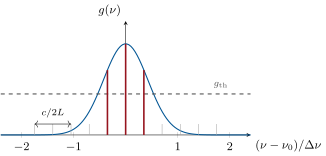
CoachA laser is an amplifying medium of length placed between two mirrors (reflectances , ) a distance apart: a Fabry–Pérot cavity (Chapter 21). One mirror, the output coupler, is partly transmitting ( of a few per cent) and lets the beam out. Light that goes round the cavity is amplified twice by the medium and attenuated by the mirrors and by the other losses (scattering, absorption, diffraction).
Examples
Example 23.11 (The helium–neon laser)
A glass tube long, bore , holding helium and neon at about a thousandth of an atmosphere, crossed by a discharge of a few milliamperes. Electrons excite helium to a metastable level at , which hands its energy by collision to a neon level at almost exactly the same height; from there neon decays to a lower level (emptying fast to the ground state — four-level) by emitting at . The small-signal gain is tiny, a few per cent per pass, so the mirrors must be excellent (, ) and the tube clean; the gain line is Doppler-broadened to , the modes are apart, so two or three modes oscillate at once. Output for several watts of discharge: efficiency ; but a wavelength defined to and a beam that stays wide across the laboratory.
Example 23.14 (Cutting, reading, pointing)
A carbon-dioxide laser at , beam radius , focused by : , peak irradiance — steel boils. A pointer, at : , a spot at , an irradiance of at the exit — above sunlight, which is why even a milliwatt must never enter an eye: the eye’s lens would focus it to a spot on the retina at millions of watts per square metre. A disc reader at with a lens of numerical aperture focuses to about , the size of a pit.