University Physics — Year 2 · Bachelor Year 2
21Multiple-Wave Interference and Gratings
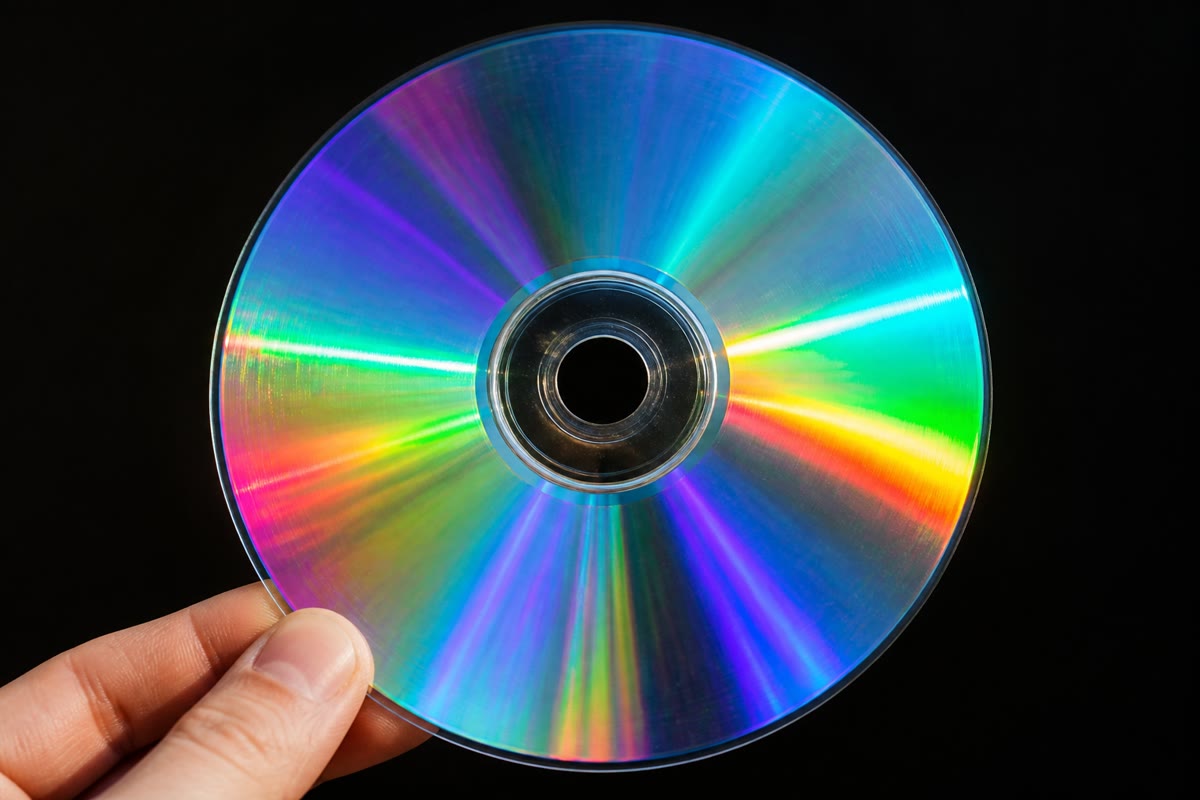
Tilt a compact disc under a lamp and it throws a rainbow: its spiral of pits, a micrometre and a half apart, is a grating — thousands of tiny reflecting strips, each sending back a copy of the wave, all interfering. Two waves give the soft fringes of the last chapters; a thousand give fringes a thousand times narrower, sharp enough to separate two wavelengths that differ by a part in a hundred thousand. That is the instrument with which the composition of the Sun and the speed of galaxies were read, and which sits in every spectrometer. This chapter adds up waves, derives the grating equation, its dispersion and its resolving power, and meets the other multiple-wave device, the Fabry–Pérot cavity that will become the laser’s resonator.
21.1 Interference of waves
Theorem 21.1 ( equal waves in arithmetic phase progression)
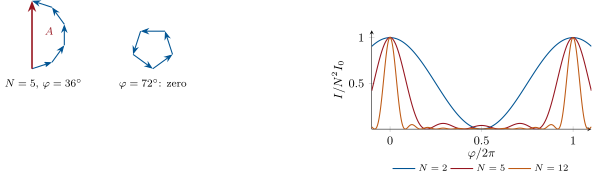
coherent waves of equal amplitude , each lagging the previous by the phase , superpose into a wave of amplitude and intensity
principal maxima of intensity where (all waves in phase), of angular half-width in (the first zeros are at ), separated by secondary maxima no higher than about of the principal ones for large . The more waves, the sharper and brighter the peaks: the width shrinks as , the height grows as , the energy (their product) as .
Proof. Complex amplitudes , : a geometric series, . Zeros where but : , not a multiple of . In the phasor picture the arrows close into a regular polygon at the zeros and align at the principal maxima. ∎
21.2 The diffraction grating
Proposition 21.2 (Grating equation)
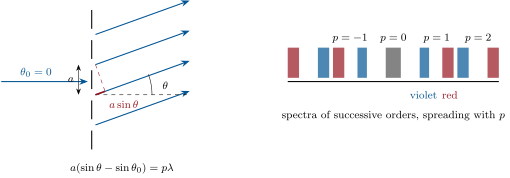
A grating is a set of identical, equidistant, parallel slits (or grooves) of period . A plane wave incident at the angle from the normal is re-emitted by each slit; in the direction the waves from neighbouring slits have the path difference , and they reinforce in the directions
— the orders of the grating. The zero order is the undeviated beam for every wavelength; each other order spreads the wavelengths, with the angular dispersion
larger for a finer grating and a higher order; the maximum order is . A reflection grating (grooves ruled on a mirror) obeys the same equation with the reflected angles.
Proof. The phase between successive slits is ; the principal maxima of Theorem 21.1 are at . Differentiate at fixed , . ∎
Example 21.3 (A classroom grating and a CD)
A grating of lines per millimetre () at normal incidence sends light to , in the first order, in the second, and has no third order (); its first-order spectrum runs from () to (). A compact disc, , is such a grating in reflection — hence the rainbow, and the fact that a DVD () spreads it wider. The second-order red ( at ) overlaps the third-order violet: orders overlap beyond the first, a nuisance cured with filters or a prism.
21.3 Resolving power
Proposition 21.4 (Resolving power of a grating)
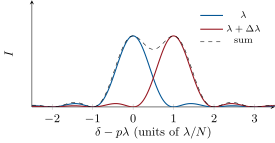
Two close wavelengths and are just resolved in order when the principal maximum of one falls on the first zero of the other (Rayleigh’s criterion), which happens for
the resolving power is the order times the number of lines lit. It can also be written with the width of the grating: the largest path difference across the grating, in wavelengths — which is why large spectrographs use gratings tens of centimetres wide and work at grazing angles.
Proof. The maximum of order for is at for that wavelength, i.e. at ; the first zero of the maximum for is at . Equating: . Then . ∎
Example 21.5 (Separating the sodium lines)
The doublet, at , needs : a thousand lines in the first order, of a grating. Its own line width, , needs : a grating in the first order, or in the second — and a grating of in the second order reaches , resolving : the width of a line broadened by the thermal motion of the atoms, and the Doppler shift of a star moving at .
21.4 The Fabry–Pérot cavity
Proposition 21.6 (Multiple-wave interference by division of amplitude)
Two parallel partially reflecting mirrors (intensity reflectance ) a distance apart transmit a wave at normal incidence only in so far as the waves that have bounced times between them add in phase: with the round-trip phase, the transmitted intensity is (Airy’s function)
sharp peaks of full transmission at (the resonances of the cavity, spaced in frequency by the free spectral range ), of relative width with the finesse — for , for . It is the grating’s equal in resolving power ( with , hence ) and, closed on itself, the resonator of the laser (Chapter 23).
Proof. Each round trip multiplies the amplitude by (up to a constant phase); the transmitted amplitude is with ; its squared modulus is . Peaks at ; half-maximum where , i.e. , against the between peaks. ∎
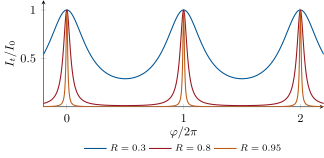
Method 21.7 (Grating calculations)
(1) Period ; grating equation with the signs of the angles. (2) List the orders that exist () and check their overlap ( against ). (3) Dispersion , converted to a position on the detector with the focal length: . (4) Resolving power with the lines actually illuminated; compare with the structure to be resolved. (5) For real instruments add the entrance slit’s width (it blurs the lines) and the detector’s pixels.
21.5 Exercises
Exercise 21.1 ★
A grating of lines per millimetre at normal incidence, : angles of the orders; highest order; angular width of the first-order visible spectrum (–); same grating at incidence: orders on each side.
Solution
Solution of Exercise 21.1.
, : , , ; no fourth order. First-order visible from to : . At : : () on one side, to (, , , , ) on the other.
Exercise 21.2 ★
The sodium doublet with a -lines/mm grating and a lens of : angular and linear separation of the two lines on the detector in the first and second orders; pixel size needed to see them apart.
Solution
Solution of Exercise 21.2.
. Order 1: , , ; order 2: , , . Pixels of or less.
Exercise 21.3 ★
Resolving power of a grating of lines/mm in orders , , ; smallest resolved at ; does it separate the sodium doublet? The hydrogen H line from its deuterium twin ( apart)?
Solution
Solution of Exercise 21.3.
: , , ; , , ; the doublet () and the H/D pair (, needing ) are easily separated.
Exercise 21.4 ★
A compact disc () and a DVD () lit at normal incidence: angles of first-order violet and red; which orders exist for each; why does the CD show two rainbows and the DVD one?
Solution
Solution of Exercise 21.4.
CD: violet , red ; red exists to order 2, violet to order 4: two (partly overlapping) rainbows. DVD: violet , red ; red has only the first order: one rainbow, wider.
Exercise 21.5 ★★
The -slit pattern. (a) Show that between two principal maxima there are zeros and secondary maxima. (b) For large , intensity of the first secondary maximum relative to the principal one (at ): about . (c) Sketch the pattern for and and give the heights of the secondary maxima for . (d) Fraction of the total energy in the principal maxima for large (compare the integrals of the peak, width , height , with the rest).
Solution
Solution of Exercise 21.5.
(a) Zeros at , : zeros, maxima between them. (b) At , : of . (c) : a single secondary maximum at of height , one ninth of the principal ; : four secondary maxima of a few percent. (d) The central lobe of holds of the energy.
Exercise 21.6 ★★
Overlapping orders. (a) Show that order of overlaps order of when ; for –, from which order? (b) Free spectral range in order : . (c) A spectrograph works in order near (an echelle grating): free spectral range; how is the overlap removed (cross-disperser)? (d) The Fabry–Pérot’s free spectral range is : write it in wavelength and compare with the grating’s.
Solution
Solution of Exercise 21.6.
(a) : from . (b) . (c) ; a prism crossed with the grating stacks the orders one above the other. (d) , a fraction of a nanometre — hundreds of times smaller than a grating’s.
Exercise 21.7 ★★
Blazed grating. A reflection grating has its grooves tilted by the blaze angle so that each facet reflects specularly into the direction where the order is wanted. (a) For the Littrow mount (): show ; blaze angle for first-order with lines/mm. (b) Why does the blaze send most of the light into one order (think of the envelope of a single facet’s diffraction, Chapter 22)? (c) The same grating is blazed for : in which order is it efficient at ? (d) Resolving power of a grating in Littrow at , (use ).
Solution
Solution of Exercise 21.7.
(a) , . (b) The single facet diffracts into a broad lobe centred on its specular direction; the orders that fall inside it get the light. (c) Order 2 ( at the same angle). (d) .
Exercise 21.8 ★★
The slit. A spectrometer’s entrance slit of width is imaged on the detector with magnification ; the grating ( lines/mm, , order , ) disperses. (a) Width of a line on the detector due to the slit alone for , in nm. (b) Width due to the grating’s resolving power. (c) Which dominates; slit width at which the two are equal. (d) Why not close the slit further?
Solution
Solution of Exercise 21.8.
(a) : is . (b) : . (c) The slit, by nine; equal at . (d) Diffraction at the slit and a starved detector.
Exercise 21.9 ★★
Fabry–Pérot. Mirrors , , . (a) Order , free spectral range in frequency and in wavelength. (b) Finesse; width of a transmission peak in frequency and wavelength. (c) Resolving power ; compare with the grating. (d) Why is a Fabry–Pérot always used with a prefilter or a grating?
Solution
Solution of Exercise 21.9.
(a) ; FSR , . (b) ; , . (c) , four times the grating’s. (d) Its free spectral range is a fraction of a nanometre: the orders overlap unless the light is prefiltered to one of them.
Exercise 21.10 ★★★
The limit of a grating. (a) Show that : the resolving power cannot exceed the width of the grating in wavelengths, times two. (b) Interpret: the largest path difference between the extreme rays. (c) A grating at : ultimate ; smallest resolvable velocity by Doppler shift (). (d) Why do astronomers nevertheless reach (think of measuring the position of a line to a fraction of its width, with many lines)?
Solution
Solution of Exercise 21.10.
(a) . (b) The extreme rays differ in path by at most . (c) ; . (d) A line’s centre is located to a hundredth of its width, and a thousand lines average down by : metres per second, with heroic stability.
Exercise 21.11 ★★★
Bragg. A crystal is a three-dimensional grating: X-rays reflected by successive atomic planes a distance apart, at the glancing angle , interfere constructively when (Bragg). (a) Derive it from the path difference between two planes. (b) Copper K radiation () on rock salt (): the Bragg angles. (c) Why do visible wavelengths give no Bragg reflection from crystals, and what does the converse (no X-ray diffraction from glass) tell about glass? (d) Why must ?
Solution
Solution of Exercise 21.11.
(a) The wave reflected by the lower plane travels more. (b) : , , . (c) : no angle satisfies the equation; glass has no regular planes, hence only diffuse rings — it is amorphous. (d) .
Exercise 21.12 ★★★
Phased array. identical antennas in a line, spaced , fed with the same amplitude and a phase step between neighbours. (a) Show that the radiated field in the direction is that of the -wave sum with : the main beam points where . (b) Half-width of the main beam, . (c) Why must to avoid a second main beam (a grating lobe) when steering? (d) A radar with elements at , : beam width; time to scan in steps of one beam width if the phases switch in .
Solution
Solution of Exercise 21.12.
(a) Neighbours differ in phase by from the path and from the feed; the principal maximum at . (b) First zero at : . (c) A second principal maximum at needs : impossible for every steering angle only if . (d) : ; steps, .
21.6 Problem: A spectrograph for a star
Problem 21.1
Weekend problem — designing the spectrograph that reads a star’s light: the grating, the detector, the lines of hydrogen, and the wobble of a planet
A spectrograph: entrance slit, collimator of focal length , a reflection grating of lines/mm and width , a camera of , a detector with pixels. It works in the first order, around , with the grating at incidence.
Part I — The grating.
- Period of the grating; number of lines lit if the beam covers the whole width.
- Diffraction angle of in the first order; of and ; angular width of the visible spectrum.
- Angular dispersion at ; linear dispersion on the detector in nm per mm and nm per pixel.
- Resolving power; smallest resolved at ; in pixels.
- Does the second-order violet fall onto the first-order visible? Which filter removes it?
- Length of detector needed for the whole visible spectrum in the first order.
- The grating is blazed at : for which wavelength is it most efficient in the first order at this incidence (use the Littrow estimate )?
- The grating returns of the light at the blaze wavelength and the telescope plus optics : fraction of the star’s photons that reach the detector.
Part II — Lines.
- The hydrogen Balmer lines of the star: H , H , H : their positions on the detector relative to .
- H from a deuterium atom is shorter: separated? By how many pixels?
- The sodium doublet in the star’s spectrum: separation in pixels; and the width of each line if the star’s atmosphere broadens them to .
- The entrance slit is wide, imaged at magnification : its width on the detector in pixels and in nm; is the spectrograph slit-limited or grating-limited?
- The light from the telescope comes as a disc of on the sky, which the telescope () makes wide at the slit: fraction of light lost if the slit is narrowed to (take the disc as uniform).
- Why does a narrower slit give sharper lines but noisier spectra?
Part III — The star moves.
- A star recedes at : Doppler shift of H in nm and in pixels.
- The Earth’s orbital motion adds over the year: why must it be subtracted, and to what precision if one wants ?
- A planet makes its star wobble at : shift in nm and in pixels; is it below the resolution? Explain how measuring the centre of a line to a hundredth of its width, over a thousand lines, recovers it (statistical gain ).
- The temperature of the instrument changes by , and the grating (glass, expansion ) dilates: shift of the lines in pixels; what stability is needed for ?
- A calibration lamp (thorium–argon) puts hundreds of known lines on the same detector: explain its role.
Part IV — Alternatives.
- The same width of grating ruled at lines/mm and used in the fourth order (with a cross-disperser to sort the orders): diffraction angle, resolving power, dispersion and free spectral range at ; what has changed, what has not?
- A Fabry–Pérot etalon (, ) placed before the slit: free spectral range in nm, finesse, peak width; what does its comb of transmission peaks look like on the detector, and what is it used for?
- A prism of in glass with has the angular dispersion near minimum deviation: compare with the grating’s; why did gratings replace prisms?
- Why are the largest astronomical spectrographs built with gratings a metre wide and used at large angles (the limit )?
- A magnitude-8 star delivers photons per second and per nanometre at the telescope: photons per pixel per second on the detector, and the signal-to-noise ratio of a exposure (photon noise only).
- Summarize: the three numbers that describe a spectrograph (dispersion, resolving power, free spectral range) and what sets each.
Solution
Solution of Problem 21.1.
1. ; .
2. (the order lies on the other side of the normal): at , at , at : of spectrum.
3. ; : , i.e. , per pixel.
4. : , a third of a pixel.
5. Second-order lands where first-order would, beyond the red: no overlap in the visible; the overlap would start at , which a glass filter removes.
6. : a detector covers a slice; the grating is turned to choose it.
7. .
8. .
9. Angles , , : , and from the position.
10. is pixels: separated.
11. pixels apart, each pixels wide.
12. , pixels, — twenty times the grating’s limit: slit-limited.
13. The image is wide: a slit passes half the light.
14. Less light for the same sharpness: the photon noise grows.
15. , pixels.
16. The Earth’s velocity shifts every line by up to pixels through the year; it is known from the ephemerides to far better than the needed for .
17. , pixel — far below the line width. A centroid to a hundredth of a line is ; a thousand lines give : pixel — the signal, just. Real instruments add resolving power and stability.
18. , , : half a pixel per kelvin — millikelvins for .
19. Its lines, recorded at the same instant on the same pixels, give the wavelength scale and track every drift.
20. , , same angle (), , same dispersion, FSR : resolving power and dispersion depend on and the angle only; the free spectral range shrank.
21. FSR ( pixels); ; peaks wide: a comb of sharp lines across the detector, a wavelength ruler.
22. against : six times less, and a prism’s resolving power () and non-linear scale lose too; gratings also work in the ultraviolet.
23. : for a metre at — width and angle are the only ways up.
24. photons per pixel per second; in : SNR .
25. Dispersion, set by and the camera’s focal length; resolving power, by the illuminated width and the angles (); free spectral range, by the order ().