Coach
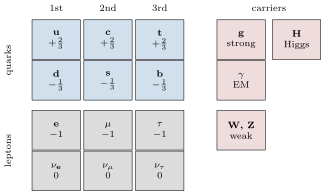
CoachMatter’s building blocks are spin- fermions (Chapter 12, Chapter 14) in two families of six. Leptons feel no strong force: the electron, muon and tau (charge , each heavier than the last) and their three neutrinos — nearly massless, nearly undetectable. Quarks come in six flavours — up, down, strange, charm, bottom, top — with charges (u, c, t) and (d, s, b), and they are never seen alone: confinement binds them into hadrons — three-quark baryons (proton uud, neutron udd) and quark–antiquark mesons (pion, kaon). Each particle has an antiparticle of identical mass and opposite charges (Exercise 26.8). Ordinary matter uses only the first generation — u, d, e, ; the two heavier copies differ, as far as anyone knows, only in mass. “Who ordered that?” physics still asks.