University Physics — Year 3 · Bachelor Year 3
14Identical Particles
Every electron in the universe is strictly, perfectly identical to every other — not similar the way two coins from one mint are, but indistinguishable in principle: no tag, no scratch, no history can mark one. Quantum mechanics takes this seriously, and the consequences run the world. Swapping two identical particles must change nothing observable, which leaves the many-particle wave function only two options: stay the same (bosons) or change sign (fermions). From the minus sign alone follow the Pauli exclusion principle, the shell structure and the whole periodic table, the stiffness of matter underfoot, and the pressure that holds up dead stars; from the plus sign follow the gregariousness of photons — hence the laser — and, three chapters ahead, Bose–Einstein condensation. Rarely in physics has one sign carried so much.
14.1 The symmetrisation postulate
Definition 14.1 (Exchange)
For two identical particles with state space spanned by products (particle 1 in , particle 2 in — positions, spins and all), the exchange operator swaps the roles: . It is Hermitian, squares to the identity, and commutes with any Hamiltonian that treats the particles identically: its eigenvalues are conserved labels of the world.
Theorem 14.2 (Bosons and fermions)
States of identical particles are not merely allowed but required to be eigenstates of every exchange: totally symmetric for one class of particles — bosons — and totally antisymmetric (a sign change under every swap) for the other — fermions. Which class a species belongs to is fixed by its spin (the spin–statistics theorem, proved only in relativistic quantum field theory and admitted here):
Photons, pions and He atoms are bosons; electrons, protons, neutrons and He are fermions. A composite behaves as the sum of its parts: an even number of fermions bound together is a boson (He: 2p + 2n + 2e), an odd number a fermion (He) — with consequences as visible as two different liquid heliums.
Proof. Admitted at this level. ∎
Corollary 14.3 (The Pauli exclusion principle)
Two fermions can never occupy the same single-particle state: putting in the antisymmetric combination gives the zero vector — no such state exists. For electrons (spin ), each orbital admits at most two, of opposite spin projection.
Example 14.4 (Counting differently)
Two particles among two states : classical (distinguishable) counting gives four configurations; bosons have three (, , and one mixed state); fermions exactly one (the mixed, antisymmetric one). Statistical physics will inherit these counts wholesale (Chapter 19); already here they dissolve a nineteenth-century embarrassment — the entropy of “mixing” two samples of the same gas (Exercise 14.10).
14.2 The periodic table
Proposition 14.5 (Shells, and why chemistry exists)
Fill the hydrogen-like orbitals with one electron each, lowest energies first, in the level order set by penetration and screening (, , , , , , , …— Exercise 11.8). Pauli’s principle makes the filling saturate: electrons close the first shell, the second and third rows, and the table of elements acquires its periods. Chemistry is the physics of whichever electrons the exclusion principle left outermost: full shells (noble gases) are inert; one electron beyond a full shell (alkalis) or one hole short of one (halogens) is reactive in opposite ways. Without the minus sign, every electron would sink into , every atom would be a shrunken helium-like ball, and there would be no bonds, no molecules, and no chemists to regret it.
Proof. Admitted at this level. ∎

14.3 The exchange interaction
Proposition 14.6 (Symmetry of the spatial pair state)
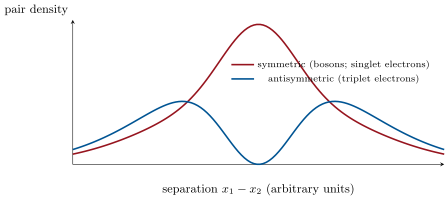
For two electrons, the total state (space spin) must be antisymmetric: a singlet (antisymmetric spin, Exercise 12.11) forces a symmetric spatial wave function, a triplet an antisymmetric one. The two differ physically: in the antisymmetric spatial state the electrons can never coincide () and keep apart, while the symmetric state lets them bunch. Since proximity costs Coulomb energy, the spin arrangement acquires an energy difference — the exchange energy — of electrostatic size (electron-volts!), though no magnetic force of that strength exists: spins align or anti-align because of geometry plus repulsion. This is the engine of Hund’s rule, of helium’s two spectra, of the covalent bond, and — scaled up through a crystal — of ferromagnetism itself (Chapter 22).
Partial proof. The symmetry bookkeeping is Theorem 14.2 plus the spin combinations; the vanishing at coincidence is antisymmetry read at . The energy consequence is first-order perturbation theory in the repulsion: the direct term is common to both symmetries and the cross (“exchange”) integral enters with opposite signs (Exercise 14.6). ∎
Example 14.7 (The two heliums in one atom)
Helium’s excited states come in two families that barely intercombine: parahelium (singlet, symmetric space) and orthohelium (triplet, antisymmetric space), the triplet lying lower — its exchange hole spares Coulomb repulsion. The ground state is necessarily para ( forces the symmetric spatial state); and the lowest ortho state, with no lower triplet to decay to and spin flips forbidden, lives for hours — a metastable atom used as a workhorse in atomic beams. Nineteenth-century spectroscopists catalogued “two heliums”; the resolution is one minus sign.
Example 14.8 (The covalent bond)
Bring two hydrogen atoms together: the two electrons can enter the symmetric spatial combination of the two atomic orbitals (spins singlet) or the antisymmetric one (triplet). The symmetric state piles charge between the protons, where it attracts both: binding — the covalent bond of H, deep. The antisymmetric state evacuates the midplane: purely repulsive. Every line of organic chemistry is bookkeeping of paired-spin electrons shared symmetrically — the exclusion principle, run in reverse, is the glue of molecules.
14.4 Bosons: the more, the merrier
Proposition 14.9 (Bosonic enhancement)
Transitions that add a boson to a state already holding of them have amplitudes enhanced by — rates by (the ladder algebra of Chapter 9, since a bosonic mode is an oscillator). The “” is spontaneous emission; the “” is stimulated emission, proportional to the crowd already present: the avalanche behind every laser (Year 2 volume), now revealed as pure exchange symmetry. The same statistics, applied to atoms cooled until their wave packets overlap, predicts a stampede into a single quantum state — Bose–Einstein condensation, kept for Chapter 19.
Proof. Admitted at this level. ∎
Method 14.10 (Handling identical particles)
(1) Decide the statistics from the spin (composites: add the fermion count). (2) For two electrons, factor space spin and pair singlet with symmetric space, triplet with antisymmetric. (3) Count states, never particles-with-names: list occupations. (4) Energy questions with repulsion: direct integral once, exchange integral with the symmetry’s sign. (5) Remember the two slogans — fermions: at most one per state, an exchange hole around each; bosons: rates boosted by occupancy.
14.5 Exercises
Exercise 14.1 ★
(a) Show is Hermitian and : what are its possible eigenvalues? (b) Show for identical particles and conclude the symmetry class is conserved. (c) Why can a state of two identical particles not simply “be” with no symmetry? (d) Classify: H, H (deuterium), He, He, a hydrogen molecule, a photon.
Solution
Solution of Exercise 14.1.
(a) Swapping twice is doing nothing: eigenvalues . (b) Identical particles enter symmetrically, so : the symmetry class never changes. (c) and would be different states describing the same physical situation — an unobservable distinction the formalism must not carry. (d) H (2 fermions): boson; deuterium (3): fermion; He: boson; He: fermion; H (4): boson; photon: boson.
Exercise 14.2 ★
(a) Write the normalised antisymmetric state built from orthogonal orbitals . (b) Show it vanishes when . (c) For three fermions in : write the fully antisymmetric combination (six terms, alternating signs — a determinant) and check one swap flips its sign. (d) Why does the determinant form make Pauli’s principle automatic?
Solution
Solution of Exercise 14.2.
(a) . (b) Identically zero. (c) The alternating sum over the six permutations — the determinant of orbitals against particles; swapping two rows flips a determinant’s sign. (d) A determinant with two equal columns vanishes: two fermions in one orbital is a repeated column.
Exercise 14.3 ★
Two particles share three orthogonal states. Count the two-particle states for (a) distinguishable particles; (b) bosons; (c) fermions (spinless). (d) Repeat (c) for electrons with spin: how many states now?
Solution
Solution of Exercise 14.3.
(a) . (b) doubles pairs . (c) pairs. (d) Six single-particle states (three orbitals two spins): .
Exercise 14.4 ★
(a) Give the ground configurations of carbon, nitrogen, oxygen and neon. (b) State Hund’s rule and apply it to nitrogen’s three electrons. (c) Justify Hund’s rule in one sentence from Proposition 14.6. (d) Which element’s full shells make it the least reactive substance known, and which single missing electron makes fluorine the most avid?
Solution
Solution of Exercise 14.4.
(a) C: ; N: ; O: ; Ne: . (b) Nitrogen’s three electrons occupy the three orbitals singly, spins parallel. (c) Parallel spins force an antisymmetric spatial state, whose exchange hole spares Coulomb repulsion — alignment is bought with electrostatic savings. (d) Helium (with its noble kin); fluorine, one electron short of neon’s closure, tears one from almost anything.
Exercise 14.5 ★★
Two non-interacting particles in a box of levels . (a) Ground energy for two bosons; for two spinless fermions; for two electrons. (b) First excited level of each. (c) The fermionic ground state costs more: this “Fermi promotion” is a pressure in embryo — explain in one sentence how it stops matter from collapsing. (d) Generalise: spinless fermions in the box — show the ground energy grows as , not .
Solution
Solution of Exercise 14.5.
(a) Bosons: ; spinless fermions: ; electrons: (opposite spins share ). (b) Bosons and electrons: ; spinless fermions: . (c) Compressing fermions forces occupation of ever-higher levels: the energy cost per squeeze is an outward pressure that no cooling removes — matter’s incompressibility in embryo. (d) : the Fermi sea’s total grows as .
Exercise 14.6 ★★
With orthogonal real orbitals and pair states : (a) show ; (b) derive , and identify which symmetry keeps the particles farther apart; (c) for a repulsive interaction , argue the sign of ; (d) connect to helium’s ortho–para ordering.
Solution
Solution of Exercise 14.6.
(a) The two terms cancel at . (b) Expanding, the cross terms contribute : the antisymmetric state has the larger mean square separation. (c) Farther apart means less repulsion energy: . (d) Helium’s triplet (antisymmetric space) lies below the same configuration’s singlet — orthohelium under parahelium, by of spared repulsion.
Exercise 14.7 ★★
Helium’s ladder. (a) Why must the ground state be a spin singlet? (b) The triplet lies below the singlet: express this as an exchange integral and compare its size with magnetic spin–spin energies (, evaluate it). (c) Why is the state metastable (which two selection rules must both be broken)? (d) Its measured life is : compare with the of hydrogen and marvel responsibly.
Solution
Solution of Exercise 14.7.
(a) is a symmetric spatial state: the spins must form the antisymmetric singlet. (b) Splitting : . The genuine magnetic dipole–dipole energy at : — a thousand times smaller: the “spin force” is electrostatics wearing spin’s colours. (c) Decay to needs a spin flip (singlet–triplet) and an transition (): doubly forbidden. (d) s against : twelve orders of magnitude, from two selection rules — metastability is rules stacked, not forces weakened.
Exercise 14.8 ★★
Ortho- and para-hydrogen. The two protons of H are fermions: the total nuclear-spin rotational state must be antisymmetric under their exchange; exchanging the protons also reverses the molecular axis, multiplying the rotational state by . (a) Show nuclear triplet (ortho) pairs with odd , singlet (para) with even . (b) At high temperature, what ortho:para ratio do the spin multiplicities dictate? (c) The lowest state of ortho () lies above para’s , and spin conversion takes days: what happens inside a tank of freshly liquefied hydrogen as the ortho fraction slowly converts, and why must liquefier plants catalyse the conversion before storage? (d) Which everyday cryogenic fuel programme (rockets!) meets this exact problem?
Solution
Solution of Exercise 14.8.
(a) Total exchange sign (spin part) must be : triplet (symmetric spin) takes odd , singlet even . (b) from the multiplicities. (c) The 3/4 ortho fraction relaxes to para (), releasing per molecule — more than the latent heat of the liquid: an uncatalysed tank slowly boils itself dry. Plants convert ortho para over a catalyst during liquefaction. (d) Liquid hydrogen rocketry — every launch pad inherits a nuclear-spin statistics problem.
Exercise 14.9 ★★
Bosonic stampede. A mode holds photons; matrix elements for adding one scale as . (a) Show emission rates into the mode scale as and absorption as . (b) In a cavity where one mode holds photons and its neighbours hold none, compare an excited atom’s emission rates into each. (c) Explain in two sentences how this makes laser light grow in a single mode. (d) Where in Proposition 9.7 did the already appear?
Solution
Solution of Exercise 14.9.
(a) Rates go as the amplitude squared: into an occupied mode, for the reverse. (b) against : the crowded mode wins by ten billion. (c) One spontaneous photon in the favoured mode tilts the odds; each stimulated photon raises and steepens the tilt: an avalanche of identical photons — gain narrowing into a single mode. (d) In : the bosonic mode is the oscillator, and the enhancement is its ladder coefficient.
Exercise 14.10 ★★★
Gibbs’s paradox, resolved by identity. Two equal volumes of ideal gas, molecules each, same temperature, are joined. (a) If the gases are different (say argon and neon), the entropy rises by — recall why (each gas doubles its volume). (b) If they are the same gas, opening the tap changes nothing macroscopic: what absurdity would follow if the mixing entropy appeared anyway (consider closing and reopening)? (c) Show that treating the molecules as distinguishable does produce the spurious entropy, and that dividing the state count by — legitimate only because molecules are identical — removes it. (d) Moral, in one sentence: classical statistical physics silently borrows a quantum fact; the next chapters will borrow it loudly.
Solution
Solution of Exercise 14.10.
(a) Each gas expands into double the volume: per gas. (b) Closing and reopening the tap would manufacture entropy without any change of state — perpetual bookkeeping fraud. (c) With named molecules, the combined gas has extra “which-side” assignments worth ; dividing all state counts by — the honest count for identical particles — removes exactly this. (d) The that classical physics needed and could not justify is the symmetrisation postulate seen from afar.
Exercise 14.11 ★★★
Pauli holds up the dead. A white dwarf packs about , i.e. electron density (one electron per two nucleon masses). (a) Compute the Fermi energy from Exercise 7.8 — and notice the non-relativistic formula strains. (b) Compare with at : in what sense is this white-hot star cold? (c) Explain in two sentences how exclusion, not heat, supplies the pressure that balances gravity. (d) What must happen as mass is added and turns relativistic — which famous limit does that foreshadow (Chapter 27)?
Solution
Solution of Exercise 14.11.
(a) — a third of the electron’s rest energy: the star sits at the edge of the relativistic regime. (b) : on the Fermi scale the white-hot star is deeply degenerate — “cold”. (c) The electrons stack Pauli-fashion up to ; compressing the star raises every occupied level, and that energy gradient is a pressure independent of temperature — exclusion, not heat, carries the weight. (d) Relativistic degeneracy softens the pressure law until gravity wins at a finite mass: the Chandrasekhar limit, kept for Chapter 27.
Exercise 14.12 ★★★
From exchange to magnets. Model two neighbouring electrons in a solid by Proposition 14.6: their energy is or with exchange constant . (a) Show this is reproduced by the effective spin Hamiltonian (use ). (b) For neighbouring spins align: what macroscopic phenomenon does a lattice of such pairs produce? (c) Estimate the ordering temperature for and compare with iron’s . (d) Why could no magnetic dipole–dipole interaction (recall its size from Exercise 14.7b) explain a thousand-kelvin magnet — and what does, in one sentence?
Solution
Solution of Exercise 14.12.
(a) : on the singlet, on the triplet — the stated Hamiltonian reproduces the split. (b) A lattice of aligned neighbours: spontaneous magnetisation — ferromagnetism. (c) : iron’s is exactly this scale. (d) Dipole–dipole magnetism is eV: it would order at millikelvins. Ferromagnetism is Coulomb repulsion choosing spin arrangements through exchange geometry.
14.6 Problem: The logic of the periodic table
Problem 14.1
Weekend problem — three quantum rules build all of chemistry
Hand a physicist the hydrogen orbitals , the electron’s spin, and the Pauli principle, and the periodic table follows — periods, families, sizes, the zigzag of ionisation energies, even the colour of gold. This problem builds it. Data: hydrogenic levels eV; measured first ionisation energies (eV): H , He , Li , Be , B , C , N , O , F , Ne , Na .
Part I — The three rules.
- State the three ingredients: the orbital catalogue with its degeneracies, the spin doubling, and the exclusion principle. How many electrons fit in , , ?
- Why does the energy order of subshells in a many-electron atom differ from hydrogen’s pure- order (recall penetration and screening, Exercise 11.8)?
- Write the filling order through and , and give the configurations of Na (), Cl (), K (), Fe ().
- Row lengths: explain the observed of the table’s first four periods from the filling order (why is the third row 8, not 18?).
- What single feature makes the noble gases chemically silent?
- Define the effective charge seen by a valence electron, and explain why it is roughly for sodium’s outer electron while helium’s electrons each see nearly the full minus a fraction of one another’s screening.
Part II — Reading the second row.
- From the data, ionisation energy climbs from Li to Ne but dips at B and at O: locate both dips.
- Explain the boron dip (which subshell opens at B, and why is costlier to hold than ?).
- Explain the oxygen dip (what must two of oxygen’s electrons do for the first time, and which rule’s comfort is lost?).
- Estimate helium’s ionisation energy naively as : why is the measured so much smaller, and what number is the fit telling you?
- Lithium’s against hydrogen’s : what pair of effects (screening; higher ) conspires?
- Why does atomic size shrink across a row (Li Ne) though electrons are being added?
Part III — Families and bonds.
- Alkalis: one electron over a noble core — derive their family traits (low ionisation, ions, violent water chemistry) from the configuration.
- Halogens: one hole in a shell — derive theirs (electron affinity, ions, diatomic molecules).
- Carbon’s four: why is a atom tetravalent in practice (what near-degeneracy lets it promote and hybridise — recall the Stark hybrids of Example 13.4)?
- Use Example 14.8: why do two closed-shell atoms (two heliums) form no covalent bond?
- Transition metals: the / near-degeneracy makes ten columns of similar chemistry: why does filling an inner shell change the chemistry so little?
- Predict, from configurations alone, which of K, Ca, Sc first shows magnetism-ready unpaired electrons.
Part IV — Beyond the rules of thumb.
- Hund’s rule assigns nitrogen three parallel spins: which measurable atomic property (its magnetic moment) does this fix, and which chapter-14 mechanism pays for the alignment?
- The table’s very existence requires strict identity of electrons: what would “slightly distinguishable” electrons do to Pauli’s principle and to shell closure?
- In heavy atoms the inner electrons move at : for gold (), estimate for the pair and state qualitatively what relativity does to the orbital’s energy — the accepted explanation of gold’s colour and mercury’s liquidity.
- The subshell fills before yet ionises first in transition metals, and chromium and copper borrow an electron to reach and : what do these anomalies say about how close the two subshells’ energies run?
- Two isotopes of an element are chemically all but identical: from the three rules, why does chemistry care only about and hardly at all about the nucleus’s mass?
- Period 7 ends near and superheavy chemistry departs from the table’s naive column logic: name the two competing scales (shell structure versus relativistic and Coulomb effects at large ).
- Summarise the named result: one catalogue of orbitals, one doubling by spin, one minus sign — and the outcome is the periodic law: rows , the dips at B and O, the families of the reactive and the noble, all measured in the ionisation ladder from (Na) to (He).
Solution
Solution of Problem 14.1.
1. Orbitals with per ; spin doubles; Pauli caps one electron per full label: , , . 2. Inner electrons screen the nucleus differently for different : penetrating orbitals sink below less penetrating and — energy order follows , not alone. 3. Order ; Na: [Ne]; Cl: [Ne]; K: [Ar]; Fe: [Ar]. 4. Rows close at each noble configuration: (), (), again ( — because lies above and waits), then (). 5. A closed shell: large gap to the next orbital, no cheap electron to give, no room to take. 6. is the nuclear charge minus the screening of inner (and partially, same-shell) electrons: sodium’s valence electron sees ; helium’s two share the bare , each screening the other by only a third. 7. Li Be rises, drops at B; N O drops: the two dips. 8. Boron opens , higher and less penetrating than : its new electron is simply easier to remove. 9. Oxygen must, for the first time, pair two electrons in one orbital: extra repulsion, lost exchange stabilisation — the fourth electron is discounted. 10. Each electron screens the other imperfectly: the fit gives — two-thirds of a charge screened. 11. A nearly complete core screen () and the outer electron’s : both cut the binding. 12. Added electrons enter the same shell and screen each other poorly while climbs: grows and the whole shell contracts — neon is smaller than lithium. 13. One cheap electron over a noble core: ionisation , instant ions, violent electron donation — the family traits are one configuration. 14. One hole in a closure: huge electron affinity, ions, and pairing of holes into X molecules. 15. and lie close: promotion four half-filled hybrids costs little and buys two extra bonds — carbon tetravalence is a near-degeneracy exploited. 16. With four electrons, both the bonding and antibonding combinations fill: the gains cancel, no covalent bond — helium remains a loner. 17. The electrons bury themselves inside the skin: outer chemistry, set by the shell, changes little across ten elements — a chemical plateau. 18. Scandium, [Ar]: the first unpaired electron. 19. A magnetic moment of three aligned spins (); the alignment is paid by exchange — Coulomb savings, not magnetic forces. 20. Slightly distinguishable electrons could all crowd toward (no exact cancellation of symmetrised states): shells would leak, closures blur, and the periodic law dissolve. 21. : relativistic mass increase contracts and stabilises the orbital; gold’s absorption slides into the blue (leaving reflected yellow), and mercury’s tightened pair bonds so feebly the metal is liquid. 22. They run nearly level: occupation-dependent ordering, ionising first, and the / borrowings of Cr and Cu — half-filled and filled subshells buy exchange stability cheaply. 23. Chemistry is the electrons’ affair, and the electrons feel only the nuclear charge: mass enters merely through tiny vibrational (isotope) shifts. 24. Shell structure (favouring noble-gas logic) against relativistic stabilisations and sheer Coulomb strain at : superheavy chemistry is their tug-of-war. 25. A catalogue of orbitals, one doubling, one minus sign: rows , dips at boron and oxygen, families from alkali to noble, the ionisation ladder from to — the periodic law derived, not memorised.