University Physics — Year 3 · Bachelor Year 3
26Particle Physics
Strip matter of its structure, layer by layer — molecules, atoms, nuclei, nucleons — and the peeling stops, abruptly, at a short list: six quarks, six leptons, a handful of force carriers, and one shy scalar found in 2012. Everything you have ever touched is three entries of that list; the rest lived in the first microsecond of the universe and live again, briefly, wherever is paid in full — cosmic-ray collisions and accelerator rings. This chapter takes inventory: the particles, the four interactions that move them, the conservation laws (Chapter 1’s Noether currents, now running the subatomic bookkeeping), and the detectors that photograph it all. It ends in your own attic, counting muons made ten kilometres overhead.
26.1 The inventory
Definition 26.1 (Leptons, quarks, hadrons)
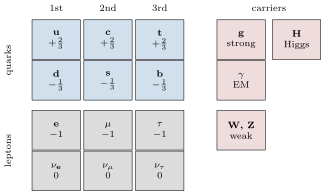
Matter’s building blocks are spin- fermions (Chapter 12, Chapter 14) in two families of six. Leptons feel no strong force: the electron, muon and tau (charge , each heavier than the last) and their three neutrinos — nearly massless, nearly undetectable. Quarks come in six flavours — up, down, strange, charm, bottom, top — with charges (u, c, t) and (d, s, b), and they are never seen alone: confinement binds them into hadrons — three-quark baryons (proton uud, neutron udd) and quark–antiquark mesons (pion, kaon). Each particle has an antiparticle of identical mass and opposite charges (Exercise 26.8). Ordinary matter uses only the first generation — u, d, e, ; the two heavier copies differ, as far as anyone knows, only in mass. “Who ordered that?” physics still asks.
Remark 26.2 (Four interactions)
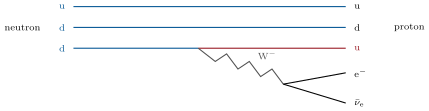
Every process is one of four forces at work, each carried by its boson. The strong force (gluons) grips quarks with a potential that grows with distance — pull two quarks apart and the stretched field snaps into a fresh quark–antiquark pair (Exercise 26.1): hence confinement, and a residue of it glues nuclei (Chapter 25). Electromagnetism (photon, massless: infinite range) runs chemistry and light. The weak force (W and Z, a massive –: range , hence “weak”) is the only flavour-changer — decay is a d quark becoming a u (Proposition 26.3) — and the only force neutrinos answer to. Gravity is times feebler than electromagnetism between two protons and plays no laboratory role — yet, unscreened and long-ranged, it will run all of Chapter 27. Electromagnetism and the weak force unify at high energy into one electroweak interaction — split apart, at our cold energies, by the Higgs field’s symmetry breaking (Exercise 26.9).
26.2 The bookkeeping: conservation laws
Proposition 26.3 (Conservation laws of particle reactions)
A reaction happens only if it balances the books. Always conserved: energy–momentum (Chapter 5), angular momentum, and electric charge — Noether’s theorem (Theorem 1.13) underwriting each. Conserved in every reaction yet observed: baryon number (baryons , antibaryons ) and lepton number (per family, to excellent accuracy). Thus the proton, the lightest baryon, has nowhere to decay — matter’s stability is a bookkeeping theorem — and decay must ship an antineutrino:
balancing (and explaining the electron’s continuous energy spectrum, which nearly cost physics its faith in energy conservation before Pauli invented the neutrino to save it). Flavours (strangeness, charm) are conserved by strong and electromagnetic processes but broken by the weak: strange particles are born copiously in pairs, then die slowly and alone — the gap between strong lifetimes and weak ones is the fingerprint of which force signed the decay.
Proof. Admitted at this level. ∎
26.3 Making and seeing particles
Remark 26.4 (Accelerators and detectors)
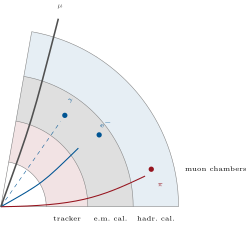
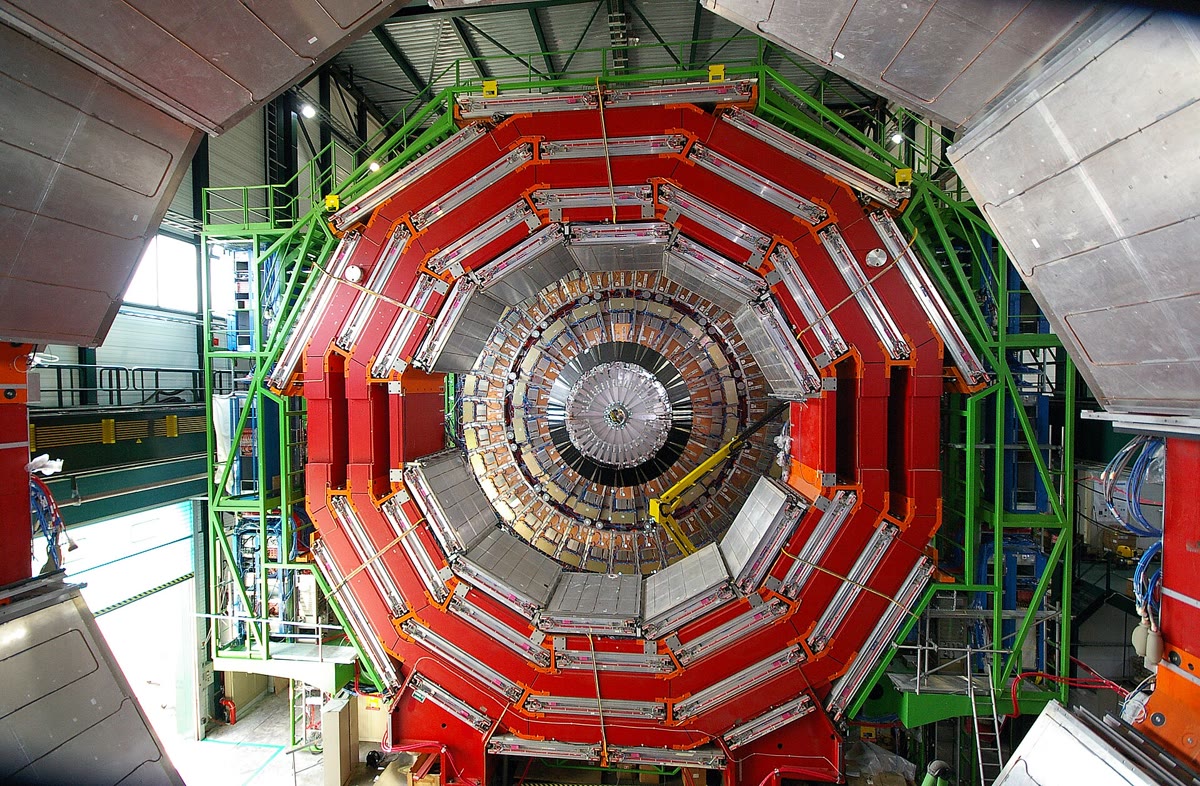
Two reasons to accelerate: resolution — a probe sees no detail finer than its wavelength (Chapter 23 used ångströms; femtometres cost s) — and creation: collision energy becomes new mass, and colliding two beams head-on spends it all (a fixed target wastes most of it carrying the debris forward: Exercise 26.4). Circular colliders recycle the same particles through the same accelerating gap while magnets steer them — paying synchrotron radiation , which is why the ring that found the Higgs collides heavy protons, not featherweight electrons. Around the crossing point sit onion layers, each asking one question: a tracker bends charged paths in a magnet (momentum); an electromagnetic calorimeter swallows electrons and photons (energy); a hadronic one swallows pions and protons; and only muons punch through to the outermost chambers — identity by depth of burial. Neutrinos leave as missing momentum: bookkeeping detects what nothing can stop.
Remark 26.5 (The Higgs, and the open ledger)
The Standard Model’s symmetry forbids bare masses for its particles; the Higgs field, filling all space with a nonzero condensate — the double-well choice of Chapter 21, promoted to the vacuum itself — breaks the symmetry and grants masses through its couplings: heavier particle, stronger grip. Its own quantum, the Higgs boson (, found 2012), completed the table. The open ledger is longer: neutrinos oscillate between flavours and so must have mass the model never wrote in (Exercise 26.10); galaxies rotate as if held by five times more matter than shines (Chapter 27); and the universe contains matter but almost no antimatter, an asymmetry the model’s tiny CP-violation cannot yet pay for. The list is the syllabus of whatever comes next.
26.4 Exercises
Exercise 26.1 ★
Quark arithmetic. (a) Verify the charges of p uud and n udd. (b) The pion is : check its charge. (c) Propose quark contents for and for the (charge ). (d) Why does pulling a quark out of a proton yield a meson shower instead of a free quark?
Solution
Solution of Exercise 26.1.
(a) uud: ; udd: . (b) (the anti-down carries ). (c) ; uuu ( — the state whose statistics helped force the invention of colour). (d) The stretched gluon field stores energy length; long before a quark is free, the stored energy exceeds and the string snaps into a fresh pair: you pull out a meson, never a bare quark.
Exercise 26.2 ★
Sorting. For each of e, , , p, n, : (a) lepton, baryon or meson? (b) which feel the strong force? (c) which are stable in isolation? (d) which can a magnetic field not deflect?
Exercise 26.3 ★
Allowed or forbidden? Judge, naming the violated law if any: (a) ; (b) (for a free proton); (c) ; (d) .
Solution
Solution of Exercise 26.3.
(a) Allowed — standard decay (the free neutron does it, ). (b) Forbidden by energy: the products outweigh the free proton (inside a nucleus, binding energy can pay, and bound decay happens). (c) Forbidden: baryon number (and lepton number ). (d) Forbidden by family lepton number: muon-ness would vanish and electron-ness appear — never observed, and hunted precisely for that reason.
Exercise 26.4 ★
The price of creation. Producing a proton–antiproton pair from a proton beam on a hydrogen target requires (by Chapter 5’s invariant-mass argument) a beam kinetic energy of . (a) Evaluate in GeV. (b) In a collider, two beams of what kinetic energy suffice for the same pair? (c) Compute the “waste” ratio and explain where the fixed-target energy goes. (d) Why did the antiproton’s 1955 discovery machine need ?
Solution
Solution of Exercise 26.4.
(a) . (b) Kinetic energy per beam ( head-on). (c) About : momentum conservation condemns most fixed-target energy to useless forward motion of the debris — head-on beams spend everything. (d) The 1955 machine was designed to just clear the threshold: accelerator budgets are written in invariant mass, and the antiproton arrived on schedule.
Exercise 26.5 ★★
The muon, twice over. The muon (, ) is the electron’s heavy twin. (a) What distance is ? (b) Cosmic muons born at reach the ground: what does survival demand, and what energy is that? (c) Describe the same survival from the muon’s own frame. (d) Why does the muon decay to an electron but never to a proton, and why is its decay slow by particle standards?
Solution
Solution of Exercise 26.5.
(a) . (b) A dilated range of needs : — exactly the cosmic scale. (c) In its own frame the muon lives its plain while the atmosphere rushes past contracted to : same survival, other ledger. (d) Baryon number: there is no baryon light enough, and the muon is a lepton; its decay must change flavour, which only the weak force does — hence stately microseconds instead of strong-force yoctoseconds.
Exercise 26.6 ★★
Inside decay. (a) Write neutron decay at the quark level and check all conserved quantities. (b) The emitted electron’s energy spectrum is continuous up to an endpoint: explain how this once threatened energy conservation and how Pauli’s neutrino rescued it. (c) The W boson weighs : estimate the weak force’s range (). (d) Use that range to explain in one sentence why the “weak” force is weak at low energy yet electroweak-strong at high.
Solution
Solution of Exercise 26.6.
(a) : charge ; baryon number ; electron-family number . (b) A two-body decay fixes the electron’s energy; the observed continuum meant either energy conservation failed (Bohr entertained it) or a third, invisible body shared the budget — Pauli’s neutrino, detected twenty-five years later. (c) — a thousandth of a proton. (d) At low energies the interaction must bridge a gap its heavy mediator makes absurdly short, so amplitudes are tiny; near the W is affordable and the “weak” force shows its true electroweak strength.
Exercise 26.7 ★★
Strange bookkeeping. Kaons and hyperons carry a flavour, strangeness, conserved by the strong force but not the weak. (a) Explain why cosmic-ray collisions produce strange particles only in pairs. (b) The lives — compare with the of strong decays and conclude which force kills it. (c) What ratio of timescales separates the two, and to what everyday ratio is that comparable (one second against what)? (d) How did this “strange” behaviour — copious birth, reluctant death — force the invention of a new quantum number?
Solution
Solution of Exercise 26.7.
(a) The strong force conserves strangeness, so it can only make and together: a kaon with its hyperon. (b) Thirteen orders of magnitude too slow for the strong force: the weak force, sole breaker of flavour, signs the death certificate. (c) : one second against three hundred thousand years. (d) Copious birth said “strong”; reluctant death said “not strong” — only a new conserved number, made by the strong force in pairs and broken by the weak, reconciles the two: the bookkeeping was the discovery.
Exercise 26.8 ★★
Antimatter, cashed. (a) Why must (one photon) be forbidden, while two photons are fine? (b) Compute the energy released by annihilating one gram of antimatter with one of matter, and compare with Exercise 25.9’s kilogram of fissioned uranium. (c) PET scanners (Exercise 25.12) run on positrons: where do medicine’s positrons come from? (d) Making antiprotons costs times their rest energy in wall-plug power: comment on antimatter as a fuel.
Solution
Solution of Exercise 26.8.
(a) In the pair’s rest frame the total momentum is zero: one photon can never have zero momentum, two back-to-back can — conservation writes PET’s geometry. (b) : two grams of annihilation outdo a fissioned kilogram of uranium. (c) From cyclotron-made isotopes — F, built into glucose: the body’s own chemistry places the positron source in the hungriest cells. (d) A fuel that costs a million times its yield, with no natural mines: antimatter is a detector calibration and a storyteller’s engine, not an energy source.
Exercise 26.9 ★★★
The Higgs as a phase transition. (a) Restate, in the language of Exercise 21.12, what it means that the vacuum sits in a broken-symmetry well. (b) Why do the W and Z get masses while the photon stays massless (what part of the symmetry survives)? (c) The Higgs boson is the field’s radial oscillation: what plays this role in the magnet of Theorem 21.4? (d) Above the symmetry restores: where and when was the universe last that hot (Chapter 27)?
Solution
Solution of Exercise 26.9.
(a) The Higgs potential is a double well (a Mexican hat): the symmetric point is a summit, and the vacuum rolled into the rim — the universe’s ground state broke its own symmetry, exactly like the magnet choosing north. (b) The choice breaks only part of the symmetry: the combination that survives is electromagnetism, so its carrier — the photon — keeps zero mass, while W and Z, carriers of the broken directions, eat the corresponding stiffness as mass. (c) The radial oscillation of the order parameter — in the magnet, the fluctuation of about its equilibrium value near . (d) In the first seconds of the universe (Chapter 27): above the electroweak temperature every particle was massless and the two forces were one.
Exercise 26.10 ★★★
Neutrinos by the billion. (a) The Sun makes two neutrinos per cycle (): from the solar constant , compute the neutrino flux at Earth. (b) How many cross your thumbnail () per second, and roughly how many will interact with your body in a lifetime (take an interaction probability of order per metre of flesh per neutrino as given)? (c) Early detectors caught only a third of the predicted : state the resolution (oscillations) and its structural consequence for the Standard Model. (d) Why does a neutrino detector live under a mountain?
Solution
Solution of Exercise 26.10.
(a) Each delivers two neutrinos: flux . (b) Through a thumbnail: per second. Lifetime passages through your , -thick body over : about , times : order one — a single solar neutrino will touch you in your whole life. (c) The missing had oscillated into and en route; oscillation requires mass differences, so neutrinos have mass — the first laboratory crack in the massless-neutrino Standard Model. (d) The mountain filters out everything else: only neutrinos pass, so kilometres of rock turn the noisiest sky into the quietest laboratory.
Exercise 26.11 ★★★
Machine numbers. LHC protons: each. (a) Compute and . (b) What wavelength probes structure, and compare with the proton’s radius. (c) Head-on collision energy: — how many proton rest masses could that create? (d) Synchrotron loss scales as : compute the electron-to-proton ratio at fixed energy and justify protons for the ring, electrons for precision machines.
Solution
Solution of Exercise 26.11.
(a) : — three metres per second short of light. (b) : thirty-thousandth of a proton radius — quark territory. (c) proton masses — were all of it convertible. (d) At fixed energy , so electron losses are worse: protons for brute-force rings, electrons (clean, point-like) for precision at lower energy.
Exercise 26.12 ★★★
Messengers from the edge. The highest-energy cosmic ray ever recorded carried — a single proton. (a) Convert to joules and name a macroscopic object with that kinetic energy. (b) Compute its , and the width of the Galaxy ( light-years) in its own frame. (c) Above , protons scatter on the cosmic microwave background (Chapter 20) — explain qualitatively why the universe is opaque to them. (d) Why do such energies, far beyond any accelerator, still teach us less than the LHC does? (Think flux and control.)
Solution
Solution of Exercise 26.12.
(a) : a hard-served tennis ball — in one proton. (b) ; the Galaxy’s light-years contract to light-seconds: it crosses the Milky Way, by its own clock, in seconds. (c) In the proton’s frame the CMB’s meek microwaves arrive blueshifted into -rays energetic enough to knock pions off it: above the threshold the universe itself is an absorber, and such protons must be local. (d) One such particle per square kilometre per century, of unknown species, aimed by nobody: the LHC’s collisions per second, of known beams at known energy, buy statistics and control that no cosmic gift can match.
26.5 Problem: The attic muon telescope
Problem 26.1
The attic muon telescope. For the science fair you build a cosmic-ray telescope: two scintillator paddles, one above the other, each read by a photomultiplier, wired in coincidence — a count only when both fire within . Sea-level muon flux through a horizontal surface: about 1 per per minute.
Part I — Counting the sky.
- Where do your muons start? Trace the chain: primary proton, upper atmosphere, pions, muons — naming which force governs each step.
- Why do the pions themselves almost never reach the ground (), while their daughter muons do?
- Predict your single-paddle rate from the quoted flux.
- The paddle alone actually clicks far more often — electronics noise and ambient radioactivity (Chapter 25). Explain how the two-paddle coincidence kills almost all of it.
- What accidental-coincidence rate do two independent noise sources produce in a window ()? Compare with the real muon rate.
- Your coincidence rate settles near 100 per minute — well below the single-paddle 400. Explain: which muons does the two-paddle geometry accept?
- Tilt the telescope: the rate falls roughly as of the zenith angle. Give the physical reason (what grows with ?).
Part II — Relativity, verified in the attic.
- Muons: . Compute and conclude what a classical muon born at could do.
- Your muons average (): compute .
- Dilated lifetime, and the corresponding range: does the attic rate make sense now?
- Retell the survival from the muon’s frame (Chapter 4).
- For , compute the surviving fraction from (, survival ).
- Your telescope is therefore which classic experiment, rebuilt with school parts? State what a null result (classical decay) would have predicted for your counter.
Part III — What a muon is.
- Place the muon in the Standard Model table: family, generation, charge, spin.
- It decays: . Check charge and both lepton family numbers.
- Why is the decay electron’s energy spectrum continuous, and what is its endpoint ()?
- Why is — never observed — so interesting to today’s experiments? (What would its discovery break?)
- A muon stopping in your paddle decays at rest: describe the delayed second flash and how it hands you directly.
- Muons are “heavy electrons”: give one consequence for atoms — what happens to a muonic hydrogen’s Bohr radius (Chapter 11), scaled by ?
Part IV — Up the chain.
- A primary proton spawns a shower of millions. Estimate the average energy per shower particle if particles share it.
- Big observatories replace your paddles with hundreds of water tanks kilometres apart, watching for Cherenkov light (Problem 25.1): what do muons do in the water, and why tanks far apart?
- Your scintillator-and-photomultiplier is the same principle as the calorimeters at the great colliders: state that shared principle in one sentence (particle light electrons count).
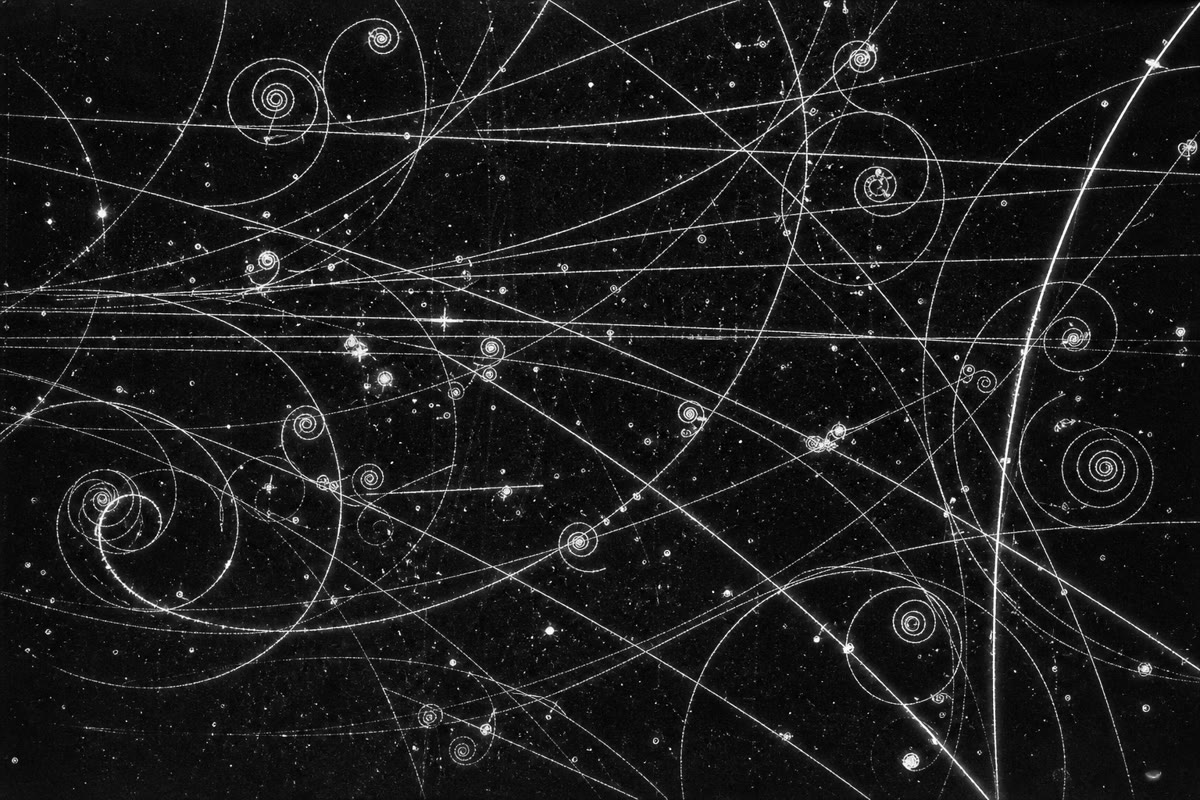
- Bubble-chamber photographs once did the seeing: charged tracks curling in a magnetic field. What two quantities does the curl hand you, and which particle leaves no track at all?
- The record cosmic ray of Exercise 26.12 hit with the energy of a served tennis ball in one proton. What does its existence say about nature’s accelerators versus ours?
- Summarise the fair poster in four lines: born of a proton ten kilometres up, delivered by time dilation, identified by two coincident flashes, and explained by a table with twelve seats.
Solution
Solution of Problem 26.1.
1. A primary proton (often –) strikes a nucleus high up (strong force), spraying pions; the charged pions decay by the weak force to muons and neutrinos; the muons, ionising only gently (electromagnetic), race for the ground. 2. : even large buys pions only hundreds of metres, and they also die by strong interactions in air; the muon, feeling no strong force and living longer, is the one that travels. 3. per minute — about 7 per second. 4. Noise flashes and local radioactivity fire one paddle at random; firing both within demands a single particle traversing the pair — geometry as a filter. 5. — one false count per quarter hour against a hundred muons a minute: negligible. 6. Only muons within the cone that threads both paddles (near-vertical, within –) are accepted: the pair measures a direction, not just a rate — that is what makes it a telescope. 7. Slanted muons cross more atmosphere: more energy loss and more proper time in flight, so fewer survive — roughly the law your tilted runs trace. 8. : a classical muon from survives with probability — the attic would count one muon a decade. 9. . 10. Dilated lifetime : range — the attic rate is exactly what relativity predicts. 11. In the muon’s frame the lifetime is the plain but the atmosphere is contracted to : crossed with time to spare. 12. : survival — half arrive, and your counter is their census. 13. The classic mountain-versus-sea-level muon experiments (Rossi–Hall, and Frisch–Smith on film): classical decay predicts essentially zero counts; your hundreds per minute are special relativity, verified above the insulation. 14. A charged lepton of the second generation: charge , spin , mass — the electron’s heavy twin. 15. Charge: ; electron-family: ; muon-family: . All books balance. 16. Three bodies share the budget in all proportions, so the electron’s spectrum is continuous; it ends when the two neutrinos recoil together against the electron: about . 17. It would break lepton-family number — the one book the Standard Model balances without knowing why. Finding it would be the charged-sector cousin of neutrino oscillations: guaranteed new physics, which is why experiments chase it to one part in . 18. The muon’s entry makes one flash; microseconds later its decay electron makes a second in the same paddle. The histogram of delays is an exponential whose slope is : a lifetime measured on a shelf. 19. All Bohr formulas scale with mass: the muonic hydrogen orbit shrinks by to — so deep inside the electron cloud that the muon feels the proton’s size: muonic atoms are proton rulers. 20. : about a GeV per particle — your attic muons are average shower citizens. 21. Relativistic muons outrun light in water and glow Cherenkov blue into the tank’s photomultipliers. A shower’s footprint spans many square kilometres, so sparse tanks sample it like raindrops in buckets. 22. A particle deposits energy in a medium that converts it to light, a photomultiplier converts the light to electrons, and electronics counts them: every calorimeter from attic to collider is this sentence. 23. The curl’s radius gives momentum, its sense gives the charge’s sign; the photon, the neutron and the neutrino — neutral — leave no track, only their debts in the bookkeeping. 24. Nature accelerates single protons ten million times beyond the LHC — humbling — but at one per square kilometre per century: our machines trade peak energy for controlled collisions a second. 25. Born of a proton ten kilometres up; delivered alive by time dilation (, half surviving); identified by two flashes a hundred nanoseconds apart; and explained, entirely, by a table with twelve seats and four forces.