
সব বই

পেশাদার

1 Markets I: The Ecosystem and Exchange-Traded Marketsবাজার অনলাইন 2 Markets II: Rates, FX and Creditবাজার অনলাইন 3 Markets III: Commodities, Energy and Cryptoবাজার অনলাইন 4 Quantitative Methodsপদ্ধতি অনলাইন 5 Derivatives and Volatilityডেরিভেটিভস অনলাইন 6 Rates, Credit, XVA and Riskসুদহার, ঋণ ও ঝুঁকি অনলাইন 7 Research Craft: Predictors, Backtests, Measurement, Portfoliosগবেষণা অনলাইন 8 Strategies I: Equities and Futuresকৌশল অনলাইন 9 Strategies II: Volatility, Relative Value, Macro and the Bank Desksকৌশল অনলাইন 10 Microstructure and Executionএক্সিকিউশন অনলাইন 11 Market Making and High-Frequency Tradingমার্কেট মেকিং অনলাইন 12 Machine Learning for Marketsমেশিন লার্নিং অনলাইন 13 Low-Latency Softwareপ্রযুক্তি অনলাইন 14 Networks, Hardware and Trading Infrastructureপ্রযুক্তি অনলাইন 15 Research, Data and Risk Platformsপ্রযুক্তি অনলাইন 16 The Desk and the Firmপ্রতিষ্ঠান অনলাইন 17 The Industry: Firms, Roles and Careersক্যারিয়ার অনলাইন 18 Interviews I: Maths, Probability and Speedক্যারিয়ার অনলাইন 19 Interviews II: Markets, Trading Games and the Final Roundক্যারিয়ার অনলাইন 20 Interviews III: Codeক্যারিয়ার অনলাইন
অ্যাপ পরিচিতি Coach সাইন ইন পড়া শুরু করো

বইগুলো এখনো বাংলা ভাষায় পাওয়া যায় না — ইংরেজি সংস্করণ দেখানো হচ্ছে।

Physics · পরিভাষা

Leptons, quarks, hadrons কী?

Definition 26.1 University Physics — Year 3 · অধ্যায় 26 — Particle Physics

Matter’s building blocks are spin-12\tfrac12 fermions (Chapter 12, Chapter 14) in two families of six. Leptons feel no strong force: the electron, muon and tau (charge −e-e, each heavier than the last) and their three neutrinos — nearly massless, nearly undetectable. Quarks come in six flavours — up, down, strange, charm, bottom, top — with charges +23e+\tfrac23e (u, c, t) and −13e-\tfrac13e (d, s, b), and they are never seen alone: confinement binds them into hadrons — three-quark baryons (proton == uud, neutron == udd) and quark–antiquark mesons (pion, kaon). Each particle has an antiparticle of identical mass and opposite charges (Exercise 26.8). Ordinary matter uses only the first generation — u, d, e, νe\nu_{\text{e}}; the two heavier copies differ, as far as anyone knows, only in mass. “Who ordered that?” physics still asks.
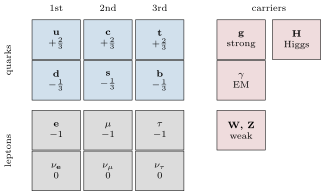
The Standard Model roster (charges in units of e). One column of it builds every atom; the other two are expensive echoes. Gravity, feeble beyond measure at these masses, has no seat at the table — the model’s most famous vacancy.
The Standard Model roster (charges in units of ee). One column of it builds every atom; the other two are expensive echoes. Gravity, feeble beyond measure at these masses, has no seat at the table — the model’s most famous vacancy.
প্রসঙ্গসহ পড়ো →