Physics · Glossary

What is Linear dipole, linear circuit?

Definition 6.16 University Physics — Year 1 · Chapter 6 — DC Circuits: Kirchhoff’s Laws and Theorems

A dipole is linear if its characteristic is a straight line (resistor, ideal and real sources); a circuit made only of linear dipoles is a linear circuit. Its unknowns obey a system of linear equations (Kirchhoff’s laws plus the characteristics), whose solution is unique.

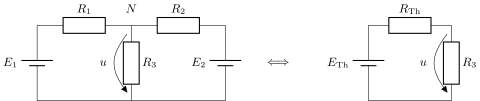
Two sources feeding a common load R_3. Seen from R_3’s terminals, the rest of the circuit is a Thévenin source (E_ Th, R_ Th); Millman’s theorem gives the potential of node N in one line.
Two sources feeding a common load R3R_3. Seen from R3R_3’s terminals, the rest of the circuit is a Thévenin source (EThE_{\mathrm{Th}}, RThR_{\mathrm{Th}}); Millman’s theorem gives the potential of node NN in one line.

Examples

Example 6.20 (Three ways to the same answer)

In the figure, E1=10VE_1 = 10\,\mathrm{V}, R1=1.0kΩR_1 = 1.0\,\mathrm{k}\Omega, E2=5.0VE_2 = 5.0\,\mathrm{V}, R2=2.0kΩR_2 = 2.0\,\mathrm{k}\Omega, R3=2.0kΩR_3 = 2.0\,\mathrm{k}\Omega. Millman: VN=(10/1+5/2+0/2)/(1+0.5+0.5)=12.5/2=6.25VV_N = (10/1 + 5/2 + 0/2)/(1 + 0.5 + 0.5) = 12.5/2 = 6.25\,\mathrm{V}. Superposition: E1E_1 alone sees R2R3=1kΩR_2 \parallel R_3 = 1\,\mathrm{k}\Omega, so u=10×1/2=5Vu = 10 \times 1/2 = 5\,\mathrm{V}; E2E_2 alone sees R1R3=0.667kΩR_1 \parallel R_3 = 0.667\,\mathrm{k}\Omega, u=5×0.667/2.667=1.25Vu = 5 \times 0.667/2.667 = 1.25\,\mathrm{V}; total 6.25V6.25\,\mathrm{V}. Thévenin seen from R3R_3: EThE_{\mathrm{Th}} is the open-circuit voltage of the divider (E1,R1,R2,E2)(E_1, R_1, R_2, E_2): E2+(E1E2)R2/(R1+R2)=5+5×2/3=8.33VE_2 + (E_1 - E_2)R_2/(R_1 + R_2) = 5 + 5 \times 2/3 = 8.33\,\mathrm{V}; RTh=R1R2=0.667kΩR_{\mathrm{Th}} = R_1 \parallel R_2 = 0.667\,\mathrm{k}\Omega; then u=8.33×2/2.667=6.25Vu = 8.33 \times 2/2.667 = 6.25\,\mathrm{V}.

Read in context →